Showing posts with label 1979. Show all posts

Thursday, October 30, 2025

1979 Pontiac Firebird Trans Am


This would be the third '79 Pontiac Trans Am seen on these pages. The first was a Tenth Anniversary Trans Am, and the second was a Sundance Yellow coupe on the standard Rally II wheels, indicating that the original owner had been pretty stingy with the options list.

Then there's this 1979 Pontiac Firebird Trans Am here...

It's a Starlight Black t-top coupe and pixel-peeping in on the hood, it looks like it has the gold outline around the opening for the shaker hood scoop, indicating it's a Black & Gold Special Edition car. The "TA 6.6" decal on the scoop is the tell that under the hood is the 220 horsepower W72 400 cubic inch Pontiac V-8, rather than the tamer L80 403 cubic inch Oldsmobile Rocket V-8, which made 185 horses and came with a "6.6 LITRE" decal on the scoop. 

The car has the iconic 8" wide gold snowflake alloy rims that came with the WS6 performance package, which came shod with 225/70R-15 tires, considered quite meaty at the time. The WS6 package also included rear disc brakes and beefier front and rear sway bars. A Black and Gold Special Edition with the W72 is one of the rarest configurations found on a '79 T/A, with only 1,107 configured thusly.

1979 was the last hurrah for the 400 cubic inch Trans Ams, and the 8,672 W72 motors installed that year in Trans Ams and Formulas were actually hoarded from earlier production. Tighter emissions regs for 1980 meant that the most potent motor in the final Second Generation Firebirds would be the 301 Turbo.

This one was photographed using a Nikon D3 and a 50mm f/1.4 lens in July of 2021.

Wednesday, September 24, 2025

1979 Pontiac Firebird Trans Am


We've had a 1979 Trans Am on here before, but it was the Tenth Anniversary model, which was actually a whole separate model from the regular Firebird, Esprit, Formula, and Trans Am.

In the photo here is a regular W87 Trans Am in Sundance Yellow. This car doesn't have the 8" wide alloy "snowflake" wheels, so the original owner probably didn't opt for the WS6 or WS7 special performance package. That explains the rear drum brakes as well.

The decal on the shaker hood scoop reads "6.6 Litre" rather than "T/A 6.6", so the car was ordered with the base L80 403 cubic inch four-barrel V-8, sourced from Oldsmobile and rated at 185 SAE net horsepower. The L80 only came with the three-speed Turbo Hydramatic TH350 transmission, and, unless you ordered the WS7 package, you got a fuel economy friendly 2.41:1 rear end to go with it.

Needless to say, a Trans Am optioned like the one in the picture was no bolt of lightning. 

They were wildly popular, though. Of the 211,453 Firebirds sold for the 1979 model year, a full 117,108... well more than half ...were Trans Ams. Subtract the seven thousand odd Tenth Anniversary cars, and that's 110k regular Trans Ams. Of those, 89,040 had the Olds V-8 and a slushbox.

This one was photographed with an Olympus OM-D E-M1X and an M. Zuiko Digital 12-200mm f/3.5-6.3 zoom lens in October of 2024.

Wednesday, February 5, 2025

1979 Ford Ranchero 500


Although the El Camino is the better known of the two, it was actually introduced in the 1959 model year as a response to the Ford Ranchero, which had been on the market since 1957. The Ranchero started out as basically a full-size "sedan delivery"-style two-door Ford wagon with an open truck bed where the wagon's enclosed cargo bay would normally be.

From 1960 to 1965 the Ranchero name was moved to an open-bed version of the Ford Falcon, before returning to the midsize Fairlane for 1966. It stayed married to the midsize Ford as that moved from Fairlane to Torino in '68 and finally to the LTD II for the seventh generation of the Ranchero in 1977.

Thanks to its LTD II genetics, it had a formal snout with an upright grille and stacked rectangular quad headlamps.

The two-tone Light Medium Blue over Midnight Blue Metallic paint marks this as a Ranchero 500, which was the base version for 1979. You could also get the Ranchero Squire, with faux wood paneling like a station wagon, and the Ranchero GT with flashy decal stripes. The original buyer also sprung for the dual sport mirrors in their aero housings, rather than the standard single side mirror.

Under the hood would be a two-barrel 302 or 351M V-8, producing 133 and 151 SAE net horsepower, respectively. The only transmission available was Ford's FMX 3-speed automatic.

While its arch rival, the El Camino, would continue on into the 1980s, the end of the road for the Ranchero came at the end of the '79 model year.

This one was photographed in April of 2015 using a Nikon Coolpix P7000. It had 30,000 one-owner miles and was for sale for $4,500. The original base price in 1979 was $5,866, or the equivalent of $25,345 in constant dollars.

Friday, November 15, 2024

1979 GMC Caballero


While the Chevrolet El Camino dates all the way back to 1959, when they added an open bed to the 2-door full size Chevy Brookwood station wagon, it wasn't until the 1971 model year that GMC began offering their own version of it.

Christened the GMC Sprint, it shared the platform of the Chevelle sedan & wagon, just like its Chevy sibling.

For the 1978 model year, the Sprint name was changed to Caballero, Spanish for "gentleman" (literally "horseman") possibly to reflect the Spanish themed name of the Chevrolet original.

Riding on the Malibu chassis with the wheelbase stretched nine inches (to 117"), the Caballero had a bed that was a bit over six and a half feet long, capable of swallowing the standard 4'x8' sheet of plywood, if you didn't mind some of it sticking up over the tailgate.

The original '78 Caballero had an eggcrate type grille, while the horizontal bars and single headlamps on either side of the one in the photo identify this Beige-and-Camel Metallic two-tone example as a 1979 model. 

Standard under the hood would have been the L26 3.3L pushrod V-6 with a 2-barrel carb, rated at 95 SAE net horsepower. A buyer dismayed at the thought of trying to drive a pickup loaded with up to 1,250 pounds of cargo using such a dismal little motor could instead opt for either the 2-barrel 4.4L L39 V-8, which put out 120 horsepower, or the LG4 305 V-8, which made 160 horsepower with a Rochester Quadrajet carb.

This one was photographed using a Hasselblad Lunar and a Sony Zeiss T* 16-70mm f/4 OSS zoom lens in August of 2021.

Saturday, October 5, 2024

1979 Chevrolet Corvette


In 1979 disco was showing signs of its impending demise, and so, by all indications, was automotive performance.

The big block American V-8, already strangled by lowered compression ratios and emissions reduction systems, had all but disappeared from most American performance cars, with the 6.6 liter in the '79 Trans Am being one of the final holdouts. The fuel crisis sparked by the Iranian revolution, as well as increasingly stringent Corporate Average Fuel Economy mandates would come for it, too.

Into this world came the 1979 Corvette, distinguishable from the '78 model mostly by its lack of 25th Anniversary badging. Under the hood, a less restrictive exhaust gave both the base L48 and optional L82 engines a 5-horsepower performance bump over the previous year.

That base L48 350 small block had an 8.2:1 compression ratio and was rated at 195 SAE net horsepower, while the L82 gave the buyer an alloy intake manifold, higher-lift cam, 8.9:1 compression, and 225 horsepower. Both could be had with either a three-speed auto or four-speed manual, and an L82 customer could also opt for a close-ratio 4-speed.


While the Corvette was still one of the quickest and fastest cars you could buy in America, that was damning with faint praise in the depths of the Malaise Era. Car and Driver tested an L82 'Vette with the 4-speed and optional 3.70:1 rear end and only managed a 6.6 zero-to-sixty time, while the quarter mile took 15.3 seconds at 95 mph. The car would pull all the way to redline in top gear, which resulted in a maximum velocity of 127 miles per hour.

All this could be yours for only $11,951 dollars in 1979 money, or roughly fifty-two grand in today's terms. The Stingray name was gone from the fenders and the sting was gone from under the hood.


The Black 1979 Corvette in the photos, with the Red interior, was photographed with an Olympus OM-D E-M1X and M. Zuiko Digital 12-200mm f/3.5-6.3 zoom lens.

Monday, September 23, 2024

1979 Lincoln Continental Mark V


Truly this car was the Last of the Dinosaurs. The fourth in Lincoln's Mark series of luxury coupes, the Mark V, though it was launched in 1976 as a '77 model, had actually begun development before the first fuel crisis in 1973.

By the time it came out, however, the nation had already experienced the shock of the OPEC embargo and so even though it rode on the same 120" wheelbase as its predecessor and was actually a couple inches longer (the longest postwar FoMoCo coupe, period, at 230.3"), vigorous weight reduction had shaved a few hundred pounds from the curb weight, down to "only" 4,652 pounds.

That new fuel consciousness also meant that the base motor for '77 was a 400 cubic inch 2-barrel version of Ford's Windsor small-block V-8, rated at 179 SAE net horsepower.The 208 horsepower four-barrel 460 cube big block remained an option.

For 1979, though, due to tightening CAFE regulations, the 460 was a goner, as was the second exhaust outlet on the 2-bbl 400, leaving only 159 ponies to propel this glamour barge down the interstate.

Motor Trend tested a '79 Mark V, a $13,594 Bill Blass Edition lacking no options but the factory CB radio, with the optional 2.75:1 performance rear axle (standard final drive ratio was 2.47:1) and managed an 11.6 second jog to sixty and a best quarter mile of 18.5 seconds at 76 mph.

About the car, they wrote:
"The 1979 Mark V was the essence of unconstrained American automotive opulence, conceived in a time when fuel economy and space efficiency were the concerns of lesser cars.

...Even with the weight loss, the Mark V is a huge piece of machinery, albeit a desirable one in terms of potential value. It is the last of a breed and has sufficient quality and style to assure eventual classic status It is entirely likely that, in 10 years, the owners of such cars will discover that they have a piece of collectible automotive machinery.

....To drive the Mark V is to be the captain of your own huge, luxurious ship. In an operational sense, the Mark V is massive, smooth and competent only in boulevard or highway applications.....What it was designed to do, it does very well. It isolates the driver and passengers from the outside world, and when you're driving, it makes you feel - and makes other people thin k you are - rich. Even with its rather straight-lined, sharp-edged styling, the car has a certain rakishness and projects the image of the driver as an elegant rogue.
"
One of the final Detroitmobiles from the era when a big Lincoln or Caddy was the height of opulence and showing up at the club in something European made you look a little effete.

The subsequent Mark VI had to hang its head in downsized shame.

The Cream 1979 example in the pictures was photographed in October of 2020 using a Nikon D7000 and Nikon's excellent 16-80mm f/2.8-4E VR zoom lens.

Friday, August 16, 2024

1979 Pontiac Firebird Tenth Anniversary Trans Am


1979 marked the tenth anniversary of the Trans Am package on the Pontiac Firebird, a vehicle that had loomed large in American lore and popular entertainment through the decade of the Seventies.

Pontiac commemorated the occasion with the Tenth Anniversary Trans Am, which was actually listed as a separate model with its own unique VIN prefix. (Firebird: S87, Esprit: T87, Formula: U87, Trans Am: W87, TATA: X87)

Only 7500 were built and the only option buyers had was a manual or automatic transmission. Manuals came with the Pontiac W72 400 cubic inch V-8 with an 8.1:1 compression ratio and rated at 220 SAE net horsepower.


The "6.6 Litre" badge on this one's hood scoop tells us that it's one of 5,683 with the automatic transmission and 185 horsepower L80 403 cid Oldsmobile Rocket V-8.

The homogenization of GM's engine lines was well underway by now: Your base Firebird buyers got Buick V-6's, Formulas and Trans Ams came with Olds engines, and buyers in California got saddled with a 2-barrel Chevy 305.

Incidentally, while the Trans Am had spent the Seventies as an atavistic Muscle Car Era throwback with a range of 455 and 400 cubic inch V-8 motors, 1979 would be the last year for that. Thanks to tightening regulations, the biggest motor under the hood of a 1980 T/A would be the aforementioned Californian 305.


The TATA got special two-tone Platinum paint with Charcoal accents, an extra large screaming chicken decal on the hood that sprawled clean across the fender tops, and those nifty "turbo" wheels (which would reappear later on actual turbo Trans Ams). The interior featured a full load of options and it was the first Trans Am to top the $10,000 dollar mark, with an MSRP of $10,620, the equivalent of about $46,000 in today's money.

Car and Driver tested a '79 Trans Am with the W72 400 motor and the WS6 handling package, and deleted the A/C, to boot, shaving a hundred pounds off the nose of their test car. They managed a 0-60 time of 6.7 seconds and a 15.3 second quarter mile at 96.6 miles per hour. Quick enough for its era, but still a shadow of its former self. The TATA in the photos... a couple hundred pounds heavier, its L80 down 35 horses to the W72, and saddled with a slushbox ...would have put up even less impressive numbers.

These photos were snapped in July of 2019 at the Indianapolis Hamfest using a Canon EOS M and EF-M 18-55mm f/3.5-5.6 IS zoom lens.

I'm pretty sure my roommate's Lexus RX350, parked just out of frame, would demolish this Tenth Anniversary Trans Am in a drag race. I'm also pretty sure Trans Am Man could not possibly care less.


Saturday, August 10, 2024

1979 Ford LTD


The OPEC oil embargo of 1973 went into effect in October, just as the '74 model year cars were hitting showroom floors in the USA.

The full-size Chevy sedans, on a 121.5" wheelbase and weighing right at two tons with a 350 V-8, had been out since the 1971 model year and were due to be replaced in a couple years. The Dodge Monaco (122", 4300 lbs, 360 V-8) was all-new for that model year, though. In an even worse position than Dodge was Ford, whose 1974 LTD (121", 4400 lbs, 351 V-8) was on the last year of its model cycle and due to be replaced for '75 model year by a new design, already finalized, that was an inch longer and a hundred pounds heavier.

Needless to say, the full-size 1975 LTDs moved off of showroom floors with the speed and enthusiasm of a condemned prisoner headed for a firing squad. Ford went on a crash program, re-badging a midsize Torino variant as the "LTD II" while scrambling to come up with a downsized version of the full-size car that would hit dealerships as a '79 model.

Built on the new Panther platform for full-size FoMoCo products, the body-on-frame 3rd Generation LTDs featured angular, creased styling reminiscent of the new mid-size Fairmont.

The one in the picture above, a Medium Jade Iridescent 2-door sedan, is a base 1979 model. (The glitzier Landau would have had a half vinyl roof and quad headlamps.)


The tall-sidewalled 78-series rubber on the skinny 14" rims looks positively twee by today's standards, and would have wobbled noticeably before giving up and letting 3400 pounds of Dearborn's finest understeer right into a ditch.

Fortunately, shenanigans were limited by the fact that the base 5.0L smog motor V-8, sipping gas through a Motorcraft 2-barrel carb, only sputtered out 129 SAE net horsepower.

This one was photographed in August of 2024 using a Canon EOS-1D Mark IV and, coincidentally, was on Barn Finds just a couple years ago.

Tuesday, August 6, 2024

1979 Porsche 928


Here's an early Porsche 928. If that Casablanca Beige Metallic paint is original, I think that makes it a 1979 model? I love those wheels, and the flip-up headlights.


The egg-like styling was otherworldly in the sharply-creased Seventies. Detroit sedans of the era were still mired in the square-cornered "formal look" (itself derived from Sixties Mercedes sedans) that made it feel like barbarians had looted Big Three styling departments of all their French curves and protractors, leaving them nothing but rulers and t-squares with which to draw cars.

A 2+2 grand tourer with a water-cooled front engine and a rear-mounted transaxle, the 928 was controversial with Porsche purists from the start and still kinda is.

The 4.5L SOHC V-8 was rated at 219 in EPA-compliant North American trim. The contemporary Corvette 5.7L L82 put out 220, as did the 6.6L W72 in a Pontiac Trans Am, so the Porsche was not lacking for power. Euro-spec ones ran 0-60 in the mid sixes and could crack 140 on the top end. The 928's rear-mounted transaxle gave it a nearly perfect 50/50 weight distribution, which was hyped in the ad copy.


By the mid-'70s the 911's air/oil-cooled engine and its aft-of-the-rear-axle location both were engineering challenges that required workarounds to achieve best performance and the 928 was intended as a replacement for the older car, and the new flagship of the marque going forward.

In the inaugural Car and Driver review of the eurospec original, David E. Davis relayed a convo he'd had with Dr. Ernst Fuhrmann of Porsche:
"It's not surprising that a car that is designed to be good at 230 kph would be good at 100. It would be very surprising if cars designed to be good at 100 kph could be good at 230. Our cars are not as they are because we are better engineers than General Motors. Our cars are as they are because Germany has no speed limits. If I was running General Motors or Ford, my cars would probably seem just as dumb as Estes's or Ford's. I run a small company with very few customers, and it is easy for me to look smart—only my risks are proportionately greater."

He warmed to his subject as we wrecked a perfect sea bass and ordered red wine for the cheese. "I design cars for a thousand people or so. I don't have to design cars for everybody. At Daimler­-Benz or General Motors, I would have to listen to this one or that one: 'The car is too small; it is too big; old people won't like it; it must have four doors.' I am in an enviable position. If I don't like it, it won't get built."

"One man can design a car. A small group of men can design a car. But a large group of men will always design gray mice. I promise you that anyone who has owned a Turbo or a 928 for one year will never forget it. On the other hand, a man who has owned a gray mouse—no matter how good it is—will look back twenty years later and say to his wife, 'What was that car we had? It was a very good one, but I can't remember the name.' "
Of course, there's a flip side to that coin, a quote from Carroll Shelby regarding the Porsche 959, which I can't find online, but paraphrased was something like this: "The 959 is an amazing car, but Porsche is losing money on every one they sell. You think the engineering department at GM or Toyota couldn't design a car like that? They could, but they're in business to make money."


Parked on the street during the golden hour back in October of 2021, the car was eye-catching. I was glad to have the D800 and 24-120mm f/4 VR with me. I'm getting pretty smitten with this camera. With the right lens, the D800's images have all the pop and colors I loved from the D700, with greater resolution and dynamic range.

Friday, July 26, 2024

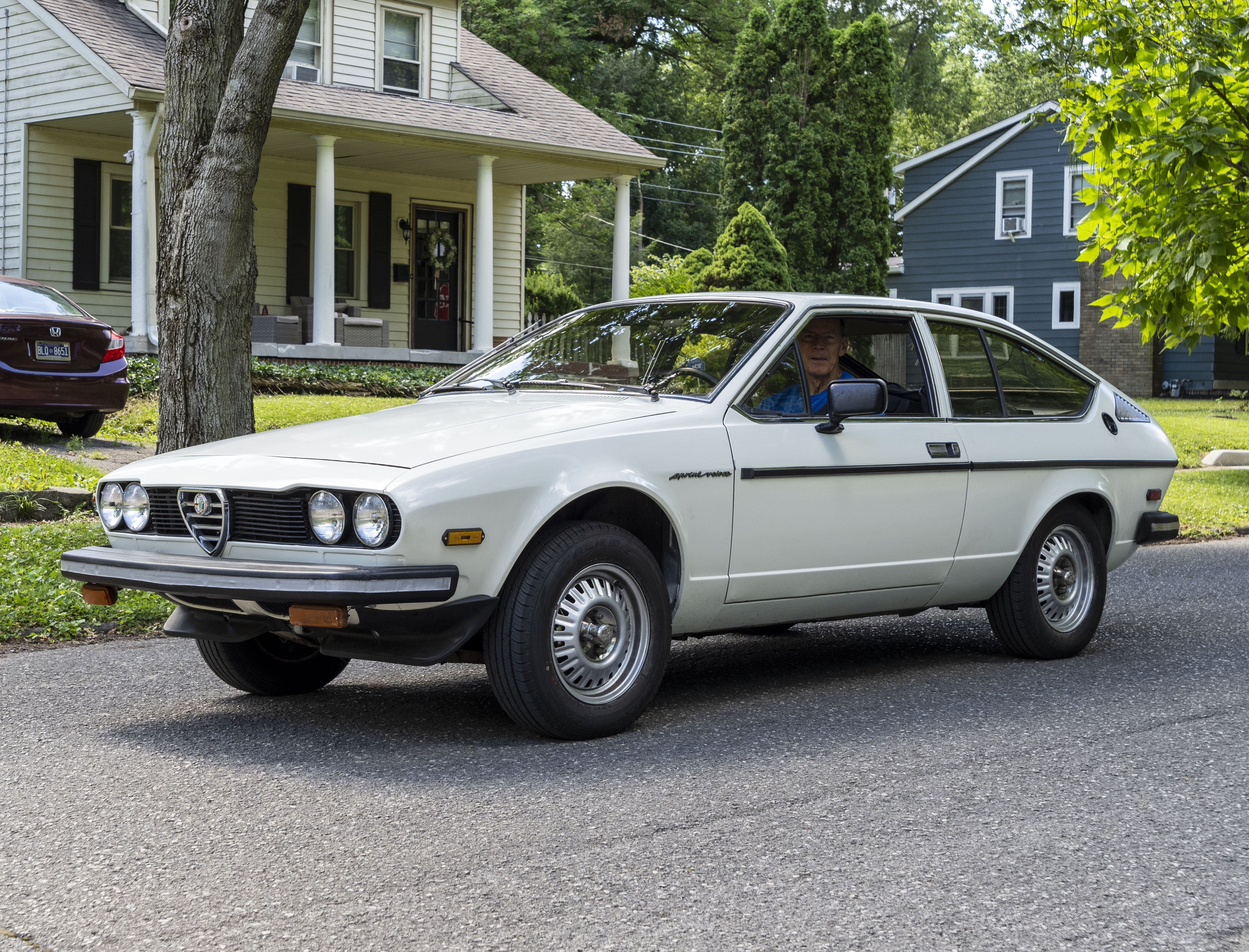
1979 Alfa Romeo Sprint Veloce


In the '70s, Alfa Romeo started selling a fastback coupe version of its compact Alfetta sedan as the Alfetta GT. Its Giugiaro-penned lines were very swoopy, very disco.

For the '78 model year the North American version was renamed the Sprint Veloce. This China White 1979 Sprint Veloce would have had a 2.0L DOHC inline four up front driving the rear wheels through a 5-speed rear mounted transaxle. The EPA-compliant version was down a bit more than a dozen ponies from the Euro mill, being rated at 111 SAE net horsepower.

Between the rear-mounted transaxle, DeDion tube rear suspension, and inboard rear brakes, these Alfas had plenty of exotica to make sporty car fans of the era salivate.

The funky nose-up stance on this is a product of NHTSA regs. The front bumper and headlights needed to be a certain height, so Alfa of North America just cranked the front torsion bars to the max.

Most buyers headed to a suspension shop first thing from the dealership. This one, however, is bone stock and had been parked for thirty years before this summer.


These photos were taken in June of 2024 with an Olympus OM-D E-M1X & Panasonic 12-60mm f/2.8-4 lens.

1966 Chevrolet Impala Super Sport Convertible

This Madeira Maroon 1966 Chevrolet Impala Super Sport has the 325 horsepower Turbo-Jet 396 cubic inch big block V-8. The '66 models can ...