Showing posts with label GTO. Show all posts

Monday, August 24, 2026

1965 Pontiac GTO


Technically the GTO wasn't a separate model yet, but rather an option package on the midsize Pontiac Tempest, and 1965 was its second model year.

Cosmetically distinguished from the original '64 most readily by its vertically-stacked quad headlamps, the GTO's crisp lines blended right in to the mid-Sixties Pontiac lineup.

Unlike the two ornamental fake intakes on the previous model year, the 1965 had a single bulged scoop in the center of the hood. However its two chrome nostrils were similarly non-functional, although a dealer-installed cold air intake kit was available.

Pontiac called its acrylic lacquer paint "Magic Mirror" back in '65 and this Goat is finished in Starlight Black.

It was available as a convertible, a hardtop coupe (like the car in the photo) or a pillared sport coupe. The base engine was a four-barrel 389 cubic inch pushrod V-8 making a claimed 335 gross horsepower, with a triple deuce 360 horsepower Tri-Power 389 as a $115.78 option (that's $1,227 in 2026 dollars.)

The car came with a Hurst-shifted three-speed manual as standard, with optional four-speed manual (in either close- or wide-ratio flavors) and two-speed automatics.

Car Life tested a well-optioned 1965 hardtop coupe with the Tri-Power motor, four-speed manual, and 3.90:1 Safe-T-Track rear axle and clocked a 5.8 second sprint to sixty and a 14.5 quarter at 100mph. Fuel mileage in the 3,590-lb car during the test was in the 11-14mpg range and top speed was measured at 114.

Total price, all optioned up, was $3,579, which is about $38k in current bucks.

The one in the photo was snapped in August of 2026 using a Nikon Zfc and a Tamron 17-70mm f/2.8 zoom lens.

Thursday, March 5, 2026

1967 Pontiac GTO


Although it still shared the body of the Tempest, 1967 marked the second year that Pontiac cataloged the GTO as an entirely separate model line. It was also the last model year for the first generation of the "Goat".

In addition to the minor cosmetic changes that differentiated each model year in Detroit back in those days, there were some important mechanical upgrades.

The most significant was that Pontiac's small journal V-8 was bored out another .06", bringing displacement to 400 cubic inches, which was the maximum displacement GM corporate management allowed in midsize cars. The base 400 V-8 in the '67 GTO had a four-barrel carb and a 10.75:1 compression ratio, making 335 gross horsepower on high-test. For people who didn't want to pay to put a tiger in their tank at every fill-up, there was an optional two-barrel 400 with an 8.6:1 compression, but it was only rated at 255 horsepower.

If you wanted to slather extra performance on your performance car, there was the Quadra-Power 400, with a hotter cam making 360 ponies, and finally the top of the line Ram Air 400, which turned the decorative hood scoop into a functional cold air intake and a slightly different cam. It, too, was rated at 360 horses, but power peaked at 5400 RPM, rather than the 5100 of the Quadra-Power.

The Quadra-Power name, incidentally, was a bit of sad misdirection. Whereas previous GTOs were known for their optional Tri-Power 389 motors, with three two-throat carbs, General Motors banned multiple carburetor setups on non-Corvettes for 1967, so "Quadra-Power" was just marketing hype.

There were two varieties of three-speed manual on the menu, both standard and heavy-duty, as well as wide- and close-ratio four-speed manuals. If you opted for the Turbo Hydra-Matic, the shifter had a dual-gate quadrant; slide the lever over into the right hand gate and ratchet the shifter through the gears manually, one at a time.

Other new options for 1967 were power-assisted front disc brakes (previous GTOs had drums on all four corners) and that nifty hood-mounted tach, which was installed at the dealership.

You could get your Goat as a ragtop, a pillared Sport Coupe or, like this Tyrol Blue car with Rally wheels, a hardtop coupe.

It was photographed with a Leica D-LUX 3 in April of 2017. 

Monday, November 3, 2025

1970 Pontiac GTO Convertible


Right up front, it's next to impossible to verify that this is an actual GTO Judge without looking at the original paperwork. It's also been repainted and lacks all the badges and decals. The "statement color" for the 1970 Judge was Orbit Orange, which was a lighter, yellower hue than this. This looks more like the Carousel Red from 1969.

Also, 1970 Judge convertibles are vanishingly rare. Skyrocketing insurance rates were crippling muscle car sales in 1970. Pontiac only sold 40,149 GTOs for that model year. Only 3,797 of that number were Judges, and only 168 Judges were ragtops.

It's every bit as likely to be a regular '70 GTO convertible with the hood tach and wing added by a later owner. Still, it's a super cool ride.

When Car Life tested a 1970 GTO coupe with the L74 366 SAE gross horsepower Ram Air III 400cid V-8, a four-speed manual, and a 3.90:1 rear end, they managed a zero-to-sixty time of six seconds flat and a 14.6 quarter at 100mph. Top speed was a buck-twenty-one and price as tested was $5,057, or about $42,300 in today's money.

This one was photographed in October of 2021 using a Nikon D3 and a 24-120mm f/4 VR zoom lens.

Sunday, September 7, 2025

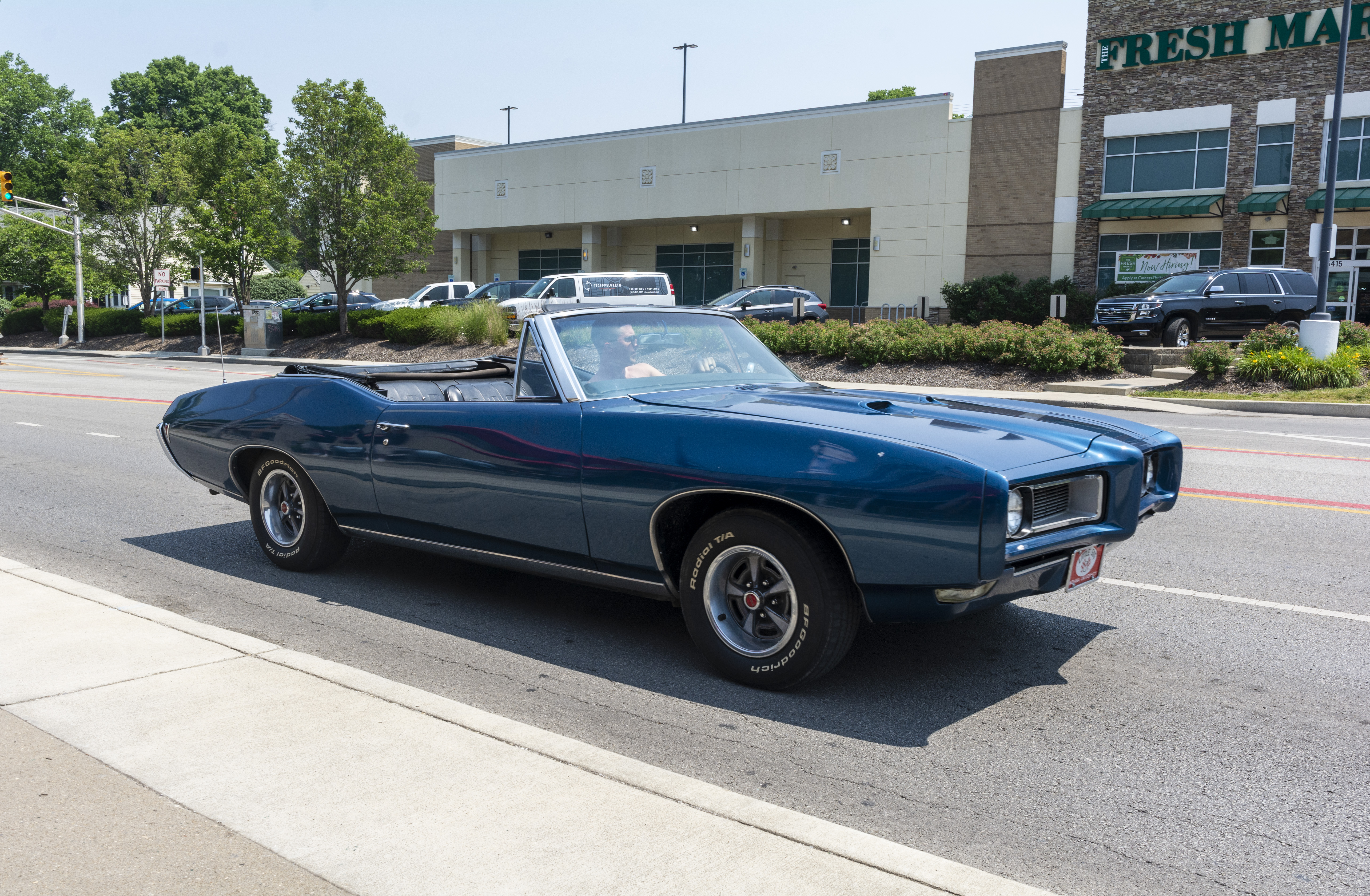
1968 Pontiac GTO Convertible


We've had a '68 Goat ragtop on these pages before, in Solar Red. That one apparently had its vacuum-operated headlight doors stuck in the open position which this one does not.

This one also has the optional hood-mounted tachometer. On the other hand, the other one was still wearing its slightly worn original paint job whereas this one's been repainted. It looks like they were aiming for the darker Aegean Blue rather than the lighter Aleutian Blue, but they didn't quite stick the landing.


So it's not concours-quality... who cares? The guy behind the wheel seems pretty happy, and who wouldn't be, tooling around in a droptop GTO?

When Hot Rod Magazine tested a '68 GTO hardtop with the 400 H.O., four-speed,  and a 3.90:1 rear end, they managed a 7.1 second zero-to-sixty time and a 14.3 quarter at 99mph. The zero-to-sixty and quarter mile times are illustrative of a spicy motor and steep rear end in the era of bias-ply rubber. You really needed to drive these things out of the hole with some care.

This one was photographed with a Canon EOS R and a 24-105mm f/4-7.1 IS zoom lens in September of 2025.

Saturday, January 18, 2025

1969 Pontiac GTO Convertible


The second year of the second generation of Pontiac's GTO, the 1969 Goat featured the 400 V-8 as the standard motor. With a 10.75:1 compression ratio, four-barrel carb, and dual exhausts, it was rated at 350 SAE gross horsepower.

For buyers who wanted to run on cheaper regular gas, a two-barrel 400 with a 9.2:1 compression ratio was available, although output dropped to 265 horsepower in that configuration.

The real go-fast options were the two Ram Air engine packages. The basic Ram Air 400, which mated the scoops on the hood to a functional cold-air intake setup and came with a hotter cam, gave the buyer 366 ponies to play with.

The Ram Air IV had different cylinder heads, high-flow exhaust manifolds, a high-rise aluminum intake manifold, bigger carb, and even lumpier cam, yet was hilariously underrated at a claimed 370 SAE gross horsepower. The Ram Air IV package came with 3.90:1 final drive standard and could be had with an optional 4.30:1 rear end, and air conditioning was not available.

Car Life tested a '69 GTO with the Ram Air IV package and recorded a 6.2 second zero-to-sixty time and a 14.4 second quarter mile at 98mph with a top speed of 124 miles per hour.


The Palladium Silver 1969 GTO convertible in the photos has the regular Ram Air option and was photographed with a Nikon Coolpix S6500 in December of 2014.

Sunday, January 12, 2025

1968 Pontiac GTO Convertible


For 1968 the GTO, along with the rest of its General Motors midsize A-body stablemates, got a serious redesign. While still utilizing body-on-frame construction, the body was much sleeker, with a waisted, coke-bottle look and contemporary fastback styling for the roofline.

The vertically-stacked quad headlamps went away, replaced by horizontally paired ones. A popular option on the '68 Goat was a hidden headlamp setup, with vacuum-operated doors that blended with the grille covering the headlamps when they were off. The headlamp doors on this Solar Red 1968 GTO convertible seem to be stuck in the open configuration.

One distinguishing feature of the GTO, heavily hyped in the advertising of the time, was the body-colored synthetic Endura nosecone, which would shrug off low-speed impacts without permanent deformation.

The single hood scoop on the previous GTO was replaced with a pair of nostrils atop the hood, which were purely cosmetic affectations unless you ordered the Ram Air package, in which case they were plumbed to the air cleaner housing for a functional cold air intake.


The base motor for '68 was the 350hp small-journal 400 cubic inch Pontiac V-8. Since the base motor had a 10.75:1 compression ratio and therefore required premium fuel, a no-cost option was an 8.6:1 compression 400 with a 2-barrel carb and single exhaust, rated at 265 SAE gross horsepower, but it could only be had with the 3-speed Turbo Hydra-Matic.


The spicier options were the 400 H.O., which came with an unsilenced air cleaner and freer-flowing dual exhaust for an output of 360 horses, and the aforementioned Ram Air 400, which offered numerous small upgrades like the aforementioned functional cold air intake and a lumpy race cam. The Ram Air package mysteriously shaved time off the quarter mile but didn't budge the brochure horsepower from the 360 advertised for the H.O. version. Insurance agents must have been amazed.

Motor Trend tested a coupe with the base motor, 3-speed slushbox, and 3.23:1 rear end and recorded a quarter mile elapsed time of 15.93 at 88mph through the traps.

The car in the photos was snapped with a Nikon D700 and 28-200mm f/3.5-5.6G zoom lens in July of 2024.

Sunday, December 22, 2024

2004 Pontiac GTO


Few genuine car guys get as high up in the corporate hierarchy at the big automakers as Bob Lutz. After leaving Chrysler for GM, one of the projects he spurred along was importing the Holden VZ Monaro and re-badging it as a Pontiac.

With the F-body Firebird Trans Am having been discontinued after the '02 model year, the Excitement Division of General Motors was left with a lineup devoid of anything sportier than a Grand Am or Bonneville and, indeed, without any rear wheel drive cars at all.

The angst among Pontiac fans caused by the lack of the Firebird would hopefully be assuaged by labeling the Monaro as a reborn GTO, bringing back a legendary name in Detroit performance that had lain dormant for thirty years.

Under the hood would be the all-alloy 350 SAE net horsepower 5.7L LS1 V-8 swiped straight from the Corvette, backed with a 4-speed auto or a Tremec 6-speed manual. Car and Driver recorded a 5.3 second zero to sixty sprint and a fourteen flat quarter at 102 through the traps, noting that it was traction limited and would likely be quicker with beefier meats allowing harder launches.

Unfortunately, the reborn GTO had two strikes against it right out of the gate. First, the styling was criticized as tepid. The hood scoops were a late model-year dealer installed option, and while it had a true dual exhaust, both pipes exited on the same side due to the asymmetrical fuel tank location.

The styling complaints always struck me as odd, because the original GTO could not be told apart from a generic Tempest Le Mans coupe except by the badges and (fake) intake nostrils on the hood.

Probably more fatal was the fact that while the car was initially designed to go head-to-head against the Mustang GT, price-wise, a combination of cost overruns, the fluctuating exchange rate between the U.S. and AUS dollars, and good ol' dealer price-gouging for the RETURN OF THE GTO! meant that people wound up paying Corvette money for Mustang performance.

Sales of the the 2004, like the Barbados Blue one in the photo, were far weaker than hoped, leading to a scramble to revise the car for '05... But that's another post.

This one was photographed with a Nikon D3 and 24-85mm f/2.8-4D zoom lens in May of 2022.

Friday, December 6, 2024

1968 Pontiac LeMans Convertible "GTO Tribute"


Without a look at the VIN plate, this one is tough to call for certain at just a glance.

It certainly could be a de-badged 1968 Pontiac GTO ragtop.

Far more likely, though, someone has added an Endura nose, scooped hood, and GTO taillights to a 1968 Pontiac LeMans or Tempest. Ethical people who do this (especially if they go whole hog and add GTO badging) will call the resulting rides "GTO Tributes". Unethical people will try and pawn them off on unsuspecting buyers as real Goats.


I think the side marker lights in the rear fenders on this Aleutian Blue example are the giveaway. The Tempest & LeMans had the red side marker light lenses that were shaped like the Pontiac logo, while those on the GTO were shaped like a GTO badge. [EDIT: My bad. The GTO emblem shaped rear side marker lights were on the '69s.]


This one was photographed in June of 2023 with a Nikon D7100 and 16-80mm f/2.8-4E VR zoom lens, which is probably the best F-mount crop sensor zoom that Nikon's yet made.

Thursday, August 29, 2024

1966 Pontiac GTO Convertible


This nice, clean 1966 Pontiac GTO convertible is painted Candlelight Cream. That's a very soothing and easy-on-the-eyes color, in my opinion.

'66 was the last year of the original 389 cubic inch V-8 in the Goat, and it could be had in a normie 335 horse setup with a single 4-barrel carb, or with the 360bhp "Tri-Power" package, featuring triple Rochester 2-bbl carburetors.

The hood scoop remained purely ornamental, although you could order a kit that converted it to a functional "Ram Air" setup. As low-profile as that scoop is, I don't know how much air would get rammed, even at speed, but you could at least hear the healthy whooping of three deuces sucking down high-test and converting it to noise and tire smoke. (And since both the 4bbl and Tri Power packages sported 10.75:1 compression ratios, you were definitely buying the good stuff at the Sunoco.)

With the wide range of options available, a GTO could be perched anywhere along a broad spectrum of the stoplight hierarchy. A four-barrel car with the 2-speed automatic transmission and the standard 3.23:1 final drive ratio had a lot more bark than bite, while a Tri-Power Goat with the optional close-ratio four-on-the-floor gearbox and 4.33 rear end would flatten your eyeballs when the signal went green...and probably turn in single-digit MPG numbers at highway speeds.


Car Life magazine tested a '66 convertible Goat with the 389 Tri-Power motor, close-ratio 4-speed, and limited-slip 3.55:1 rear end. They managed a 6.8 second zero-to-sixty time and put the quarter away in 15.5 at 92 mph. The not-totally-gonzo final drive ratio netted them 9-10 miles per gallon around town and 12-13 mpg on the highway.


Dig that year-of-manufacture 1966 Indiana Sesquicentennial license plate!

These photos were taken in May of 2023 using a Canon EOS-1D Mark IV and EF 24-105mm f/4L IS zoom lens.

1966 Chevrolet Impala Super Sport Convertible

This Madeira Maroon 1966 Chevrolet Impala Super Sport has the 325 horsepower Turbo-Jet 396 cubic inch big block V-8. The '66 models can ...