Showing posts with label Cutlass. Show all posts

Sunday, March 22, 2026

1967 Oldsmobile Cutlass Supreme Convertible


The Cutlass Supreme line was introduced for 1966 as a more upscale version of the midsize Olds, above the budget-priced F-85 and the regular Cutlass. For 1967, the last year for the second generation of Cutlasses, a light styling refresh on the snout brought its aesthetics into line with the larger Delta 88.

Available as a hardtop Holiday Sedan or a pillared Town Sedan, a pillared Sport Coupe or a hardtop Holiday Coupe, or a convertible like this Provincial White example with Strato Bucket seats upholstered in Blue "Morrocceen" vinyl.

Unlike cheaper Cutlasses, the base motor in the Supreme was the 330 cubic inch Jetfire Rocket V-8 with a Quadrajet carburetor and a 10.25:1 compression ratio. Olds touted the "Ultra High Compression Ratio" as being a key part of the claimed 310 horsepower output. Base price on this beauty in 1967 would have been  $3,026 before you started going crazy with the option book. That's about $29,600 in current dollars.

This one was photographed using a Canon EOS R and an RF 24-105mm f/4-7.1 IS zoom lens in March of 2026.

Monday, December 8, 2025

1994 Oldsmobile Cutlass Supreme SL


Oldsmobile moved the Cutlass Supreme nameplate to a front-wheel drive W-body car for the 1998 model year. Initially available only as a coupe, it spent that first year being sold alongside its G-body RWD predecessor, which was known as the Cutlass Supreme Classic.

For 1990, a sedan version was added, as well as a convertible. Due to the oddball "beer tap" door handles being located in the B-pillars, the convertible had a fixed hoop or roll bar. A 1992 restyle saw the coupe and convertible get squinty little miniature quad headlamps, which were also used on its W-body stablemate, the Pontiac Grand Prix.

This Bright White coupe is a 1994 model. For that year the Cutlass Supreme could be had in the base "S" trim level or the more upmarket SL. The SL package got sporty body cladding, fog lamps, dual power mirrors, and standard 16" alloy wheels.

The base motor was the GM corporate 3.1L pushrod V-6 with sequential port fuel injection, rated at 160 SAE net horsepower, with an optional 3.4L DOHC V-6 making 210 horses. Both motors were backed by a four-speed automatic transmission.

While they're no sports cars (a 3.1L Cutlass SL would turn in 0-60 times in the mid nine second range) I've always liked the styling of the W-body GM coupes, and this one's no exception.

I turned my car around on a cold December morning in 2025 to photograph this one using a Nikon D2H and 17-55mm f/2.8 zoom lens. 

Thursday, August 28, 2025

1972 Oldsmobile 442 Convertible


By 1972 the lights were going out on the Muscle Car Era. Surging insurance rates were causing manufacturers to downplay power, and now Detroit manufacturers were advertising everything in SAE net horsepower anyway. Emissions controls had gotten stricter and compression ratios had dropped across the board.

The 442 was no longer a separate model, as it had briefly been, but an optional trim level of the Cutlass and Cutlass S coupes or the Cutlass Supreme convertible. So, to be absolutely technical, the car in these photos is a 1972 Oldsmobile Cutlass Supreme Convertible 442, but nobody would call it that.

The 442 could be had with the L32 Rocket 350 V-8 with a two-barrel carburetor or the L34 four-barrel Rocket 350 V-8. On the menu were also the L75 Rocket 455 V-8, with a four-barrel carburetor and dual exhausts, and... if you ordered the top of the line W-30 performance package ...the L77 Rocket 455.

1972 would be the last year for the W-30 and its snarling 300hp L77 455. The package was not available with air conditioning and came with a mandatory limited-slip diff with a 3.42:1 ratio (3.73:1 was optional.) Oldsmobile made it plain that the high performance motor, with its special alloy intake manifold, heavy duty cooling system, would not be able to match the forthcoming emissions controls in 1973.

In a sign of the times, Oldsmobile brochures for '72 didn't even mention power outputs at all (in '71 they only gave torque figures and no horsepower numbers) and dedicated a page in the full line catalog to how safe and low-emission the new Oldsmobiles for 1972 were.


The twin pipes on this one suggest it's got the optional L75 455. 

Hi-Performance Cars Magazine tested a 1972 Cutlass 442 coupe with the W-30 package and pronounced it a shadow of its former self. Even so, the torquey big block meant it needed to be babied off the line lest everything end up in a cloud of tire smoke. At Raceway Park in Englishtown, NJ, zero-to-sixty was accomplished in 7.1 seconds, with the quarter mile taking 14.4 seconds at 98 mph. The 3.42 rear gears meant the fun ran out at a buck fifteen. Price of the test car was $5,255, or about $40,600 in current dollars. That was a 60% price increase over the base $3,087 Cutlass coupe.

The one in the photos was snapped in June of 2025 using a Sony a700 and a 16-80mm f/3.5-4.5 zoom lens. 

Monday, May 19, 2025

1968 Oldsmobile Cutlass S Convertible


Along with the curvaceous restyling of the A-body Oldsmobile Cutlass for the 1968 model year came a new trim level: the Cutlass S.

For '68 the Olds 4-4-2 technically became its own model, rather than a trim level on the Cutlass. The Supreme remained the most luxurious trim level with the spartan F-85 as the bargain basement entry, and the Cutlass S slotted between them as a youth-oriented version that emphasized both value and sportiness. The Cutlass S was only available as a hardtop or pillared coupe, or a convertible like the Sapphire Blue one in the photos.


Period Olds advertising materials called it a "low-priced, low-slung Youngmobile swinger" and the interior, with its (standard on the convertible) bucket seats, was described as a "swingin' place for a sit-in". The standard, albeit non-functional, hood louvers emphasized its sporty character.

Standard powerplant was either the Action Line 250 cubic inch inline six, making 150 SAE gross horsepower, or else the low-compression version of the Rocket 350 V-8 with a 2-barreled carburetor and 250 horsepower. The dual exhausts on this car suggest the buyer sprang for the only optional motor, which was a 10.5:1 compression Rocket 350 with a Rochester Quadrajet 4-barrel and 310 ponies.

Standard transmission was a column-shifted three-speed manual, although a four-on-the-floor was available as an option, as was Oldsmobile's two-speed Jetaway automatic.


This one was photographed with a Sony a700 and a 16-80mm f/3.5-5.6 Zeiss Vario-Sonnar T* zoom lens in May of 2025.


Saturday, April 19, 2025

1989 Oldsmobile Cutlass Cruiser


For the 1984 model year, Oldsmobile discontinued the rear wheel drive G-body Cutlass wagon and moved the Cutlass Cruiser wagon nameplate over to the front wheel drive Cutlass Ciera. This was the same model year that all the GM A-bodies got station wagon versions: Chevy Celebrity, Pontiac 6000, and Buick Century.

Facelifted in 1985 and again in 1987, for 1988 all Olds Cutlass Ciera models got composite headlamps, giving the nose a sleeker look.


The row of little flags under the Cutlass Cruiser fender badge were part of Olds's advertising schtick from the late '70s through the early '90s, showing that Olds was trying to position itself as a competitor against sporty European and Asian competitors and set itself apart from its more traditionally 'Murrican-flavored GM stablemates. A tough sell when all you can really do to distinguish yourself from the herd is minor styling, suspension tuning, and powertrain differences.

The base motor in this Light Beechwood Metallic '89 Cutlass Cruiser would have been the pushrod 2.5L Tech IV, the latest evolution of the creaky old "Iron Duke" four banger, now with a balance shaft and throttle-body injection and making 98 SAE net horsepower. Optional motors were the 2.8L 125 horsepower V-6 or the 3.3L 3300 GM corporate V-6, which featured multiport fuel injection and 160 SAE net horses. (Incidentally, this was twenty more ponies than the 5.0L Olds 307 made in the 1988 Cutlass Supreme Classic, the last of the rear wheel drive G-bodies.)


The 14x6" aluminum alloy wheels would have come with the FE3 performance suspension package on an '89 Cutlass Cruiser, and they weren't available on the '88 model, and in 1990 the front seat shoulder harness anchors moved from the B-pillars to the door frames to comply with passive restraint requirements, so that nails down the model year.

It was photographed using an Olympus E-510 and a Zuiko Digital 12-60mm f/2.8-4 zoom lens in April of 2025.

Tuesday, January 28, 2025

1971 Oldsmobile Cutlass Supreme Holiday Coupe


With its more formal notchback roofline and standard bucket seats, the Cutlass Supreme Holiday Coupe could be looked at as the top-of-the-line midsize two-door Cutlass...or else as a budget entry in the burgeoning personal luxury coupe market.

The dual-scoop W25 forced air induction fiberglass hood was not on the option list for the Supreme in '71, being a 442-only option, but judging from the stance, I don't think this guy's going for maximum points at the Concours d'Elegance.


Standard motor in the Holiday Coupe was the four-barrel Olds Rocket 350 V-8 making 260 SAE gross horsepower. As a sign of the times, GM advertising for 1971 also included the new SAE net measurement, which was 200 for the Rocket 350. Optional was the L32 Olds Rocket 455 V-8, which made 320 gross horsepower (250 net) and was only available with the 3-speed Turbo Hydra-matic 400 slushbox.

The 1971 and 1972 models are hard to tell apart in these views. The chrome side trim is a '71 thing, for '72 it was gone, replaced with chrome rocker panel trim. Also the headlight surrounds on the '72 were painted black, while these are still chrome.

This one was photographed in June of 2022 using a Nikon D7100 and 16-80mm f/2.8-4E zoom lens.

Saturday, January 25, 2025

1977 Oldsmobile Cutlass Supreme Brougham


1977 was the final model year for the pre-downsized Oldsmobile Cutlass Supreme. It was also the final year for the fourth generation of the Cutlass nameplate and the third generation of the Supreme trim level.

This generation of GM midsize cars was still rolling on a 112" wheelbase, like their '68-'72 predecessors, but had replaced the graceful pillarless hardtop roofline with what the manufacturer termed a "Colonnade" roof which, depending on how you looked at it, featured either a B-pillar with a small side window abaft it, or else a thick C-pillar with a small opera window-type porthole cut in it. This was due to the same worries about rollover standards that saw the disappearance of convertibles from Detroit.

The Brougham trim level was added to the Cutlass Supreme coupe line for the '76 model year and featured a 60-40 split bench front seat like that found in the larger and more luxurious Olds models, complete with pillowy soft "loose cushion" velour upholstering. It also featured a half-vinyl roof and the debut of rectangular headlamps on a car in the Cutlass line.

The '77 model year saw the 455 Rocket V-8 disappear from the catalog, replaced with a new 403 Rocket V-8, which had a four-barrel carburetor and made 185 SAE net horsepower, only a 5-horse reduction from the 455. The base motor in the Cutlass Supreme Brougham coupe was the 260 cubic inch Olds V-8. This was an economy-oriented motor originally developed for the 1975 Olds Starfire compact, had a two-barrel carb and was rated at 110hp. The final of the trifecta of engines available was the classic four-barrel 350 Rocket V-8, putting out 170 horses. The only transmission was the 3-speed Turbo Hydra-matic.

The White 1977 Cutlass Supreme Brougham coupe with optional styled steel wheels in the photo was snapped in June of 2020 using a Nikon D700 and a 24-85mm f/2.8-4D zoom lens.

Saturday, December 7, 2024

1970 Oldsmobile Cutlass Supreme Holiday Coupe


By 1970 the performance wars of the Muscle Car Era had reached a crescendo and Detroit was starting to feel some pushback in the press as well as soaring insurance rates on higher horsepower vehicles. Pollution controls were already a thing and looked to only get tighter in the future. The leading edge of the Baby Boom generation was graduating college and entering the workforce & starting families.

The hot new vehicle was the "personal luxury coupe", which had been around in cars like the Thunderbird and Eldorado for a while, but was starting to spread downmarket. Mercury had a plusher Mustang in the shape of the Cougar. Olds and Buick had the Toronado and Riviera. Then came the workingman's personal luxury coupes: In 1969 Pontiac launched the Grand Prix based on the midsized GM A-body, but with a stretched snoot to give it those classic long-hood, short-deck proportions. For '70 it was joined by a Chevy platform sibling, the Monte Carlo, which had a successful first year, moving almost 160,000 cars despite a two-month labor strike at the Flint, Michigan plant where they were built.

Oldsmobile wanted some of that market share, but while Monte Carlos started at $3,100 and MSRP for a base Grand Prix squeaked a few bucks under four grand, the Olds Toronado was a plush, high-tech car with a Corvette-like over-$5,000 sticker.

The solution for 1970 was to take the A-body Cutlass Supreme and take a chunk out of its fastback profile, giving it a more formal roofline and the name "Cutlass Supreme Holiday Coupe". With a $3,100 base MSRP it could go right at the Monte Carlo and Cougar on price.


This Rally Red 1970 Oldsmobile Cutlass Supreme Holiday Coupe has, at some point over the last half-century wound up with a Cutlass S badge on the nose, but the notchback roofline says it's a Supreme. All Cutlass S coupes had the fastback roofline.

The standard motor for the Cutlass Supreme was the 4-barrel 350 cube Oldsmobile Rocket V-8 with a single exhaust pipe, requiring premium fuel for its 10.25:1 compression ratio and rated at 310 SAE gross horsepower. Optionally, the buyer could get the SX performance package with either the L33 320 horsepower 2-barrel 455 or the 365 horsepower W32 four-barrel 455 Rocket V-8.

This one was photographed with a Canon EOS 7D and EF-S 17-85mm f/4-5.6 IS zoom lens in April of 2023.

Sunday, October 27, 2024

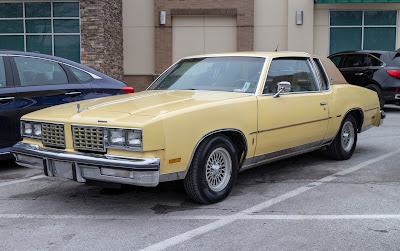
1980 Oldsmobile Cutlass Calais


For 1980, the "Calais" name badge signified the tip-top tier of the personal luxury coupe G-body Cutlasses, even higher up the luxo ladder than the Supreme and Supreme Brougham.

$7,199 was the base MSRP, about $27,500 in constant dollars, and it got you a two-door notchback coupe with a Buick-sourced 3.8L pushrod V-6 with a 2-barrel carburetor and 110 SAE net horsepower, backed by a three-speed automatic. Performance was typical Malaise-era, with zero-to-sixty times in the high thirteen second range.

Buyers could opt for a 105hp Olds 260 cubic inch V-8, or a 305 Chevy 4-barrel small-block putting out 155 ponies. (Or an Olds 350 diesel V-8, if they liked long chats with the mechanics at their dealership.)

This Yellow '80 Cutlass Calais with a Light Camel vinyl landau top was photographed in March of 2019 using a Canon EOS M mirrorless camera and an EF-M 18-55mm f/3.5-5.6 IS zoom lens.

Wednesday, September 4, 2024

1969 Oldsmobile 4-4-2 Convertible


Here's a car born of intramural rivalry at General Motors. In 1964, John DeLorean and the gang at Pontiac introduced the GTO as an option package for the midsize Tempest LeMans, replacing the 326 cubic inch V-8 normally found in the midsize model with the 389cid motor from the full-size Bonneville.

Oldsmobile, the next brand up in General Motors' internal hierarchy, saw all those sweet, sweet sales to the burgeoning sporty car market and came up with a performance package for their own midsize car, the Cutlass. It had a performance version of the Olds 330cid Rocket V-8 and a bunch of suspension upgrades. They called it the "4-4-2", for its 4-barrel carburetor, 4-speed transmission, and dual exhausts.

With the second generation of both cars in 1968, the GTO and 442 became their own models, and the base V-8s in each had swole up to 400 cubic inches, which was GM's self-imposed displacement limit at the time for motors in midsize cars.

The car in the photos is a 1969 Oldsmobile 4-4-2 convertible in Ebony Black with some classy racing stripes.


Depending on the option boxes checked, the 400 cubic inch Olds Rocket V-8 in the '69 ragtop could put out anywhere between 325 and 360 SAE gross horsepower, and could be had with the 4-speed manual, 3-speed manual, or 3-speed Turbo Hydra-Matic transmission.

Olds built 26,357 4-4-2's in 1969, of which 4,295 were convertibles, making this ride relatively uncommon. There certainly can't be that many left in such nice shape out driving around.

This one was photographed with a Canon EOS-1D Mark IV and EF 24-105mm f/4L IS zoom lens in May of 2023.

Wednesday, August 14, 2024

1992 Oldsmobile Cutlass Ciera S


There's been quite the brouhaha among auto buffs regarding the decisions by Ford and GM to expand the Mustang, Camaro, and Corvette badges into entire sub-brands. I mean, that almost happened with the Corvette from the start; in some alternate universe there were probably Corvette Nomad station wagons built right alongside the roadsters in 1953.

One of the most notable recent examples was Oldsmobile's use of the "Cutlass" name to cover all of its midsize coupes and sedans in the mid 1980s.

The Cutlass nameplate had been a winner for GM. Between the '78 and '81 model years, Olds dealers had moved something like two million of the RWD midsize Cutlass, which was available in coupe, sedan, and wagon body styles.

Hyped by this success, in 1982 they renamed the existing rear-wheel-drive Cutlass the "Cutlass Supreme" and added the slightly smaller and cheaper Cutlass Ciera, built on the on the FWD A-body shared with the Buick Century, Chevy Celebrity, and Pontiac 6000. 1985 saw the Cutlass Supreme and Cutlass Ciera joined by the compact-midsize Cutlass Calais, build on the N-body FWD platform of the Buick Skyhawk and Pontiac Grand Am.

Like the Buick Century, the Cutlass Ciera was a darling of fleet buyers, and so while Chevy and Pontiac axed their A-body cars after the 1990 model year, Oldsmobile and Buick let theirs continue to sell alongside their more modern replacements all the way through 1996.

The car in the photo is a a post-facelift '90-'94 Cutlass Ciera S sedan in Bright White. It's in unusually nice shape for a GM sedan of its era, most of which have either decayed into hooptie-dom or succumbed to rust.

If we split the difference and guess at a model year of 1992, the base engine would have been the 2.5L Tech IV inline-4. This was the final evolution of the elderly pushrod Iron Duke four-banger, with throttle body fuel injection, 9.0:1 compression, and 110 SAE net horsepower, a nearly thirty-percent bump from the original 85hp carbureted version back in '77. If the buyer were feeling frisky...well, they wouldn't have bought a Cutlass Ciera...but if they were feeling frisky by buying-an-Oldsmobile-in-1992 standards, they could have ordered the optional GM corporate 3.3L pushrod V-6, rated at 160hp.

This one was snapped in November of 2023 using a Canon EOS 40D and EF 24-105mm f/4L IS zoom lens.

1966 Chevrolet Impala Super Sport Convertible

This Madeira Maroon 1966 Chevrolet Impala Super Sport has the 325 horsepower Turbo-Jet 396 cubic inch big block V-8. The '66 models can ...