Showing posts with label 1980. Show all posts

Monday, April 6, 2026

1980 Datsun 280ZX 2+2


Nissan's Z-car had featured a 2+2 version since the 260Z version of 1974, but when it was completely redesigned for the S130 series as the 280ZX, it was clear that the four-seater version was taken into consideration from the start, with the car morphing from a harder-edged sports coupe into a plusher grand tourer. Magazines at the time noted the more boulevardier nature of the car, even though the S130 2+2 was no heavier than its S30 forebear. 

By the '80 model year the Z-car was already badged in the North American market as a "Datsun by Nissan", and under the hood was Nissan's iron block L28E SOHC 12V inline six. With electronic fuel injection and an 8.3:1 compression ratio, the 2.8L six made 135 SAE net horsepower and could be backed by a five speed manual or, if the buyer had no soul, a three-speed auto.


Motor Trend tested a 1980 2+2 with the five speed and recorded an 11.3 second zero-to-sixty run and managed a quarter in eighteen seconds flat at 77mph. The four wheel power discs hauled the 2,910 pound car down from sixty in 160 feet.

Price of the test car, with the Grand Luxury Package, was $13,203, which comes to $52,360 in 2026 dollars.

The Golden Mist car in the photos was snapped with a Nikon Coolpix P7000 in White Rock, New Mexico back in October of 2015.

Sunday, December 29, 2024

1980 Jeep Wagoneer Limited


This was something that doesn't happen often. Myself and fellow Indy-area car spotter Jim Grey both caught this Russet Metallic 1979-1985 Jeep Wagoneer Limited, possibly the same day. Certainly we both saw it on College Avenue.

The plush "Limited" model of the AWD Wagoneer was introduced midway through the 1978 model year, and all Wagoneers, whether base or Limited, only came with the 360 V-8. Over fifteen feet long, with a two-and-a-quarter ton curb weight and boasting full-time Quadra-Trac four wheel drive, the V-8's torque was felt necessary.

Then came the '79 Energy Crisis, triggered by the Iranian Revolution, and so for '80, you could get your 4WD Wagoneer with either a 97bhp 258 cubic inch OHV inline six as a credit delete option, or with the standard 360cid American Motors V-8 fitted with a Motorcraft 2bbl carburetor and pumping out 127 SAE net horsepower.

The faux-woodie fad was starting to wane by the early Eighties, but it still signified the more luxurious version of most wagon models. I think those optional slotted forged aluminum wheels mark it as a 1980, but I'm no Jeep expert.


It was photographed with a Canon EOS-1D Mark III and EF 24-105mm f/4L IS zoom lens in April of 2024.

Tuesday, December 3, 2024

1980 Mercedes-Benz 300D


The W123 midsize sedans from Mercedes-Benz were the immediate forebears for what's now known as the "E-class" Benz. They were sober-sided, solid cars that broke sales records for the brand.

Launched in 1976, they were sold as coupes, sedans, and wagons, and came with an array of gas and diesel powerplants and both manual and automatic transmissions. These were found in roles as everything from taxicabs to junior executive cars all around the globe, but M-B North America only brought the higher-trim varieties into the U.S. market.

Stateside we could get either the 2.8L fuel-injected DOHC 12V inline-six rated at 142bhp or one of two diesels: the 62hp 2.4L four banger or the 77bhp 3.0L inline five-cylinder. After 1980, only the diesels remained, with the gasoline M110 I6 dropped to keep CAFE (Corporate Average Fuel Economy) numbers up.


The early-'80s (you can tell by the yellow lenses on the fog lamps; '76-'79 cars had clear ones) Mercedes-Benz 300D in English Red in these photos would be bog-slow, with a zero-to-sixty time that struggled to crack the twenty second barrier and a top speed of something like 90mph, but they got good mileage for their time and a well-maintained diesel Benz from this era is harder to kill than a cockroach. If you couldn't get 300k miles out of one, you weren't trying, and in an era when a car was considered completely knackered when its five-digit odometer rolled over, that was nothing short of miraculous.

This one was photographed with a Nikon D800 and 24-120mm f/4 VR zoom lens in May of 2024.

Sunday, October 27, 2024

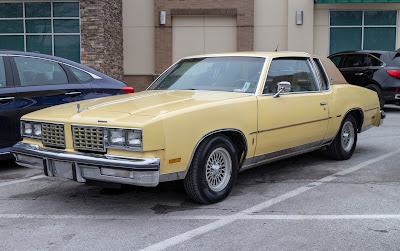
1980 Oldsmobile Cutlass Calais


For 1980, the "Calais" name badge signified the tip-top tier of the personal luxury coupe G-body Cutlasses, even higher up the luxo ladder than the Supreme and Supreme Brougham.

$7,199 was the base MSRP, about $27,500 in constant dollars, and it got you a two-door notchback coupe with a Buick-sourced 3.8L pushrod V-6 with a 2-barrel carburetor and 110 SAE net horsepower, backed by a three-speed automatic. Performance was typical Malaise-era, with zero-to-sixty times in the high thirteen second range.

Buyers could opt for a 105hp Olds 260 cubic inch V-8, or a 305 Chevy 4-barrel small-block putting out 155 ponies. (Or an Olds 350 diesel V-8, if they liked long chats with the mechanics at their dealership.)

This Yellow '80 Cutlass Calais with a Light Camel vinyl landau top was photographed in March of 2019 using a Canon EOS M mirrorless camera and an EF-M 18-55mm f/3.5-5.6 IS zoom lens.

Monday, October 21, 2024

1980 Pontiac Catalina


The "Catalina" badge at Pontiac started life in the 1950s as the top trim package on their full-size Chieftains and Star Chiefs.

Beginning with the '59 model year it became its own line, the lowest level of the full-size Pontiac hierarchy, beneath the Star Chief and top-line Bonneville. There it remained for the next two decades, in various levels of sportiness. During the Bunkie Knudsen years, the Catalina 2+2 was the flag bearer for full-size Poncho performance, with wild triple carb "Tri-Power" Super Duty mills until GM forbade multiple carburetors in anything that wasn't a 'Vette or a Corvair.

Going into the Malaise Era of the Seventies, the enormous B-body Catalinas got more formal and sedate and finally got their turn in the downsizing barrel for the 1977 model year.

That final generation of the Catalina, available as a coupe, sedan, or wagon, rode on the same 116-inch wheelbase as the Bonneville, Impala, LeSabre, and Olds 88. 

By 1980, this Mariposa Yellow coupe would have come with the LS5 Pontiac 2-barrel 265 cubic inch V-8, rated at 120 SAE net horsepower, as the base motor, tasked to lug 3500 pounds of Pontiac down the boulevard. Optionally, a buyer could pay for the 301 cubic inch Pontiac V-8, which featured a Rochester QuadraJet and 150 ponies.

Neither of those Pontiac V-8s would meet California emissions standards, so buyers in the Golden State could get a 115hp 3.8L Buick V-6 or a 160hp Old Rocket 350.

After the 1981 model year, the Catalina nameplate was no more, and neither were Pontiac's in-house V-8 motors. Future performance Ponchos would have Chevy and Buick mills until the division's demise in thirty years.

Thursday, September 19, 2024

1980 Cadillac Eldorado Biarritz


Still sharing the longitudinally-engined General Motors E-body front wheel drive platform with the Olds Toronado and Buick Riviera, the 1979 Eldorado saw the first round of downsizing for Cadillac's swank personal luxury coupe.

What a round of downsizing it was, too! The 1978 Eldo had been among the last of the dinosaurs: 224 inches long and riding on a 126.3" wheelbase, the '78 Eldorado Biarritz hardtop coupe tipped the scales at an earth-crushing 5,048 pounds of curb weight, tanked up and ready to set sail.

The Tenth Generation '79 Eldorado lost almost two feet of overall length, stretching only 204" from nose to tail. The wheelbase took a foot-long chop, too, to 114". The 7.0L Cadillac V-8 was put out to pasture, too, replaced by a fuel-injected version of the Olds Rocket 350. This resulted in a ten horsepower drop, from 180 to 170 SAE net, but that was more than made up for by the half ton of weight pared off the platform.


The 1980 Eldorado in the photos, Colonial Yellow with Yellow vinyl landau top and Saddle leather interior, would be identifiable as a Biarritz by the stainless steel roof panel, even if you couldn't make out the "Biarritz" script on the C-pillar. The lack of amber turn signal lenses on the front mark it as a '79 or '80. The faux-Rolls Parthenon grille was a common aftermarket geegaw, sometimes dealer-installed.

These shots were taken in August of 2020 using a Nikon D7000 and 16-80mm f/2.8-4E VR zoom lens.

Thursday, September 5, 2024

1980 Checker Marathon Deluxe


Checker started making their final iteration of the classic A11 Checker Taxi and the slightly plusher A12 Marathon, intended for consumers, in 1960 for the 1961 model year and production continued largely unchanged for over twenty years.

That makes precisely dating this Marathon Deluxe limousine a difficult task. The round side marker lights, amber up front and red in the rear, tell us it's a '68 or later. The heavy steel girder bumpers front and rear indicate it's a '74 or later. The final clue is the windshield wipers, which work in parallel and tell us it's a '78-'82 (earlier cars had wiper arms that swung from the center to the edge, in opposition to each other.

For 1980 Checkers used Chevy powerplants, in the form of the 3.3L OHV V-6 or the 265 or 305 V-8s. (You could also get a diesel Olds 350, but why would you? Ick.)


The limousine version was cushier than the regular Marathon and can be identified from the outside by the half vinyl roof and the thick C-pillar with an opera window.

It was available in regular and long-wheelbase versions, 120" and 129" respectively, with the latter separately identified as the A12E chassis. This is one is one of the shorter ones, identifiable by the shorter rear doors.

In 1980 a Checker Marathon Deluxe started at $9,653, or about $37,000 in today's cash.

This one was photographed in September of 2021 using a Canon EOS 7D and EF-S 17-55mm f/2.8 IS zoom lens.

Sunday, September 1, 2024

1980 Oldsmobile Delta 88 Royale Brougham


For a GM product of this vintage north of the Ohio river that appears for all the world to be a daily driver, the fact that this thing's not a rusted out hulk is a wonder.

If I'm reading the tea leaves of the grille inserts correctly, this Light Blue Metallic Oldsmobile Delta 88 Royale Brougham coupe is a 1980 model.

The eighth generation of the Oldsmobile 88 ran from the 1977 through the 1985 model years. Sharing the same platform as the Buick LeSabre, Chevy Caprice, and Pontiac Bonneville, it represented the first round of downsizing for General Motors full-size cars, losing eight inches of wheelbase relative to their '71-'76 predecessors.

The 1980 model year represented the first styling refresh for this generation, and was one of the last model years to feature brand-specific engines, as GM was gradually homogenizing their powertrain lineup. (The first steps in this direction caused a bit of a stink in 1977.)

For the 1980 model year, the base motor was a 110 horsepower Buick 3.8L V6. The next step up was the 260 cubic inch (4.3L) version of the Olds Rocket V8, with 307 cid and 350 cid versions also available. These were rated at 120, 150, and 160 horsepower, respectively.

Also available as an option was the disastrous Olds 350 diesel V8, which put out 105 SAE net horsepower when you could get it to run at all.

Alas, the 185-horsepower 403 cubic inch 4-barrel Rocket V-8 was discontinued after the '79 model year. It had been a sluggish seller due to fuel economy concerns.

You could get the 1980 Delta 88 models in plain, Royale, and Royale Brougham flavors, with each one having a more deluxe list of features as standard. The Royale Brougham was crowding basic Cadillac models when it came to included features, yet started at $7,528, or about $29,000 in constant dollars.

This one was photographed in November of 2023 using a Canon EOS 7D and an EF-S 17-55mm f/2.8 IS zoom lens, which is probably the best dedicated APS-C glass Canon makes.

Tuesday, August 20, 2024

1980 Datsun 810


It's a larval Nissan Maxima! 

Only imported for the 1979 and 1980 model years, the Datsun 810 hardtop coupe is not at all a common sight here in the United States.

This 1980 model, in Alpine White, packs Nissan's fuel injected L24 SOHC 2.4L inline six under the hood. Power output was rated at 118 SAE net, driving the rear wheels through either a 5-speed manual or 3-speed automatic gearbox. It was essentially an updated version of the powertrain from the 240Z sports car.

This one was photographed on the high plains in Colorado back in October of 2015 using a Nikon Coolpix P7000.

Friday, August 16, 2024

1980 Ford Thunderbird


Behold the nadir of the Ford Thunderbird, the Eighth-Generation version from the 1980-1982 model years.

This was the second round of downsizing for Ford's personal luxury coupe, which had entered the '72 model year as a nearly five thousand pound boulevard barge built on the same platform as its sister ship, the Lincoln Continental Mark IV. The first round of downsizing saw the '77 T-bird moved to the Panther platform shared with the Torino, Cougar, and LTD II. That downsizing shaved nearly ten inches of length and a thousand pounds of weight off the '72-'76 cars.

For the Eighth Generation, the Thunderbird was moved to the Fox platform, also used by the Fairmont and Mustang. This whacked another foot and 700 pounds off the bill of lading.

Styling-wise, the car kept a lot of the baroque cues from the bigger Seventh Generation version, which looked bizarrely cramped when it was all crammed together on the smaller body.

Under the hood, the base motor was a 255 cubic inch version of the Windsor V8 making a weaksauce 115bhp, with an upgrade to a 131 horsepower 302 available on the option sheet. Performance was...less than stellar. Car and Driver clocked a 12.9 second zero-to-sixty time from a test car with the base motor and a slightly less sluggish 11.3 seconds with the 302. Quarter mile times were recorded as 19.4 @ 75 and 18.6 @ 78 mph, respectively.

The Medium Red Iridescent example in the photo was snapped in January of 2021 using a Nikon 1 J4 and the 1 Nikkor 18.5mm f/1.8 lens.

Thursday, August 15, 2024

1980 Pontiac Firebird Esprit Yellowbird


Here's a nice, lightly restomodded late 2nd Generation F-body. Specifically, it looks to be a 1980 Pontiac Firebird Esprit, which featured trim and equipment a notch above the base model, and RPO W73: the Yellowbird appearance package. The Yellowbird package came with the two-tone pale yellow paint, pinstriping, and some interior appearance enhancements. It originally had color-matched Pontiac "snowflake" alloy wheels, too. Not a performance-oriented model like the Formula or Trans Am, the Esprit was more like the later Berlinetta package on Camaros.

The last few model years of the 2nd Generation marked an odd era for the F-bodies.

When the 2nd Gen was launched in 1970, the midsize cars from Chevy and Pontiac were the Chevelle and the LeMans, both of which were noticeably larger than the compact-derived Camaro and Firebird. A 1970 Pontiac LeMans rode on a 112" wheelbase and was 207" long overall, which is a four inch longer wheelbase and almost a foot more distance between the bumpers than a 1970 Firebird.

Since the Firebird in the photo is a 1980 model, it would have been sold on a lot next to mid-size LeMans sedans that had undergone a radical round of downsizing in the late Seventies and which now rode on a 108" wheelbase the same length as that of the sporty coupe. In fact, in 1982 that platform would be re-badged as the Bonneville and would be the new "full-size" Pontiac sedan, and the "mid-size" Pontiac banner would be handed off to an even smaller FWD car. When the 3rd Gen Firebirds launched in 1982, whey whacked a full seven inches off the wheelbase of their predecessor.

It wasn't that the '79-'81 Firebirds had gotten big and bloated, so much as it is that Detroit shrank around them. It didn't help that a bunch of heavy safety and emissions equipment had been added since 1970, while the motors in the engine compartment shrank in response to the '73 and '79 Oil Crises.

The Yellowbird was just an appearance package, so the base motor in this Esprit still would have been a Buick-sourced 231 cubic inch V-6 rated at 115 SAE net horsepower. Buyers could also pay extra for the LS5 265cid V-8 or L37 301cid V-8. Both were derived from the small-journal Pontiac block. The 265 had a 2-bbl carb and was rated at 120hp while the 301 had a 4bbl and put out 140 net horsepower.

Judging from the wheels and tires and general stance of the car, though, as well as the healthy exhaust burble it gave off, I doubt this thing's rolling with the stock 140 horses.

This one was snapped in August of 2021 using a Nikon D3 and 24-120mm f/4 VR zoom lens.

Wednesday, July 24, 2024

1980 Chevrolet Chevette SL


It's something of an achievement in itself to drive a Chevette long enough that it becomes head-turningly cool, like this guy did. It definitely caught the attention of most folks eating lunch on the patio at Twenty Tap.

I hollered "Nice 'Vette! What year?" to the driver, who grinned and answered "1980!"

There was something about it that made my car nerd itch, though. The front end was a little... off. The bumpers seemed a little slim. And, wait, there were no side-marker lights up front.

The cue is in the vintage license plates...


Those are Sao Paolo license plates... from Brazil, because this is a 1980 Chevette SL from General Motors do Brasil.

The Brazilian model used a 1.4L (85 cubic inch) inline four just like the base domestic Chevette, but the Latin American version had a single overhead cam instead of pushrods. The Brazilian market version could be ordered in either ethanol (called "gasoól" in Brazil) or gasoline-burning versions, putting out 60 and 59 SAE net horsepower, respectively. With its huge sugarcane production, Brazil's been running its light vehicle fleet on biofuels longer than anyone.

This Chevy was photographed in April of 2022 using a Fujifilm X-T2 and an XF 16-80mm f/4 R WR OIS zoom lens.

1966 Chevrolet Impala Super Sport Convertible

This Madeira Maroon 1966 Chevrolet Impala Super Sport has the 325 horsepower Turbo-Jet 396 cubic inch big block V-8. The '66 models can ...