Showing posts with label Cadillac. Show all posts

Monday, July 20, 2026

2016 Cadillac ATS-V Coupe


The Cimarron faceplanted and the Catera stumbled so this car could fly.

With the ATS, especially in its ATS-V coupe configuration, General Motors' most bougie division finally produced a genuinely desirable sporty car in a size comparable with the more compact offerings from the high-end Euro manufacturers.

Built on a shortened version of the GM Alpha platform, the ATS  had a wheelbase something like five inches shorter than its CTS sibling and even an inch shorter than the sixth generation Camaro.

Powered by a twin-turbo direct-injected 3.6L DOHC alloy V-6 cranking out 464 ponies, the ATS-V coupe came standard with a Tremec six-speed manual, although if your soul was dead inside you could get a six-speed automatic.

When Car and Driver tested a manual transmission car it managed a 4.2 second zero-to-sixty dash and put away the quarter in 12.6 at 115. It circled the skidpad at a hold-on-to-your-Big-Gulp 0.97g. Price as tested was $74,450 or about $103,600 in today's smaller dollars.

The Radiant Silver Metallic example in the picture was photographed with a Canon EOS R and an RF 24-105mm f/4-7.1 IS zoom lens in August of 2025.

Tuesday, May 12, 2026

1962 Cadillac Sixty-Two Sedan


We've had a 1962 Cadillac Sixty-Two sedan on these pages before, but it was the shorter four-window Town Sedan, whereas this is the full-length six-window Sedan.

Like the shorter car, the six-window is powered by the 390 cubic inch iteration of Cadillac's 331 Series overhead valve V-8, rated at 325 gross horsepower.


This example, painted in the color Cadillac called "Sandalwood", was photographed in May of 2026 using a Canon EOS 5Ds and an EF 24-105mm f/4L IS zoom lens.

Tuesday, April 21, 2026

1932 Cadillac Series 452B Fleetwood Madame X Sedan


Walking home from brunch at the Gallery Pastry Shop one fine June day in 2017, I spotted one of the rarest and most unusual cars I've ever run into just out and about. Built in 1932 for the president of General Motors of Canada, this is one of the last Madame X Cadillacs to be sold. (It's car number 5131 at this online registry.)

The "Series 452" referred to the displacement of the mighty V-16 OHV engine in cubic inches. There was also the V-12 Series 370 and the V-8 Series 355. It wasn't until 1936 that Cadillac switched to the two-digit Series designations that they used for the next forty years and the V-16 halo cars became the Series 90.


The V-16 was a narrow-angle 45° vee pushrod motor in an era when most American cars were still using flathead valve-in-block powerplants. These early Series 452 engines were essentially two separate straight-eight motors driving a common crank and made 165 horsepower, which could propel these massive cars to eighty or a hundred miles per hour, depending on the axle ratio ordered by the purchaser. 

With electric start and Synchro-Mesh manual transmissions, these were truly advanced vehicles for the time, and priced like it. The top-of-the-line Madame X series cars were essentially bespoke creations that went for over $7,000, which is as close to $180k in today's money as makes no nevermind.


This one was photographed using a Nikon Coolpix P7000.

Tuesday, April 14, 2026

1967 Cadillac Eldorado


The Eldorado nameplate was used for prestige coupes and convertibles hovering around the top of Cadillac's lineup starting in 1953. While these shared their underpinnings with GM C-body Series 62 Caddies, the eighth generation of the Eldorado saw a real change.

For 1967 the completely redesigned Eldo (formally the "Cadillac Fleetwood Eldorado") was moved to a chassis shared with the Oldsmobile Toronado and Buick Riviera luxury coupes. Like the Toronado, but unlike the Riv, the Eldorado was now a front wheel drive car.

The powertrain was a unitized power pack mating the 429 cubic inch Cadillac 390 Series OHV V-8, with a 10.5:1 compression ratio and making 340 gross horsepower, to a Turbo Hydra-Matic 425 three-speed automatic transmission. This was essentially a mirror-imaged TH400 that was bolted below and alongside the engine, driven off a chain on the output side of the bell housing.


While the 429 Caddy was a beefy motor that muscled out 480 foot-pounds of torque, it had its work cut out for itself with a two-and-a-quarter ton coupe with a 120" wheelbase. Zero-to-sixty times were typically reported in the low nine second range, even with the 3.21:1 axle ratio. Top speed was something like 125-130. Power drums were standard for the braking system, although front discs were optional and became standard the following model year.

Base price was $6,277, which comes to something like $61,500 in today's money.

This example, in a color Cadillac called "Doeskin", was photographed in Springfield, Missouri in April of 2026 using an Olympus PEN E-P5 and an M. Zuiko Digital 12-45mm f/4 PRO zoom lens.

Saturday, March 7, 2026

1966 Cadillac DeVille Convertible


Cadillac’s DeVille line was the middle of its lineup, above the Calais but beneath the deluxe cars with bodies from the Fleetwood plant, which were the top of the line for 1966. If you were driving a Cadillac convertible, whether a Fleetwood Eldorado or a DeVille, you were letting everyone know that you'd made it in life.

The base price for a droptop Eldo was $6,631 in great big 1966 dollars, while a DeVille Convertible started at $5,555. This works out to something close to $65,900 and $55,200 in current tiny inflation bucks.

Almost everything that would be a luxury option on lesser cars came standard on the Fleetwood; power-operated everything and they still had real wood in the cockpit in those days. Every seating position had its own ashtray, and the front ones were lighted, while each rear seat had its own cigarette lighter. DeVilles were only slightly less luxuriously appointed.

Power was provided by the 429 cubic inch version of Cadillac's 390 Series V-8. With a four-barrel carburetor and a 10.5:1 compression ratio, it was rated at 340 gross horsepower. 

This Cape Ivory example was photographed in September of 2015 using a Nikon Coolpix P7000.

Friday, February 20, 2026

1959 Cadillac Sedan de Ville (Six Window)


The styling on the 1959 Cadillacs is eye-catching, iconic, and instantly recognizable with its enormous rakish tail fins, each tipped by dual bullet-shaped taillight lamps.

New for '59, the deVille line was no longer a trim level on the Series 62 but was moved to its own series, the Series 6300. It was available as a Coupe as well as Four Window and Six Window Sedans, with the Ebony example in the photo being an example of the latter.

These were large cars, riding on a 130" wheelbase with an overall length of 225". Under the hood was the new 390 cubic inch version of Cadillac's 331 Series overhead valve V-8, with a single four-barrel carburetor and a 10.5:1 compression ratio, rated at 325 gross horsepower. The Hydra-Matic was the only transmission offered.

Base price in 1959 was $5,498, which works out to $60,800-ish in current dollars.

This one was photographed in November of 2016 using a Nikon Coolpix P7000.

Sunday, November 2, 2025

1962 Cadillac Sixty-Two Town Sedan


The newly restyled Cadillacs for 1961 featured crisper, more angular styling than the previous generation. While they still had fairly prominent tail fins, they were but a vestige of the previous generation's monstrosities. Rather than the twin bullet-shaped taillights that protruded from the rear of its predecessor's fins, the new Cadillacs had a single taillight cleanly faired into the trailing edge of the fins, with another lamp assembly at either end of the rear bumper. The lower edge of the bodywork featured a distinctive skeg or strake that became emblematic of these early Space Age Cads.

The Series 62 was the less expensive model of the full-size Cadillacs, with a less posh interior than the pricier de Ville models. The Four Window Town Sedan had a shorter decklid and roof, sacrificing some trunk space and rear seat legroom to give an overall length half a foot shorter than the 222"-long Six Window Sedan, making it easier to park on city streets and fit in normal garages.


Under the hood could be found Cadillac's 390 cubic inch pushrod V-8, with a four-throat carburetor and a 10.5:1 compression ratio, making 325 SAE gross horsepower. Base MSRP was $4,590, or roughly $49,400 in current dollars.

This one was photographed with a Fujifilm X-T2 and an XF 18-55mm f/2.8-4 R OIS zoom lens in September of 2021.

Saturday, September 13, 2025

1970 Cadillac Coupe De Ville


1970 marked the final year for the third generation of Cadillac's De Ville, which had begun with the 1965 models. They'd received a pretty serious makeover for the 1969 model year, going from vertically-stacked to horizontal quad headlamps, and gaining more sharply-creased flanks ending in notional fins.


Under the hood was Cadillac's 472 cubic inch V-8 with a four-barrel carburetor, making 375 gross horsepower and a monstrous 525 lb/ft of torque and backed by a THM400 three-speed automatic. This would be the last year for the full 10.0:1 compression ratio. The next year would see compression drop to 8.5:1 to allow the use of regular gasoline, which would give the output a thirty horsepower haircut.

This Cotillion White coupe rides on a 129.5" wheelbase and stretches a full 225" from stem to stern. It would have had a base sticker of $5,884, which is about $49k in current money.


This one was photographed in September of 2025 using an Olympus E-3 and a Zuiko Digital 12-60mm f/2.8-4 zoom lens.

Tuesday, September 9, 2025

1990 Cadillac Brougham


After Cadillac dubbed a new full-size transverse-engined front-wheel-drive model the "Fleetwood" for 1985, they tried to keep calling the old RWD car the "Fleetwood Brougham", but two completely different cars with the same name was too confusing, so the old body-on-frame car... so important to the coach trade ...lost the prefix and became just the Brougham in 1987.

The year on this Cotillion White example is sussed by noting the grille, the Premier Vinyl Roof, and the bumper treatment. The '87-'88 had crosshatched grilles, with the vertical slats appearing for '89. The Premier Vinyl Roof, which included surrounds around the rear opera windows, showed up as an option in '88 and became standard in '90. The body-colored aero bumper treatment showed up as part of a light 1990 restyle, a response to the redesigned Lincoln Town Car.

Other cues are the one-piece composite headlamps and the front seat seatbelt anchors mounted on the door frames.


For 1990 buyers could opt for a L05 Chevrolet 5.7L throttle-body injected V-8 making 175 horsepower, but the decklid badge indicates this one has the base 5.0L Chevy with a Rochester Quadrajet carburetor, rated at 140 SAE net ponies.

This one was snapped in September of 2025 using a Canon EOS R and an RF 24-105mm f/4-7.1 IS zoom lens.

Monday, July 28, 2025

1977 Cadillac Coupe deVille


While Cadillac had already sent a smaller car to market in the form of the 1975 Seville, the 1977 model year saw the first downsizing of full-size Caddies in response to the seismic shock of the 1973 fuel crisis.

Of course, "downsized" is a relative term. The wheelbase was shortened by eight and a half inches, to 121.5", while the overall length dropped from 230.7" to 221.2". Cadillac engineers whittled off nearly a half ton of curb weight from the Coupe deVille, bringing it down to 4,360 pounds and making the big two-door the second lightest car on the Cadillac dealer's lot, only about sixty pounds heavier than the small Seville.

A chunk of that weight savings happened under the hood. Cadillac took the previous year's 500 cubic inch 472-series V-8 and redesigned the block. The new 425-series V-8 used the same bore centers and had the same stroke, but a smaller 4.082" bore and displaced, as the name might suggest, 425 cubic inches (or "7.0 Litres" in the Cadillac advertising of the time.) The motor was a hundred pounds lighter than its predecessor and available in 4-barrel carbureted L33 or the electronic multi-port fuel injected L35, with the former making 180 SAE net horsepower and the latter, 195 ponies.

Car and Driver tested a '78 Coupe deVille with the L33 motor, essentially the same car as the '77 but with a different grille, and recorded a 10.6 second zero-to-sixty time and an 18.2 second quarter mile run at 79mph. Top speed was a mere 108, but it did get around a skidpad at 0.79g, which was not bad for a car big enough that the hood ornament and spare tire are frequently in different ZIP codes. Full-size Caddies, other than the Fleetwood Brougham, still had not been bestowed with the blessings of four-wheel discs, so the stop from seventy took 208 feet.

The well optioned test car cost $13,375 in 1978 dollars, which is the next thing to $66k in current money.

The one in the photo was photographed in May of 2025 using a Canon EOS-1D Mark IV and an EF 24-105mm f/4L IS zoom lens.

Saturday, July 19, 2025

1949 Cadillac Series Sixty-One Coupe


Cadillac styling for the 1948 model year had been all-new and strikingly modern, introducing tail fins allegedly inspired by the Lockheed P-38 Lightning fighter of World War Two fame. Under the hood, however, had been the same old 346 cubic inch "Monobloc" flathead V-8 that had been powering Caddies since the late Thirties.

For 1949, however, the all-new postwar styling was joined by an all-new postwar motor. This new overhead valve V-8, dubbed the 331 Series after its displacement in cubic inches, was billed as "America's Newest, Finest Motor Car Engine". It was an oversquare design with a 3.81" bore and a 3.625" stroke and sported hydraulic lifters, a two-barrel Carter carburetor, aluminum pistons, a 7.5:1 compression ratio, and made a claimed 160 SAE gross horsepower at 3,800 RPM.


The Series Sixty-One was the entry-level Cadillac and had previously ridden on a shorter chassis, but for the '48 model year it had been moved to share the same full size C-body chassis as the Series Sixty-Two, so the big differences were in trim and appointments.

The slick lines of the '48-'49 Caddies make them popular starting points for classic hot rod builds, like this striking purple example photographed with a Canon EOS-1D Mark IV and an EF 24-105mm f/4L IS zoom lens in September of 2022.

Wednesday, June 4, 2025

1963 Cadillac Fleetwood Seventy-Five


The 70/75 Series from Cadillac were their largest and most luxurious postwar cars, not only sold as large sedans but also in limousine form, as well as serving as the platform for livery cars, hearses, ambulances, et cetera.

The 1961 redesign marked the eighth generation of the Series Seventy-Five and carried on the Fleetwood name, denoting that its body was made by the coachbuilder Fleetwood Body Company, which had been purchased by Fisher Body in the 1920s and absorbed into the General Motors family. Fleetwood bodies were exclusive to Cadillac, and only the top-flight Cadillacs, at that.


This was still the era where Detroit made small cosmetic changes for every model year, so it's easy to place this Basildon Green Fleetwood Seventy-Five nine-passenger sedan as a 1963, halfway through the eighth generation's 1961-1965 run.

It is a massive car, stretching twenty feet and three inches from stem to stern, riding on a nearly 150" wheelbase, and weighing a pavement-crushing 5,400 pounds.

Power was provided by a 390 cubic inch version of Cadillac's proprietary V-8. While it retained the same bore and stroke of the previous year's engine, a 390 cube development of the 331 Series OHV engine that debuted in 1949, it featured extensive changes. The new motor had a smaller, lighter block, a revised mounting setup for accessories, and was dubbed the 390 Series. With a Rochester 4-barrel carburetor and 10.5:1 compression, the 390 was rated at 325 SAE gross horsepower.


Base price in 1963 was $9,724 in 1963, which adjusts to over $101k in current money.

This one was photographed in May of 2025 using a Canon EOS 40D and an EF-S 17-85mm f/4-5.6 IS zoom lens.

Tuesday, May 13, 2025

1982 Cadillac Eldorado


The 1981 experiment with improving the fuel mileage of the old 6.0L Cadillac V-8 via the means of selective cylinder deactivation had been a debacle.

It had also been something of a stopgap because the 1982 model year saw the introduction of the HT4100 V-8, the first all-new Cadillac engine since the Sixties. The HT4100 had been slated for an '83 rollout, but the V4-6-8 fiasco caused it to be rushed to market.

The "HT" stood for High Technology, and by Caddy standards of the day I guess a throttle body fuel injected 4.1L pushrod V-8 with an aluminum block and cast iron heads was sorta high tech. The little 249 cubic inch motor sent 125 SAE net horsepower to the front wheels through a four-speed automatic. This small herd of ponies was tasked with towing over 3,700 pounds of luxury coupe down the road.

Car and Driver tested one in Touring Coupe trim and recorded a dismal 15.2 second slog to sixty. It needed 20.2 seconds to complete a standing quarter mile, staggering through the traps at 68 miles per hour. Top speed was only 92.

Base price for an '82 Eldo was $18,716, or about sixty-two grand in current dollars.


Cadillac was not officially back in the convertible business yet in 1982, but aftermarket conversions by companies like Hess & Eisenhardt or ASC are not uncommon. The convertible top on this Sable Black Eldorado had not held up well. The mildew smell was noticeable from thirty feet away and was strong enough that it probably prevented tailgating. 

It was photographed in September of 2016 using a Nikon Coolpix P7000.

Thursday, May 1, 2025

2012 Cadillac Escalade EXT


Launched for the 2002 model year, the EXT version of Cadillac's Escalade luxury SUV was intended to compete with the first iteration of the Lincoln Blackwood. While the Blackwood fizzled after a single model year, having sold fewer than 3,500 units, the Escalade EXT did well enough to get continued.

In fact, the Cadillac of pickup trucks did well enough to get a second generation for the 2007 model year.

The new styling featured an even more massive chrome grille, with a rodeo belt buckle sized Caddy badge front and center. Only mild styling changes to trim bits followed over the next several years.

For 2012 the powerplant was the L94 version of GM's Vortec 6200 6.2L V-8, interesting for being the first mass produced pushrod motor with variable valve timing. It belted out 403 SAE net horsepower, which was ample enough to let even a nearly three ton SUV get out of its own way. The L94 differed from the earlier L92 only in having Active Fuel Management, which could shut off cylinders when cruising under light throttle load. Given Cadillac's previous experience with a more primitive version of the same concept, you can see why they'd pick a vague circumlocution to call its reboot.

When Motor Trend tested a 2007 Escalade EXT with the L92, the enormous land barge nevertheless managed a 6.5 second lunge to sixty and a 15.1 quarter at 92.5 through the traps. Respectable numbers for a vehicle that could have its own ZIP code.

This Radiant Silver Metallic 2012 model is from the second-to-last year of the EXT, which was discontinued after only 1,972 of the luxotrucks crossed the curb at Caddy stores.

It was photographed with an Olympus E-510 and a Zuiko Digital 14-42mm f/3.5-5.6 zoom lens in November of 2021.

Sunday, April 27, 2025

1995 Cadillac Eldorado Sport Coupe


The Eldorado debuted in 1953 as a sporty convertible coupe with show car styling at the pinnacle of Cadillac's lineup.

From then on, it remained as Caddy's sports-luxury coupe, and often debuted new tech for the company. The '53 had been the first Cadillac with a wraparound windshield, and the '67 Eldo was the first front-wheel drive Cad. The '76 Eldorado was the first with the fuel-injected 500, and the last Cadillac convertible until 1984.

The Eldorado in the picture, I think a '95 in Pearl Red, would be from the twelfth… and final …generation of the Eldorado. While the sportier Eldorado Touring Coupes had the 300hp version of the 4.6L 32V DOHC Northstar V8 along with a silly "ETC" decklid badge, this base ESC model would have had the lower-revving 275-horse LD8 variation of the Northstar. 

While the higher-output L37 and the LD8 shared the same variable valve timing 32V architecture and 10.3:1 compression ratio, the LD8 had five more lb/ft of torque, at 300, that peaked lower in the rev range so that it didn't require as much pressure on the gas pedal from an orthopedic loafer to summon up.

While 275 horsepower may not seem like a lot by modern standards, or by those of the ‘60s Muscle Car Era, the LD8 Northstar was a big bump over the ‘93 Eldo’s 4.9L pushrod L26 port fuel-injected V-8 that only put out 200hp. The ESC ("Eldorado Sport Coupe") could squeak under the 8.0 second mark in the sprint to sixty, and the ETC was quicker. The price on the 1995 ESC started at $38,220, which is eighty grand in today's money.

Alas, Eldorado sales numbers had been on a steady glide slope toward oblivion since 1986 and the Eldorado nameplate went to that Great Country Club Parking Lot in the Sky after the 2002 model year.

This one was photographed in November of 2023 using a Fujifilm X-T2 and a Fujinon XF 16-80mm f/4 R OIS WR zoom lens. 

Friday, April 25, 2025

1981 Cadillac Fleetwood Brougham Coupe


Dating this Azure Blue Firemist Cadillac Fleetwood Brougham Coupe is made easy by the fender badge, which denotes that it had Caddy's V-4-6-8 engine.

While cylinder deactivation isn't especially uncommon now, it was pretty radical back in the days when even really powerful computers still had their memory measured in kilobytes.

The 1980 Caddies had been using the 368 cubic inch L61 V-8, which was the older 425 cube motor with the bore reduced to 3.8 inches. The stroke was left at 4.06", which made for an undersquare tractor motor that got better gas mileage. It was fuel-injected on the front wheel drive Eldos and Sevilles, but the RWD bodies still used Rochester Quadrajet carbs.

For 1981, Cadillac added a complicated cylinder deactivation system that would use solenoids to lock the rocker arms on the deactivated cylinders, creating the 140bhp L62 V4-6-8. Now using throttle body injection on all models, it would theoretically use all eight cylinders for accelerating, six for normal around-town driving, and only fire on four cylinders for interstate cruising.

Car and Driver tested an '81 Sedan de Ville with the V4-6-8 and got a zero-to-sixty time of 11.6 seconds and oozed through the quarter mile in 18.4 seconds at 74 mph. Top speed was 101 and the brakes... 11.7" vented discs up front and drums in the back ...took 233 feet to haul the 4240-pound barge to a stop from 70.

The V4-6-8 motor was a public relations nightmare. It had almost no practical effect on fuel economy (The EPA rating of 15 MPG City, 25 Highway was identical to the the previous year's car) and received thirteen programming upgrades in its sole model year of retail sales, and would probably be remembered as the crappiest artifact of the Malaise Era if it weren't for the fact that Oldsmobile's 350 Rocket Diesel had been an even bigger disaster.

Fortunately, the whole system could be disabled by disconnecting a single wire, which this one has almost certainly had done since the driver does not appear to be gnawing on the steering wheel while shedding tears of impotent rage.

This one was photographed with a Canon EOS-1D Mark IV and EF 24-105mm f/4L zoom lens in February of 2024.

Saturday, March 1, 2025

1987 Cadillac Brougham D'Elegance


When Cadillac moved the Fleetwood name to a front-wheel drive platform in 1985, they continued producing the old rear-wheel drive body-on-frame car as the Fleetwood Brougham. After a couple of confusing model years at Caddy dealerships where unrelated Fleetwoods and Fleetwood Broughams were sold side-by-side, they ended the confusion by dropping the Fleetwood part of the name from the older car.

The 1987 Brougham in the picture, finished in Chestnut with a Buckskin vinyl roof, has the ultra-luxe D'Elegance package, with such niceties as rear seat reading lamps.

Standard equipment under the hood would be a Oldsmobile-sourced 5.0L V-8 with a four-barrel Quadrajet carburetor. This 307 cubic inch engine sent 140 SAE net horsepower to the rear wheels via a 4-speed automatic transmission.

Like the other big RWD full-size cars from GM, these things soldiered in the catalog long after they were intended to be axed because sales stayed strong and the tooling was long amortized, so they were pure profit centers as long as they remained popular. A friend's mom in high school bought one after getting rear ended while riding with a friend. After that experience she no longer wanted to drive her Fiat Spider 2000 and went shopping for the biggest slab of sheet metal she could find.

This one was photographed with a Canon EOS 40D and an EF-S 18-135mm f/3.5-5.6 IS zoom lens in April of 2023.

Friday, February 28, 2025

1978 Cadillac Coupe De Ville


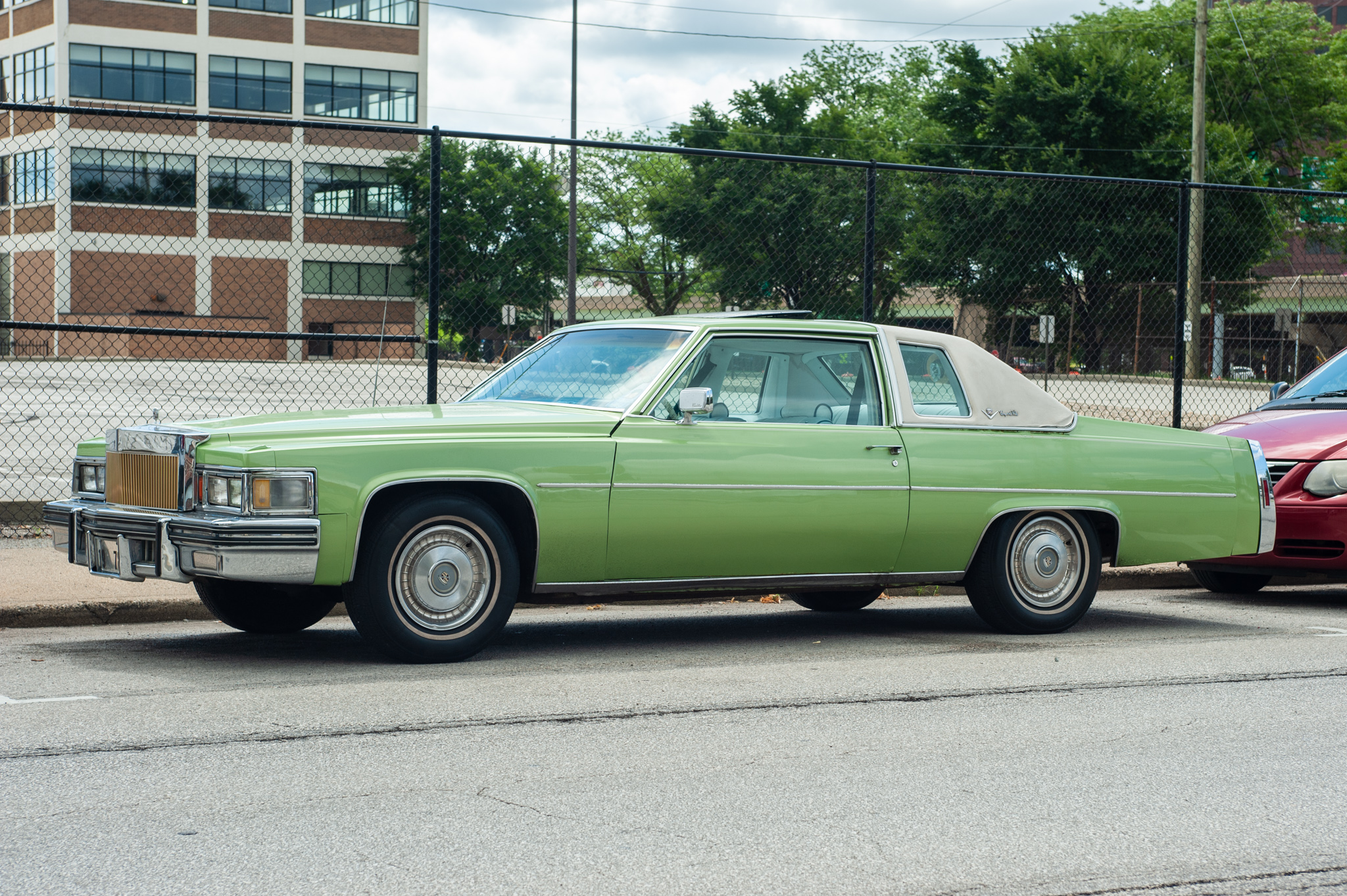
1978 marked the second model year of the newly-downsized Cadillac Coupe DeVille. While being nineteen inches shorter than the previous generation, it was still a large car, riding on a 121.5" wheelbase and weighing 4,270 pounds, all gassed up and ready to go.

Under the hood was Cadillac's 7.0 litre pushrod 425 V-8. Available as the in the same carbureted L33 configuration as the previous year, with a Rochester Quadrajet carb, 8.2:1 compression, and 180 SAE net horsepower, or the new port fuel injected L35, which bumped output to 195 ponies. The only transmission available was a 3-speed THM 400.

This Basil Green Firemist '78 Coupe DeVille sports a Light Beige vinyl landau roof and aftermarket bling in the form of a gold grille and a faux Rolls radiator shell.

When Car and Driver tested a '78 model with the L33 carbureted engine, they managed a zero-to-sixty time of 10.6 seconds and an 18.2 quarter mile at 79 mph. With the California-spec 2.73:1 rear end, the test car topped out at 108 miles per hour, and it took 207 feet to stop from 70.

Fully optioned, the test car's price ballooned from the $10,444 base to what was then an eye-popping $13,375 (it would have been another $744 if you wanted the fuel injection.) That price tag comes to over sixty-five grand in today's money.

This one was photographed with a Nikon D700 and a 35-70mm f/2.8 zoom lens in July of 2020.

Thursday, February 27, 2025

1970 Cadillac Coupe De Ville


We've seen a convertible 1970 Cadillac Coupe De Ville on these pages before, but here's a hardtop coupe. Eye-catching as the color on this example is, it's not a factory shade, despite the rest of the bodywork being extremely factory.

The factory motor would have been the Cadillac 472 cubic inch V-8, rated at 375 SAE gross horsepower.


This one was photographed with a Nikon D800 and a 24-120mm f/4 VR zoom lens in May of 2022.

Thursday, February 6, 2025

1973 Cadillac Eldorado Convertible


1973 was the third model year for the Eldorado's ninth generation. It was also the first model year that the Eldo was formally separated out of the Fleetwood series to become its own model.

It gained the clunky new mandatory five mile per hour front bumper and lost the faux intake vents from the rear fenders that the '71-'72 models had sported. The hood was flatter and the grille was now a huge egg crate-styled expanse between the quad headlamps.

The 8.2L V-8 carried over from the previous model year, still rated at 235 SAE net horsepower, as the real Malaise Era haircut wouldn't start until the '74s debuted.


Variable ratio power steering was, of course, standard and you could get optional steel-belted radials from the factory.

This Cotillion White '73 ragtop rides on a 126.3" wheelbase, casts a shadow 222" long, and has a curb weight of 5130 road-hugging pounds.

It was photographed with a Nikon D300S and 18-200mm f/3.5-5.6 VR II zoom lens in June of 2022.

1976 Chevrolet Caprice Classic

We've had a '76 Caprice Classic, the last of the big Chevy land yachts before downsizing, on these pages before. That one was on ch...