Showing posts with label 1968. Show all posts

Tuesday, April 7, 2026

1968 Chevrolet Camaro Convertible


Chevrolet's entry in the pony car class received a few mild styling changes for its second model year. FMVSS-compliant side marker lights were added and the vent windows were deleted and the v-shape of the grille became more pronounced.

The fender badges on this Sequoia Green droptop say 327 but the hood has the chrome fake velocity stack looking dinguses from the SS350 and SS396 models. This one has the snappy-looking optional Rally wheels, too.

The LF7 327 cubic inch Turbo-Fire small block was the standard motor. With a two-barrel carb and an 8.75:1 compression ratio, it was advertised as thrifty but still reasonably powerful, making 210 gross horsepower. The other 327 in the catalog was the L30, which had a 10.0:1 squeeze and a four-barrel carb and put out 275 horses.

A three-speed manual was standard, and a buyer could opt for a four-on-the-floor, a two-speed Powerglide, or a three-speed Turbo Hydra-Matic.  

This one was photographed with a Nikon D2X and an 18-200mm f/3.5-5.6 VR II zoom lens in November of 2022.

Wednesday, November 5, 2025

1968 Chevrolet Camaro RS Convertible


There have been a couple first generation Camaro Rally Sport convertibles on the blog already, but they were both 1967 models.

The FMVSS-compliant side marker lights and the lack of vent windows on this Chevrolet Camaro RS ragtop in Palomino Ivory mark it as a 1968 model.


According to the fender badges, this one's got a 327 Turbo-Fire small block under the hood. That could either be the base two-barrel motor with an 8.75:1 compression ratio and 210 gross horsepower, or the four-barrel version with a 10.0:1 squeeze and 275 ponies. Both versions had a single exhaust from the factory, so there's no real external clues.

Both photos were snapped in September of 2023, the top one with a Nikon D800 and a 24-120mm f/4 VR zoom lens and the lower one with a Nikon 1 V1 and a 1 Nikkor 32mm f/1.2 lens.

Sunday, October 19, 2025

1968 Pontiac Catalina


For 1968, the full-size Pontiac lineup contained a bewildering number of distinct models, ranging downwards thusly: Brougham, Bonneville, Executive, Ventura, and Catalina. The Catalina was the cheapest trim level of full-size Pontiac and represented the entry point for the line; you got all the sporty Pontiac look for the minimum amount of dollars.


The Catalina could be had in 2- and 4-door pillared sedan or 2- and 4-door hardtop form (as well as a station wagon). The standard engine was a 400 cubic inch small-journal Pontiac V-8, with a 2-barrel carburetor and a 10.5:1 compression ratio requiring premium fuel. It was rated at 290 SAE gross horsepower, and could be subbed out for a 265hp version of the same engine that ran on regular.

Optional motors were a 4-barrel 400 making 340 ponies, or two versions of the large-journal Pontiac 428 putting out 375 or 390 gross horsepower.

A base Pontiac Catalina 4-door sedan with the optional Turbo Hydra-Matic stickered at $3,218, which was cheaper than either an Impala or Galaxie 500 with a comparable engine, and is equivalent to about $29,960 in current dollars.

This Cameo Ivory hardtop coupe was photographed in September of 2025 using an Olympus OM-D E-M5 and a Panasonic Leica 12-60mm f/2.8-4 zoom lens.

Sunday, September 7, 2025

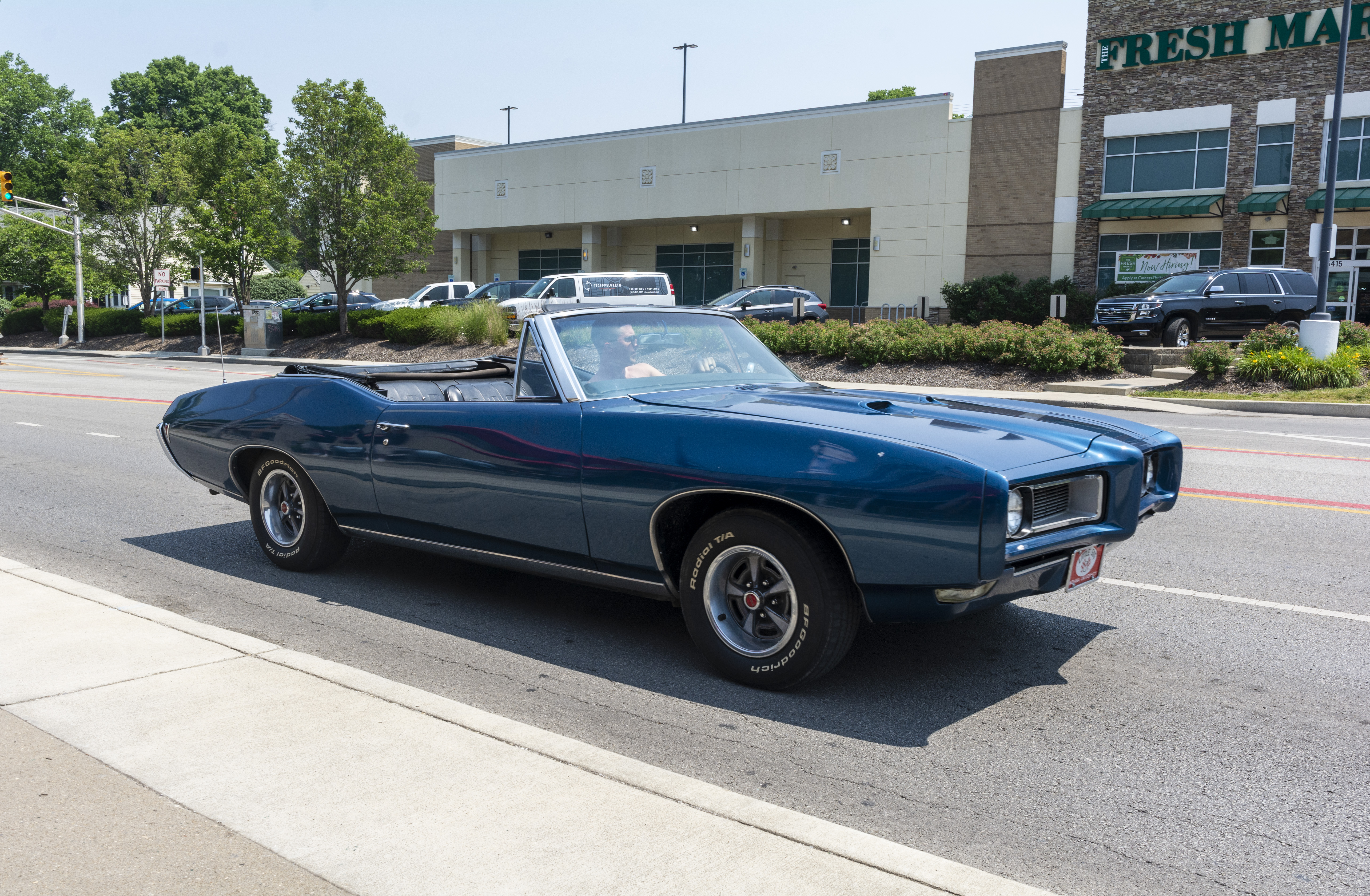
1968 Pontiac GTO Convertible


We've had a '68 Goat ragtop on these pages before, in Solar Red. That one apparently had its vacuum-operated headlight doors stuck in the open position which this one does not.

This one also has the optional hood-mounted tachometer. On the other hand, the other one was still wearing its slightly worn original paint job whereas this one's been repainted. It looks like they were aiming for the darker Aegean Blue rather than the lighter Aleutian Blue, but they didn't quite stick the landing.


So it's not concours-quality... who cares? The guy behind the wheel seems pretty happy, and who wouldn't be, tooling around in a droptop GTO?

When Hot Rod Magazine tested a '68 GTO hardtop with the 400 H.O., four-speed,  and a 3.90:1 rear end, they managed a 7.1 second zero-to-sixty time and a 14.3 quarter at 99mph. The zero-to-sixty and quarter mile times are illustrative of a spicy motor and steep rear end in the era of bias-ply rubber. You really needed to drive these things out of the hole with some care.

This one was photographed with a Canon EOS R and a 24-105mm f/4-7.1 IS zoom lens in September of 2025.

Tuesday, June 3, 2025

1968 Pontiac Firebird Convertible


Ford's Mustang stole a march on the rest of Detroit. The quickest response to leaked news of the upcoming close-coupled little 2+2 coupe from Dearborn was from Plymouth, who put slapped a glass fastback and bucket seats onto their Valiant coupe and dubbed it the "Barracuda" and actually squeaked it into showrooms ahead of Ford's Falcon-based sales juggernaut.

Actual purpose-built competition for the original pony car wouldn't come until the 1967 model year, when GM launched the Chevrolet Camaro and its F-body sibling from Pontiac, the Firebird.

The F-bodies made use of extensive mechanicals from the Chevy Nova compact, to include the entire front subframe, mated to attractive coke-bottle contoured unibodies. Following the established pony car pattern, they were affordable coupes with small-but-useable rear seats and available in a variety of trims from mild and thrifty to hairy and snarly.

This was still the era when every GM division still had their own engines, and the '68 Firebird convertible in the photo would have been available with several different powerplants.

The base Firebird, "the nifty, thrifty" one in the brochure's ad copy, would have come with the 250 cubic inch SOHC inline six with a one-barrel carb, making 175 SAE gross horsepower. Then there was the Firebird Sprint, advertised as being the European-flavored variant, which had a 4-barrel 215hp version of the inline six and came with a floor shifter, hood tach, and heavy duty suspension.

The standard V-8 was Pontiac's small journal 350, available in 2-barrel form with 265 horses or the H.O. version, which had a 4-barrel carb and a 10.5:1 compression ratio and made 320 ponies. Top of the line was the 400 cube small journal V-8, in three levels of tune: The standard 400 rated at 330, the H.O. at 335, and the Ram Air 400, mysteriously also only making 335 horsepower, which must have surely placated insurance companies.

Car and Driver's test of a 1967 Firebird ragtop with the base 400 and a 4-speed returned a 5.8 second zero-to-sixty run and a 14.4 quarter mile at 100mph. 

The one in the photo was snapped with an Olympus OM-D E-M1X and a Panasonic Leica 12-60mm f/2.8-4 zoom lens in August of 2024.

Monday, May 19, 2025

1968 Oldsmobile Cutlass S Convertible


Along with the curvaceous restyling of the A-body Oldsmobile Cutlass for the 1968 model year came a new trim level: the Cutlass S.

For '68 the Olds 4-4-2 technically became its own model, rather than a trim level on the Cutlass. The Supreme remained the most luxurious trim level with the spartan F-85 as the bargain basement entry, and the Cutlass S slotted between them as a youth-oriented version that emphasized both value and sportiness. The Cutlass S was only available as a hardtop or pillared coupe, or a convertible like the Sapphire Blue one in the photos.


Period Olds advertising materials called it a "low-priced, low-slung Youngmobile swinger" and the interior, with its (standard on the convertible) bucket seats, was described as a "swingin' place for a sit-in". The standard, albeit non-functional, hood louvers emphasized its sporty character.

Standard powerplant was either the Action Line 250 cubic inch inline six, making 150 SAE gross horsepower, or else the low-compression version of the Rocket 350 V-8 with a 2-barreled carburetor and 250 horsepower. The dual exhausts on this car suggest the buyer sprang for the only optional motor, which was a 10.5:1 compression Rocket 350 with a Rochester Quadrajet 4-barrel and 310 ponies.

Standard transmission was a column-shifted three-speed manual, although a four-on-the-floor was available as an option, as was Oldsmobile's two-speed Jetaway automatic.


This one was photographed with a Sony a700 and a 16-80mm f/3.5-5.6 Zeiss Vario-Sonnar T* zoom lens in May of 2025.


Tuesday, February 25, 2025

1968 Fiat 500F


It's hard to pin a year on this Fiat 500. We know from the bumper and the fact that it has front-hinged doors rather than the older rear-hinged suicide doors that it's a 1966 to 1972 model and a 500F rather than the more posh 500L "Lusso".

The tiny 12" wheels and short 72.4" wheelbase must make for an interesting ride on Indianapolis's bomb-cratered streets. The overall length of this car is only 116.9", which is less than the wheelbase on a late Sixties GM full-size sedan. The car only weighs 1,100 pounds, or less than half what even the lightest Ford Mustang weighed. The trunk on that luggage rack is so groovy!


This little Rosso Medio coupe would have been propelled by a rear-mounted OHV 500cc air-cooled two-cylinder putting eighteen horsepower through a 4-speed manual gearbox, giving a top speed of about sixty. British car mag MOTOR tested a '68 model and noted a 0-50 time of 33.6 seconds and an elapsed time of 26.9 seconds in the quarter.

This one was photographed in June of 2024 using an Olympus E-M1X and a Panasonic Leica DG Vario-Elmarit 12-60mm F2.8-4.0 ASPH zoom lens.


Sunday, January 19, 2025

1968 Chevrolet Chevelle SS396


The Chevrolet Chevelle was all new for 1968, available as a convertible, coupe, hardtop sedan, pillared sedan, or wagon. Further, it came in several levels of plushness, from the base 300, through the 300 Deluxe, to the Malibu. Much more rounded and aero-looking than the previous iteration of the Chevelle, the coupes were especially good looking. They rode on a shorter 112" wheelbase and had classic long hood and short deck proportions and a graceful fastback slope to the rear window, above the muscular haunches of the rear fenders.  

The top of the Chevelle heap for '68 was the SS396.

Technically the SS396 treatment was an option package that could be ordered on any trim level of Chevelle coupe or convertible, so the cheapest way to speed was to stack it on a basic 300 coupe. The Super Sport treatment added 7" wide sport wheels with polyester-belted F70-14 tires, power front disc brakes, and that all important Turbo-Jet big block V-8.


Under the hood of this Tuxedo Black beast would be one of two different flavors of Turbo-Jet 396. The one that came with the package was the L35, rated at 325 SAE gross horsepower. Optionally the buyer could spring for the 350hp L34 motor. Both motors had the same 10.25:1 compression ratio, Rochester Quadrajet carb, oval-port closed chamber heads, intake & exhaust manifolds, and hydraulic lifters. The difference was that the more potent L34 used the hotter camshaft borrowed from the L36 'Vette 427 motor.

When Car and Driver tested a 1969 SS396 with the L35 motor, 3.55:1 limited slip rear end, and Turbo-Hydramatic three-speed automatic, they recorded a zero-to-sixty time of 5.8 seconds and a 14.4 second quarter at 97 miles per hour.

The one in the pics was snapped with a Nikon D700 and a 24-85mm f/2.8-4D zoom lens in June of 2020.

Sunday, January 12, 2025

1968 Pontiac GTO Convertible


For 1968 the GTO, along with the rest of its General Motors midsize A-body stablemates, got a serious redesign. While still utilizing body-on-frame construction, the body was much sleeker, with a waisted, coke-bottle look and contemporary fastback styling for the roofline.

The vertically-stacked quad headlamps went away, replaced by horizontally paired ones. A popular option on the '68 Goat was a hidden headlamp setup, with vacuum-operated doors that blended with the grille covering the headlamps when they were off. The headlamp doors on this Solar Red 1968 GTO convertible seem to be stuck in the open configuration.

One distinguishing feature of the GTO, heavily hyped in the advertising of the time, was the body-colored synthetic Endura nosecone, which would shrug off low-speed impacts without permanent deformation.

The single hood scoop on the previous GTO was replaced with a pair of nostrils atop the hood, which were purely cosmetic affectations unless you ordered the Ram Air package, in which case they were plumbed to the air cleaner housing for a functional cold air intake.


The base motor for '68 was the 350hp small-journal 400 cubic inch Pontiac V-8. Since the base motor had a 10.75:1 compression ratio and therefore required premium fuel, a no-cost option was an 8.6:1 compression 400 with a 2-barrel carb and single exhaust, rated at 265 SAE gross horsepower, but it could only be had with the 3-speed Turbo Hydra-Matic.


The spicier options were the 400 H.O., which came with an unsilenced air cleaner and freer-flowing dual exhaust for an output of 360 horses, and the aforementioned Ram Air 400, which offered numerous small upgrades like the aforementioned functional cold air intake and a lumpy race cam. The Ram Air package mysteriously shaved time off the quarter mile but didn't budge the brochure horsepower from the 360 advertised for the H.O. version. Insurance agents must have been amazed.

Motor Trend tested a coupe with the base motor, 3-speed slushbox, and 3.23:1 rear end and recorded a quarter mile elapsed time of 15.93 at 88mph through the traps.

The car in the photos was snapped with a Nikon D700 and 28-200mm f/3.5-5.6G zoom lens in July of 2024.

Tuesday, December 24, 2024

1968 Ford F-250 Ranger Camper Special


1968 marked the second year model of the fifth generation of Ford's F-series pickup trucks. Available trim levels were the base truck, "Custom Cab", and the relatively deluxe "Ranger".

New to the engine lineup, and under the hood of this '68 Sky View Blue & Wimbledon White two-tone Ranger, was the FE big block 390 V-8. With a two-barrel carburetor and an 8.6:1 compression ratio, it was rated at 255 SAE gross horsepower.

This F-250 is a Camper Special, which came with a heavy-duty alternator, heavy-duty radiator, and wiring hookups in the bed for a camper.

It was photographed in September of 2021 using a Canon EOS 7D and an EF-S 17-55mm f/2.8 IS USM zoom lens.

Sunday, December 8, 2024

1968 Volkswagen Karmann Ghia Convertible


A collaboration between Turin-based styling house Ghia, coachbuilder Karmann of Osnabrück, and Volkswagen in Stuttgart, the Karman Ghia gave VW a stylish 2+2 coupe to slot in above its sturdy little Beetle as postwar Germany became more prosperous in the mid-1950s.

While the underpinnings were pure Beetle, the voluptuous bodywork was old-fashioned coachbuilding. Rather than being bolted on, the fenders were hand shaped and manually butt-welded to the main shell. A convertible model was added to the lineup in the 1958 model year.

The round rear side marker lights, added for FMVSS compliance on US models, mark this Velour Red convertible as either a 1968 or 1969 model. The headrests, all in a unit with the seatbacks, say it's a '68, because the '69 and later models had theirs on struts.


The one in the photos is local and gets spotted fairly frequently. The upper photo, from August of 2021, was taken with a Nikon D3 and 24-120mm f/4 VR zoom lens, while the lower shot was with a Canon EOS-1D Mark IV and EF 24-105mm f/4L IS zoom lens in October of 2023.


Friday, December 6, 2024

1968 Pontiac LeMans Convertible "GTO Tribute"


Without a look at the VIN plate, this one is tough to call for certain at just a glance.

It certainly could be a de-badged 1968 Pontiac GTO ragtop.

Far more likely, though, someone has added an Endura nose, scooped hood, and GTO taillights to a 1968 Pontiac LeMans or Tempest. Ethical people who do this (especially if they go whole hog and add GTO badging) will call the resulting rides "GTO Tributes". Unethical people will try and pawn them off on unsuspecting buyers as real Goats.


I think the side marker lights in the rear fenders on this Aleutian Blue example are the giveaway. The Tempest & LeMans had the red side marker light lenses that were shaped like the Pontiac logo, while those on the GTO were shaped like a GTO badge. [EDIT: My bad. The GTO emblem shaped rear side marker lights were on the '69s.]


This one was photographed in June of 2023 with a Nikon D7100 and 16-80mm f/2.8-4E VR zoom lens, which is probably the best F-mount crop sensor zoom that Nikon's yet made.

Thursday, October 10, 2024

1968 Plymouth Road Runner


Shortly after the release of the deluxe GTX midsize muscle car, Brock Yates pitched the idea of a bare-bones street racer, a stripped Belvedere business coupe stuffed with a Hemi or 440 Super Commando, to Plymouth product planner Jack Smith. Jack Smith, who drove a Belvedere with a breathed-on 383 himself liked the idea.

GTX sales were somewhat soft because they were expensive and Plymouth had a rep as a stodgy brand who sold cars to your maiden aunt and other sober-sided citizens, so it was hard to generate youth appeal. Smith wanted a car that would do a sub seven second 0-60 and a sub fifteen second quarter, right off the showroom floor, with a price tag under $3000. To get interest from the youth demographic, he pursued a character license from Warner Bros, and thus was born the car with the horn that went "BEEP! BEEP!" (Mopar fan lore was that they spent fifty grand getting the horn note just right.)


The side marker lights and grille tell us this Mist Green Plymouth Road Runner with an Antique Green vinyl top is a 1968.

The fact that it's a hardtop means it was made in the latter part of the model year, since the Road Runner was originally only available as a pillared coupe with a bench seat.

The 440 badges on the hood, if they're not lying, mean that someone's upgraded things in the engine bay from the original Road Runner 383 V8, since the '68 was only available with a 383 4bbl or a 426 Hemi. (The standard Road Runner 383 was a 335bhp version, with a hotter cam and other tweaks exclusive to the model, unless you ordered A/C, in which case you got the same Super Commando 330bhp 383 4bbl as in Uncle Lester's Fury.)

When Car and Driver tested the original '68 Road Runner with a 383, four-speed, and optional 3.55:1 limited slip rear end, it cracked off a 7.1 second zero-to-sixty run and a 15.0 quarter mile at 96 mph. It pulled all the way to 114 at redline in fourth, too. They got a little carried away with the options on the test car, like power brakes with discs up front, and the styled wheels like the ones on the car in the photo, which cost $102.05, so the total as-tested price was $3,753 in 1968 dollars, or about $34k in today's dough.

This one was photographed with a Canon EOS-1D Mark IV and EF 24-105mm f/4L IS lens in September of 2022.

Saturday, August 24, 2024

1968 MG MGC GT


Here's something you don't see every day: An MGC GT.

The MGC was introduced in 1967 as a more potent version of the common MGB, substituting an inline six in place of the B's little 1.8L four. You can see the bulge in the hood needed to clear the radiator, which was located further forward due to the longer motor, and the little bump that gives clearance for the dual SU carbs.


The 2.9L BMC C-series six cylinder made 145bhp in production tune, which was a fifty horsepower boost over the four. In exchange for half again the horsepower, though, the car became extremely nose-heavy. Even though the powerplant was a redesigned, lightened version of BMC's existing straight six, it still weighed two hundred pounds more than the four cylinder engine in the MGB (itself not very svelte, being a 350+ pound cast iron lump) and almost all those pounds were out there over the front axle.

The resulting car, in hardtop GT coupe form, weighed in at something right around 2600 pounds before the driver clambered in, and while it was a capable tourer, it had lost all the tossability that made people love the B.

The MGC was roasted in the British motoring press and only lasted a couple years in production.


Interestingly, the later MGB GT V8, which used the 3.5L Rover V8, did not suffer from these problems. In fact, the aluminum...well, "aluminium" now, I guess...V8, originally designed by Buick, was actually about forty pounds lighter than the cast iron B-series inline four.


The top photo, of the car motoring down College Avenue, was taken with a Nikon D2X and 24-120mm f/3.5-5.6 AF-D zoom lens in September of 2021. The photos of the car parked in the Fresh Market parking lot were snapped with an Olympus E-600 and Zuiko Digital 14-54mm f/2.8-3.5 II zoom lens in March of 2022.

Saturday, August 3, 2024

1968 Triumph TR250


For the 1968 model year, Triumph released the TR5, which was basically a TR4A with the 2.5L pushrod inline six developed for the forthcoming TR6 shoehorned into the engine bay. This bumped horsepower by almost fifty percent, to 150, versus the previous 105-horse 2.1L four cylinder, which had begun life as a propulsion unit for Ferguson tractors.

But 1968 saw the dawn of ever-tightening emissions regulations in America and the new fuel-injected, 9.5:1 compression, 2.5L straight six would be tough to bring into compliance. (To say nothing of the cost bump, estimated at as much as $600, on a car that cost under $3,500.) So the US market got the TR250, with a pair of Zenith-Stromberg carbs and an 8.5:1 compression ratio instead.

This cut horsepower from 150 to 111 on U.S.-market cars. Performance took a hit, understandably. While the fuelie motor in the TR5 would clock a 16.5 second quarter mile on its way to a 118 mph top speed, Road & Track only managed a 17.8 second quarter and clocked 107 mph on the top end with their test TR250.


The Triumph inline six was a big improvement over the four cylinder tractor motor it replaced, but it still displayed a very British quirk. With a 74.7mm bore and a 95mm stroke, it was decidedly undersquare. This is because motor vehicle taxes in the UK were based on piston area, so adding displacement by lengthening the stroke hurt customers wallets less than enlarging the bore would have.

Priced at $3,395, about $30,650 in 2024's money, Triumph managed to sell 8,484 TR250s before it was replaced with the TR6 for 1969. An estimated 1,300 remain roadworthy.


This example was snapped in Indianapolis in October of 2020 using a Nikon D7000 and 16-80mm f/2.8-4E VR zoom lens.


1966 Chevrolet Impala Super Sport Convertible

This Madeira Maroon 1966 Chevrolet Impala Super Sport has the 325 horsepower Turbo-Jet 396 cubic inch big block V-8. The '66 models can ...