Showing posts with label 1983. Show all posts

Friday, May 16, 2025

1983 Ford Mustang GT


1983 marked the fifth model year of the Fox Body Mustang. It had by now lasted as long as the entire run of the ill-fated Mustang II, although nobody realized that it would hang on for almost another decade.

The effects of the 1979 Gas Crisis were still fresh in everyone's mind and Ford, like other Detroit automakers saw the V-8 as an endangered species. In fact, from the middle of the model year, the 1983 Mustang GT was available with an optional 2.3L Turbo four making 145 SAE net horsepower.

The standard GT engine, though, was the 5.0L H.O. small block like the one in this Bright Red hatchback, with a four-barrel carburetor, a new high performance cam, and a low restriction dual-snorkel air cleaner combining to boost the output to 175 horses, which was an 18hp bump from the 1982 model.

Motor Trend tested a 5.0 five-speed GT and managed a 7.4 second run to sixty and a 16.06 quarter mile at 81.5 through the traps. They didn't measure the top speed, but Car and Driver got their '83 GT up to 128mph on the track.

The 1983 Ford Mustang GT represented the final year of the Malaise Era. For 1984 the 5.0 would see its output bumped to 210hp, which was the first time a Mustang engine had cracked the 200 horsepower barrier since the 351 Cobra Jet "Q-code" motor of 1973, which put out 266 net ponies and was the swan song of the original Muscle Car Era.

This one was photographed in May of 2025 using a Sony a700 and a Sony ZA 16-80mm f/3.5-4.5 Carl Zeiss Vario-Tessar* zoom lens.

Sunday, October 13, 2024

1983 Chevrolet S-10


From the 1972 through 1982 model years, Chevrolet sold re-badged Isuzu Faster mini pickup trucks in the US as the Chevy LUV. It nominally stood for "Light Utility Vehicle", but also for how you'd feel about their fuel mileage and ease of driving and parking. Get it? Yeah, it was too precious.

Anyway, thanks to the infamous Chicken Tax, the Isuzus had to be imported without a bed attached, in what's called "chassis-cab" configuration, and assembled here. By the early Eighties, both GM and Ford, who was doing the same thing with the Mazda B-series as the Ford Courier, realized "Hey, this is America. The pickup truck is practically our national vehicle. Surely we could design and build our own mini trucks?"

Thus were born the Chevrolet S-10 and Ford Ranger, which quickly came to dominate the mini truck market in sales numbers.

The '83 long-bed S-10 Durango in the picture is an example of a vehicle class that hardly exists anymore. Riding on a 117.9" wheelbase, the long bed had a 7'6" cargo box and the whole truck weighed something like 3,000 pounds and had a half ton cargo capacity.

Testing a 1982 short-bed S-10 with the V-6 and a 5-speed manual against an '82 Ford Ranger and Dodge Ram 50, Car and Driver declared the Chevy the winner. The 110 horsepower 2.8L V-6 pushed the little truck to sixty in 11.7 seconds and through the quarter in 18.1 at 75 mph. Top speed was 96 mph which I can tell you from personal experience felt plenty fast with those agricultural underpinnings. Its current descendant, the Colorado, is a "small" pickup that weighs some 5,000 pounds, stretches nearly eighteen feet between the bumpers... and can only be had with a bed that's six-ish feet long.

This S-10 was photographed in November of 2017 using a Sony a-7 and FE 50mm f/1.8 lens.

Monday, September 16, 2024

1983 Ford Mustang GT Convertible


1983 was a big year for Ford's Mustang for several reasons. 

It received its first big styling refresh since the Fox body Third Generation pony car had debuted in 1979. In addition to revised taillights and other trim and interior details, the snout was revised, with a slimmer grille and better aero, giving a claimed ~2% reduction in drag.

Not content to cede the droptop renaissance to GM and Chrysler, the convertible Mustang returned after a decade-long hiatus. Ford performed the roof-ectomy in-house, rather than farming the work out to ASC. Initially only offered on the Mustang GLX, it was joined mid-year by a ragtop GT. Despite their high price premium over a hardtop 'Stang, convertible sales wildly exceeded the manufacturer's expectations. (GT hatchbacks started at $9,300 while base price for a GT convertible was $13,479, or the equivalent of $42,600 in 2024 dollars.)

Finally, the GT version saw big performance gains. The 302 Windsor V-8 under the hood saw the previous year's 2-barrel carb replaced by a genuine Holley 4-barrel, while the exhaust system was reworked for better flow, including a more efficient catalytic converter. As a bonus, the previous 4-speed overdrive manual, with its awkward, widely-spaced gear ratios, was replaced by a 5-speed Borg Warner T5.

The results were impressive, with an 11.5% horsepower bump over the previous year (157 to 175 SAE net). Car & Driver tested an '83 hardtop GT and recorded a zero to sixty time of 7.0 seconds and a 15.4 quarter at 90 mph. The 5.0L H.O. pushed that new aero snout through the air all the way to 125 miles per hour, too. The Medium Charcoal GT convertible in the picture would have been a few ticks more sluggish due to the added weight of the stiffening added to keep the chassis flex to a tolerable minimum.

It was a pretty clear statement from Ford that the Malaise Era was done in Dearborn.

The one in the photo was captured in July of 2022 using a Canon EOS-1D Mark III and an EF 28-135mm f/3.5-5.6 IS zoom lens.

Saturday, September 7, 2024

1983 Buick Riviera Convertible Indy 500 Official Car


There are two automotive phenomena in play with today's ride: The Indy 500 Pace Car, and the Indy 500 Official Car.

First, there's the Pace Car. Pace Cars have mostly been convertibles, but more importantly, the Pace Car needed to be able to be able to perform the chores of the actual pace car in the race. During the Malaise Era, this resulted in actual Pace Cars that were heavily modified to be up to the high speeds involved, and those modifications were not applied to the replica Pace Cars sold for the street. As an example, the actual '83 Riviera convertible Pace Cars for the track (there were two built) had 4.3L twin-turbo intercooled V-6 motors that pumped out more than 400 horsepower and were in no way remotely street legal.

Then there are the Official Cars, which are used in 500 Festival events and parades leading up to the race and in the festivities on race day. Frequently these are the same make and model as the Pace Car, but not necessarily. In 1983, they were, though: Riviera convertibles.


Of the Official Cars that Buick provided to the Indianapolis Motor Speedway that year, sixty were white Riviera convertibles with maroon interiors, making these somewhat rarer than the 502 Pace Car Riviera XX replicas.

This one was snapped in September of 2024 using an Olympus OM-D E-M1X and Panasonic 12-60mm f/2.8-4 zoom lens.

Sunday, August 4, 2024

1983 Mercedes-Benz 300D


Here's a 1983-vintage W123 300D still out there racking up miles as a daily driver.

Boasting 87 bhp and a monster 127 lb/ft of stump-pulling torque in their original normally-aspirated form, the later 3.0L Benz inline five-cylinder diesels for the North American market all got turbos for '82, bumping horsepower and torque to 123hp and 181 lb/ft. They'll do 0-60 in the mid teens and top a hundred mph by a few MPH on a slight downhill with a tailwind, but they're harder to kill than a cockroach.

My dad's boss had a 240D of similar vintage, and I once had to drive it to a local service station to get a leaky tire plugged. Now, the 240D had a truly feeble 2.4L normally aspirated diesel putting out only 67 horsepower. They were painfully slow.

Anyway, I realized I was in the wrong lane at a red light and, needing to beat the panel truck next to me across the intersection, started brake-torquing it when I saw the crossing light turn yellow.

The light turned green and I side-stepped the brake pedal with the little diesel clattering away for all it was worth. The panel truck still beat me across the intersection (I'm not a hundred percent sure the driver knew it was a race) and quickly pulled enough of a lead that I got a good look at the trailer full of lawn mowers and the crowd of bemused Mexican dudes peering out of the open back of the truck.

I was so embarrassed by this humiliating defeat that I forgot to bring the receipt for the eight-buck tire repair back with me and got in trouble.

Thursday, July 25, 2024

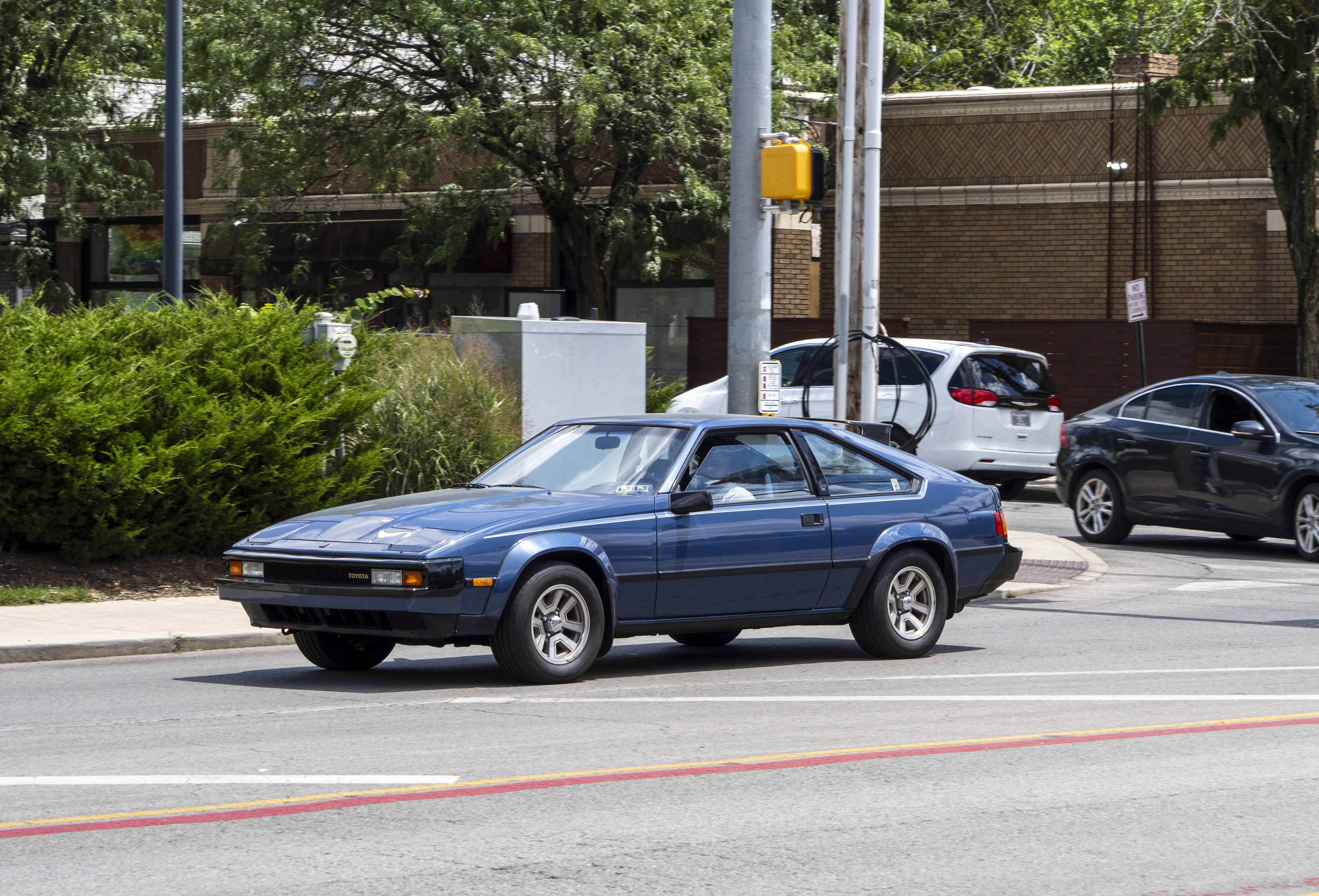
1983 Toyota Celica Supra


The car that eventually became known as just the Supra started out as a zhuzhed-up Celica with a snout stretched to accommodate an inline six. In Japan it was the Celica XX, but export models were sold as the Celica Supra.

For the 1982 model year a whole new generation of Celica Supra debuted, the A60. In the North American market these came in two flavors, the P-type and L-type, for Performance and Luxury. The fender flares, rear spoiler above the hatchback, and wide wheels indicate that this Dark Blue Metallic 1983 Celica Supra is a P-type.

For 1983, power would be provided by Toyota's 5M-GE 2.8 liter inline six. A DOHC motor with two valves per cylinder, for 1983 it was rated at 150 SAE net horsepower and 159 lb-ft of torque in U.S. trim.

While not threatening the Corvette on American streets, this generation of Supra was able to give the late Malaise Era Mustangs and Camaros a run for their money, at least in their lower-spec versions. Car and Driver got 0-60 times in the mid 8-second range and clocked a top speed of 115mph, which is pretty comparable to what my 1984 Pontiac Trans Am would do. Unsurprising since that Trans Am had the sluggish carbureted 150hp LG4 305 V-8 and weighed something like 300 pounds more than the Toyota.


The A60 was one of a number of Japanese performance cars in the early Eighties that announced that the era of cars from Japan being viewed as cut-rate econoboxes was well and truly over. Heck, my orthodontist at the time drove a black A60 Celica Supra.

These photos were taken in July of 2024 with an Olympus OM-D E-M1X and a Panasonic 12-60mm f/2.8-4 zoom lens.

1966 Chevrolet Impala Super Sport Convertible

This Madeira Maroon 1966 Chevrolet Impala Super Sport has the 325 horsepower Turbo-Jet 396 cubic inch big block V-8. The '66 models can ...