Showing posts with label 1967. Show all posts

Thursday, September 17, 2026

1967 Chevrolet Impala SS 427 Sport Coupe


For its third model year, the Fourth Generation Chevy Impala got refreshed styling, heavy on the "Coke bottle" shape. The Super Sport version, available as a hardtop Sport Coupe or a convertible, came with only one motor, the L36 427 cubic inch Turbo-Jet big block V-8.

With a four-barreled carburetor and the fames "porcupine" heads, the L36 had hydraulic lifters and a 10.25:1 compression ratio and was rated at 385 gross horsepower. It could be backed with three- or four-speed manuals or a Turbo Hydra-Matic, with the three-speed being a special heavy duty unit.

Car Life magazine tested a '67 Impala SS 427 Sport Coupe with the Turbo Hydra-Matic and the optional 3.07:1 rear end (The standard unit was a 3.31, and a 3.55 rear was also available.) The sprint to sixty was accomplished in 8.4 seconds, with the quarter taking 15.8 seconds at 87mph. Top speed was measured at 125.

Optioned like it was, the test car stickered at $4,903, which comes to $49,174 in current money.

The Marina Blue example in the photos was snapped using an iPhone 13 Pro Max in Dayton, Ohio back in July of 2026.

Sunday, April 19, 2026

1967 Jaguar XK-E


This car has an unusual combination of features. It has the old-style Series 1 bumpers & taillights, and no side marker lights. It also has no "wings" on the knock-off hubs and no headlight covers, but the headlights lack the prominent raised mounting of the later cars.


I'm no Jag expert, but I think that makes this 4.2L E-type a very late Series 1 car and not one of the interim cars dubbed the "Series 1½" that preceded the Series 2 cars in the '68 model year. It would have still had the triple SU carb setup and brought the full complement of 265 ponies to the rodeo.

Like a C2 Corvette, just seeing an E-type in the wild justifies having dragged the camera along with me all day.

This one was photographed using a Nikon D7100 and a 16-80mm f/2.8-4E zoom lens in June of 2022.

Tuesday, April 14, 2026

1967 Cadillac Eldorado


The Eldorado nameplate was used for prestige coupes and convertibles hovering around the top of Cadillac's lineup starting in 1953. While these shared their underpinnings with GM C-body Series 62 Caddies, the eighth generation of the Eldorado saw a real change.

For 1967 the completely redesigned Eldo (formally the "Cadillac Fleetwood Eldorado") was moved to a chassis shared with the Oldsmobile Toronado and Buick Riviera luxury coupes. Like the Toronado, but unlike the Riv, the Eldorado was now a front wheel drive car.

The powertrain was a unitized power pack mating the 429 cubic inch Cadillac 390 Series OHV V-8, with a 10.5:1 compression ratio and making 340 gross horsepower, to a Turbo Hydra-Matic 425 three-speed automatic transmission. This was essentially a mirror-imaged TH400 that was bolted below and alongside the engine, driven off a chain on the output side of the bell housing.


While the 429 Caddy was a beefy motor that muscled out 480 foot-pounds of torque, it had its work cut out for itself with a two-and-a-quarter ton coupe with a 120" wheelbase. Zero-to-sixty times were typically reported in the low nine second range, even with the 3.21:1 axle ratio. Top speed was something like 125-130. Power drums were standard for the braking system, although front discs were optional and became standard the following model year.

Base price was $6,277, which comes to something like $61,500 in today's money.

This example, in a color Cadillac called "Doeskin", was photographed in Springfield, Missouri in April of 2026 using an Olympus PEN E-P5 and an M. Zuiko Digital 12-45mm f/4 PRO zoom lens.

Friday, April 3, 2026

1967 Pontiac Grand Prix


The Grand Prix was introduced in 1962 as a sporty personal luxury coupe based on the two-door Catalina. Bucket seats and a console (with a console-mounted shift lever and tachometer) were standard equipment.

For 1965, the second generation of the Grand Prix featured more curvaceous sheet metal, and a mid-cycle refresh in 1967 saw the vertically-stacked quad headlamps switched to horizontally-paired ones and retreat behind retractable covers in the grille. (Notably, '67 was also the only year that the GP was offered as a drop-top.)

The standard motor in the '67 Grand Prix was Pontiac's small journal 400 cubic inch V-8 with a four-barrel Carter carburetor and a 10.5:1 compression ratio rated at 350 gross horsepower. Optionally, the buyer could spring for a large journal 428 V-8 rated at 360 horsepower or the "Quadra-Power" 428 H.O. making 375 ponies. Note that the "Quadra-Power" term was mostly marketing hype. Previous years of Pontiac could be had with "Tri-Power" engines sporting triple two-throat carb arrays, but the powers-that-be at GM banned multiple carburetor setups on everything but Corvettes for the 1967 model year.

If you wanted to burn cheaper regular gas, a lower compression two-barrel 400 was available as a credit delete option, but it only put out 265 horsepower.

A three-speed manual gearbox was standard, with a Turbo Hydra-Matic or a four-speed manual as options. The buyer could select from a variety of rear axle ratios.


Car Life tested a fairly well-optioned '67 Grand Prix hardtop coupe, similar to the Tyrol Blue one in the photos, with the base 350-horse 400, a Turbo Hydra-Matic slushbox, and a tall 2.73:1 final drive. With a curb weight of 4,160 pounds, the 6.6L motor had its work cut out for it.

Zero-to sixty sprints took 9.4 seconds and the quarter mile was crossed in 17.1 at 83.5mph. Top speed was measured at 110. Optioned as tested, the car stickered at $4,848, which comes to $47,433 in today's money.

The one in the photos was snapped in April of 2026 using an Olympus PEN E-P5 and an M. Zuiko Digital 14-45mm f/4 PRO zoom lens.

Sunday, March 22, 2026

1967 Oldsmobile Cutlass Supreme Convertible


The Cutlass Supreme line was introduced for 1966 as a more upscale version of the midsize Olds, above the budget-priced F-85 and the regular Cutlass. For 1967, the last year for the second generation of Cutlasses, a light styling refresh on the snout brought its aesthetics into line with the larger Delta 88.

Available as a hardtop Holiday Sedan or a pillared Town Sedan, a pillared Sport Coupe or a hardtop Holiday Coupe, or a convertible like this Provincial White example with Strato Bucket seats upholstered in Blue "Morrocceen" vinyl.

Unlike cheaper Cutlasses, the base motor in the Supreme was the 330 cubic inch Jetfire Rocket V-8 with a Quadrajet carburetor and a 10.25:1 compression ratio. Olds touted the "Ultra High Compression Ratio" as being a key part of the claimed 310 horsepower output. Base price on this beauty in 1967 would have been  $3,026 before you started going crazy with the option book. That's about $29,600 in current dollars.

This one was photographed using a Canon EOS R and an RF 24-105mm f/4-7.1 IS zoom lens in March of 2026.

Thursday, March 5, 2026

1967 Pontiac GTO


Although it still shared the body of the Tempest, 1967 marked the second year that Pontiac cataloged the GTO as an entirely separate model line. It was also the last model year for the first generation of the "Goat".

In addition to the minor cosmetic changes that differentiated each model year in Detroit back in those days, there were some important mechanical upgrades.

The most significant was that Pontiac's small journal V-8 was bored out another .06", bringing displacement to 400 cubic inches, which was the maximum displacement GM corporate management allowed in midsize cars. The base 400 V-8 in the '67 GTO had a four-barrel carb and a 10.75:1 compression ratio, making 335 gross horsepower on high-test. For people who didn't want to pay to put a tiger in their tank at every fill-up, there was an optional two-barrel 400 with an 8.6:1 compression, but it was only rated at 255 horsepower.

If you wanted to slather extra performance on your performance car, there was the Quadra-Power 400, with a hotter cam making 360 ponies, and finally the top of the line Ram Air 400, which turned the decorative hood scoop into a functional cold air intake and a slightly different cam. It, too, was rated at 360 horses, but power peaked at 5400 RPM, rather than the 5100 of the Quadra-Power.

The Quadra-Power name, incidentally, was a bit of sad misdirection. Whereas previous GTOs were known for their optional Tri-Power 389 motors, with three two-throat carbs, General Motors banned multiple carburetor setups on non-Corvettes for 1967, so "Quadra-Power" was just marketing hype.

There were two varieties of three-speed manual on the menu, both standard and heavy-duty, as well as wide- and close-ratio four-speed manuals. If you opted for the Turbo Hydra-Matic, the shifter had a dual-gate quadrant; slide the lever over into the right hand gate and ratchet the shifter through the gears manually, one at a time.

Other new options for 1967 were power-assisted front disc brakes (previous GTOs had drums on all four corners) and that nifty hood-mounted tach, which was installed at the dealership.

You could get your Goat as a ragtop, a pillared Sport Coupe or, like this Tyrol Blue car with Rally wheels, a hardtop coupe.

It was photographed with a Leica D-LUX 3 in April of 2017. 

Monday, August 11, 2025

1967 Ford Mustang


The 1967 model year brought the first redesign of the original pony car, Ford's wildly successful Mustang. It was a subtle update. Wheelbase remained the same at 108", but a couple inches were added in length and width. Notably, room was added under the hood to allow installation of Ford's FE big block motors.

Body styles on offer remained the same: a notchback or fastback coupe, and a convertible.

The base motor remained the 200 cubic inch Thriftpower OHV inline six, rated at 120 SAE gross horsepower. The 289 V-8 was on the menu in three flavors: a two-barrel Challenger making 200 horsepower, a four-barrel Challenger Special rated at 225 ponies, and the snarling "K-code" Cobra hi-po variant that swung 10.5:1 pistons and slurped high octane fuel to belt out 271 horses. Finally, the 390 cubic inch Thunderbird V-8 topped the options list with a rated 320 SAE gross horsepower.


This Lime Gold 1967 coupe would have had the two-barrel Challenger 289 small block. Motor Trend tested a '67 coupe with the four-barrel Challenger Special and recorded a zero-to-sixty time of 9.5 seconds and a quarter mile run of 17 seconds flat at 81mph through the traps, while noting a tested fuel economy of 15 miles per gallon.

This one was photographed in November of 2018 in Los Alamos, New Mexico using a Fujifilm X-E1 and a Zeiss Touit 32mm f/1.8 lens.

Saturday, April 12, 2025

1967 Chevrolet Camaro RS Convertible


1967 was the debut model year for the once and future arch rival of Ford's Mustang, the Camaro from Chevrolet.

We've actually seen a '67 Camaro convertible on these pages before, but it had the 155 horsepower 250 cubic inch Turbo-Thrift inline six.

Like that one, this droptop has the Rally Sport trim package, with its hidden headlights, special taillights, and other highlights, like chrome trim edging the wheel openings in the fenders. Unlike that one, this Ermine White example has the "V" fender badges indicating that under the hood is a 327 cubic inch Turbo-Fire V-8.

This could have taken one of two forms. The lesser one was a two-barrel motor with an 8.75:1 compression ratio and single exhaust outlet, making 210 horsepower. The sportier of the two had a 10.0:1 compression ratio, dual exhausts, and a four-barrel carburetor and was rated at 275 SAE gross horsepower.

This one was photographed in August of 2020 using a Nikon D7000 and a 16-80mm f/2.8-4E zoom lens.

Saturday, January 11, 2025

1967 Pontiac Tempest Convertible


The final year of the second-generation Pontiac Tempest continued with the stacked quad headlamps and coke-bottle lines of its 1965 and 1966 predecessors.

For '67, the base engine in the Tempest was Pontiac's 230 cubic inch overhead cam inline six. The OHC six cylinder was available in either standard 165 horsepower configuration with a 1-bbl carb, or in an H.O. form with a four-barrel carb and 10.5:1 compression ratio to give 215 SAE gross horsepower.

The fender badges on this one indicate that the buyer sprang for the 326 V-8, which also came in two flavors: A standard 2-barrel making 250 horsepower, or the 4-barrel H.O. that had a 10.5:1 compression ratio necessitating premium fuel and an output of 285 SAE gross horsepower. Transmission choices were a column-shifted three-speed manual, a four on the floor, or the 3-speed Turbo Hydra-Matic slushbox.

The Regimental Red '67 Tempest ragtop in the photo was snapped in August of 2018 using a Fujifilm X-E1 and a Zeiss Touit 32mm f/1.8 lens.

Friday, January 10, 2025

1967 Buick Electra 225


1967 was the third model year of the third generation Buick Electra, and it saw the car receive only a light styling update. The Electra's snout now sported a grille with a central dividing bar, echoing a theme more usually associated with Pontiac and Oldsmobile.

The big news for '67 was under the hood, where the previous year's increasingly archaic 425 cubic inch "Nailhead" V-8 (a nickname acquired due to the motor's valves having long stems relative to the size of the valve itself) replaced by an entirely new motor.

The new "Big Block" V-8 from Buick came in two sizes: a 400 cid version for the division's midsize Special and Skylark to comply with the corporate-imposed displacement limit on midsize cars, and a larger 430 cube version, with the same 3.9" stroke but a 0.15" larger bore, for the full-size Le Sabre, Wildcat, and Electra.

The 430 in the Arctic White '67 Electra 225 in the photo would have been rated at 360 SAE gross horsepower, with a 4-barrel Rochester carburetor, dual exhausts, and a 10.25:1 compression ratio demanding premium fuel. This was as much horsepower from the standard 430 as was produced by the exotic dual-quad variants of the old 425 Nailhead. The standard, and only, transmission was a column-shifted 3-speed Super Turbine automatic, which was Buick's house name for the GM corporate TH-400.


The one in the photos was captured in July of 2023 using an Olympus E-5 and a Panasonic Leica D Vario-Elmar 14-150mm F3.5-5.6 Asph Mega OIS superzoom lens.


Saturday, December 7, 2024

1967 Plymouth Barracuda Convertible


Ford's Mustang was one of the worst-kept secrets in Detroit as its April of 1964 launch date neared. The Falcon-based sporty coupe available in a wide range of performance and price levels threatened to upend the equilibrium of a car market where most Detroit companies only made two sizes of car.

In a crash program, Plymouth fitted a wraparound glass fastback and a 2+2 seating arrangement to their Valiant compact coupe and got the new Plymouth Barracuda into showrooms two weeks before the original pony car.

Both in terms of sales and performance, though, the Mustang trounced the original Barracuda, which had somewhat awkward styling and mechanically literally was a Valiant fastback coupe.

For 1967, a second generation Barracuda debuted, and while it still shared some mechanicals with the Dart/Valiant compacts, the sheet metal was all new and it was gorgeous. The coke bottle flanks and bobbed Kamm-esque tail were a one thousand percent improvement over the boxy, tail-heavy looks of the first ones.

The lack of side marker lights on the Bright Red ragtop in the photo mark it as a '67 model.


The base motor was that Mopar stalwart, the 225 cubic inch Slant Six. Optionally, buyers could spring for 2- or 4-barrel versions of Chrysler's 273 cid LA small block V-8, making either 180 or 235 SAE gross horsepower. Finally, if the shopper sprang for the Formula S package, they'd get cool badges, a suite of performance parts, and unlocked availability of the 383 cubic inch B-series Commando V-8. The engine bay had been widened enough to accommodate the big block, but there wasn't any room for a power steering pump, so not only did you get the quickest Barracuda, but also a tremendous upper body workout machine. The exhaust was more restrictive in the small car, too, so the 4-barrel Commando only made 280 horses, instead of the 325 it did in a Sport Fury.

When Car Life put a '67 hardtop coupe with the 145 horsepower Slant Six and three-speed TorqueFlite through its paces, they recorded a zero to sixty time of 13.6 seconds and a 19.4 second quarter mile at 70 miles per hour, and a 97mph top speed.

This one was photographed with a Nikon Coolpix S6500 in August of 2014.

Monday, December 2, 2024

1967 Chevrolet Corvette Sting Ray Convertible


Intended to have been replaced by the 3rd Generation Corvette, the Sting Ray stuck around for one last model year to allow the C3 to get debugged.

The lack of a hood bulge on this Sunfire Yellow ragtop indicates a small block V-8 lives under there, which in 1967 would be one of two flavors of 327. The base four-barrel motor had a 10.25:1 compression ratio and was rated at 300 SAE gross horsepower, while the L79 bumped the compression up to 11.0:1 and made 350 horses. Either one could be mated to a 3-speed automatic or 4-speed manual transmission.


You can tell it's a '67 by the four gills on the fender vents.

Road & Track tested a four-speed convertible Sting Ray with the base 300hp 327 and recorded a zero-to-sixty time of 7.6 seconds and a quarter mile run of 16.0 flat at 86mph. Base price was $4,228, which is as close to forty grand in current money as makes no nevermind.

This example was photographed in August of 2021 using a Nikon D2X and 24-120mm f/3.5-5.6 VR zoom lens.

Wednesday, September 25, 2024

1967 Oldsmobile Delta 88 Convertible


1967 was smack in the middle of the sixth generation of Oldsmobile's 88, and received a mid-cycle styling refresh like the rest of its General Motors B-body stablemates. They continued fiddling with various trim levels and names, with the Delmont 88 at the bottom, the Delta 88 in the middle, and the Delta 88 Custom at the top. The Dynamic 88 and Jetstar 88 nameplates went into the dustbin of history.

The convertible body style was only available for 1967 as a Delmont 88 or a Delta 88, with the faded (but otherwise remarkably straight) Spanish Red example declared to be the latter by the badges on the aft end of the rear fenders.


Under the hood would have been one of several flavors of Oldsmobile's 425 cubic inch Super Rocket V-8, ranging from a tame 2-barrel with a 9.0:1 compression ratio rated at 300 SAE gross horsepower to a snarling 365 horsepower 4-barrel that needed premium gas for its 10.5:1 squeeze.

This one was photographed in September of 2017 using a Leica D-Lux 3.

Friday, August 30, 2024

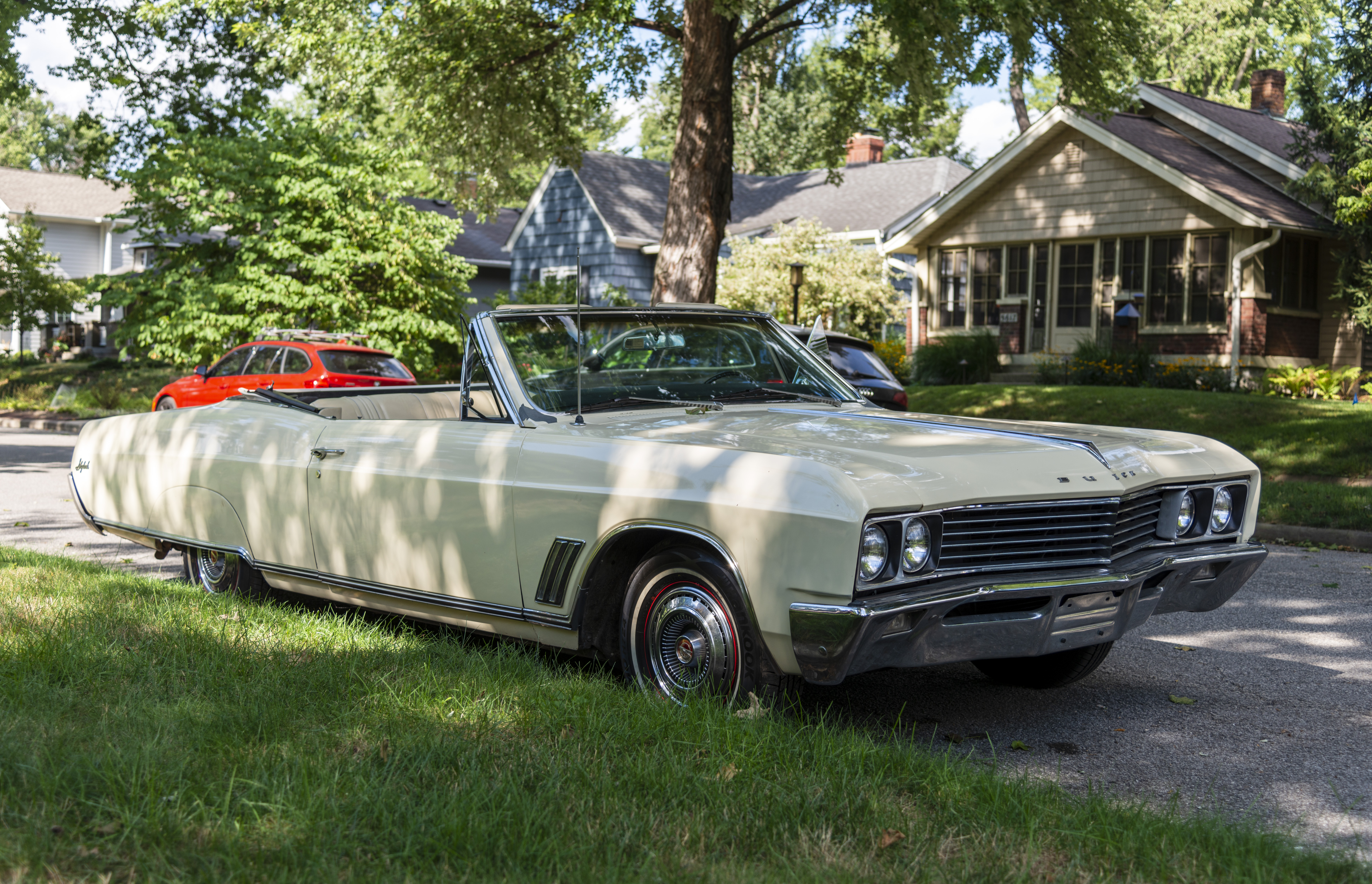
1967 Buick Skylark Convertible


Here's a 1967 Buick Skylark convertible out for a Sunday cruise on College Avenue.

The Skylark began life in 1961 as a trim level of the Buick Special compact before becoming its own nameplate the following model year. For 1964 both the Special and Skylark had their wheelbases stretched from 111" to 115", becoming true midsize cars.

The Special had three normal Buick portholes along the upper fender; portholes to let you know it was a Buick, and only three of them to let you know it wasn't as ritzy as a "real" Buick, like the Electra. The Skylark, on the other hand, got vertical chrome gills low on the fender to let you know it was a sporty Buick, like a Wildcat.

For '67, Buick offered two different whites: Arctic White, which was a very white shade of white, and the almost-pale-yellow Ivory you can see on this Skylark. On Pontiacs it was called Cameo Ivory.

The two-door sedan version of the '67 Skylark had the 225cid Buick V6 as a base motor, as a vestige of the classic inexpensive Businessman's Coupe, but this convertible would have come with a 210 horsepower 300 cubic inch two-barrel V-8 as standard equipment, with a couple four-barrel 300- and 340cid performance options above it.


Here's that 1967 Buick Skylark convertible in Ivory with a Dove interior parked on a side street about a month later. A peek at the dash shows us it has the 2-speed Super Turbine 300 automatic transmission.


If you wanted the Super Turbine transmission, you could also get an optional 340cid four-barrel "Power Pack" V-8, basically a stroked 300 that also bumped the compression ratio from 9.0:1 to 10.25:1, rated at 260bhp SAE gross.


Like the all-alloy Buick 215 V-8 to which they were related, the iron-block 300/340 Buick small blocks originally had aluminum heads, intake manifolds, and accessories, and were fairly light for Detroit V-8s at only a little over 400 pounds, although for '66 they switched to iron cylinder heads.


Back in 1967, Car Life magazine tested a Skylark four-door hardtop sedan with the 260-horsepower four-barrel 340 cube V-8 and the 2-speed Super Turbine auto and recorded a 0-60 time of 11.0 seconds and an 18.0 second quarter mile at 78 miles per hour.


The first five pictures were taken in August and September of 2022 using a Nikon D800 and 24-120mm f/4G VR zoom lens, while the bottom picture was snapped with an Olympus E-300 and Zuiko Digital 14-45mm f/3.5-5.6 zoom lens.

Monday, August 26, 2024

1967 Buick Wildcat


The Wildcat began life as a performance option package on the Buick Invicta hardtop coupe in '62, but became its own model line for the 1963 model year.

Bigger than the midsize Special/Skylark models, it was still slightly smaller than the big C-body Electras and the '63 Wildcat's junior status was signaled by having three chrome "Ventiports" in the front fenders rather than the four of the Electra. 

To proclaim its sporting intentions, the porthole-esque Ventiports got replaced in '64 with an arrangement of three vertically-stacked horizontal slots and when the model got upgraded with a whole new generation for 1965, the alternative chrome baubles continued, changing year-to-year so you could signal you had the newest model in classic Detroit fashion.


For 1967 they were a row of raked chrome gill slit thingies low on the fender and blending into the chrome rocker trim, reminiscent of the chromed exhaust of a Thirties classic. This combined with the prominent display of another piece of classic Buick styling, the "Sweepspear" line, recalling the "Airfoil" fenders of the elegant Harley Earl designs of the Forties.

For 1967, the Wildcat received an entirely new engine, too. Buick's previous big V-8, officially originally named Fireball and then Wildcat, was known colloquially as the "Nailhead" for the appearance of its small valves with their long stems. It was felt that future performance increases would be stymied by the small diameter of the valves and so a whole new big-block V-8 was designed.

In the '67 Wildcat it displaced 430 cubic inches and was rated at 360 SAE gross horsepower, with a 4-barrel carburetor, dual exhaust, and 10.25:1 compression, necessitating premium fuel. 

Car Life magazine tested a 1967 hardtop coupe, more or less identical to the Platinum Mist example in these photos, and recorded an 8.4 second 0-60 run and a quarter mile time of 15.8 at 84.5, which is pretty sprightly for a well-optioned luxobarge of a sports coupe riding on a 126" wheelbase and weighing every bit of two and a quarter tons. Base price was $3.603, but by the time they were finished with the option book, the as-tested sticker was $5,280.


The one in the photos was snapped in June of 2021 using a Nikon D3 and 24-85mm f/2.8-4D zoom lens.

Sunday, August 25, 2024

1967 Chevrolet Camaro RS Convertible


After allowing Ford a two and a half model year head start in the Pony Car Wars, Chevrolet finally provided the Mustang with its once and future arch rival in the form of the 1967 Camaro.

While its curvy coke bottle lines obviously came from the styling team responsible for the swoopy second generation rear-engined Corvair, the Camaro was a thoroughly conventional front-engined auto.

It featured a unit body aft of the firewall with a bolt-on subframe that carried the motor and front suspension (and which it shared with the Chevy II/Nova). This shared commonality with Chevy's compact, much like the Mustang's Falcon-derived genes, served to keep the costs down and the profit margins high for the new sporty coupe.


The Butternut Yellow convertible in the photos has the RS, for "Rally Sport", package. This was mostly a trim and accessory package, and got the buyer headlights hidden behind vacuum-operated doors, different taillights, and RS badges and extra chrome trim.

The fender badges say this one's got the 250 cubic inch inline six cylinder, which is a bump up from the base 230 cid six. The twenty extra cubic inches boosted power from 140 to 155 SAE gross bhp.

While the big-motored SS Camaros and GT Mustangs get all the ink, the bulk of pony car sales have always been what enthusiasts derisively term "secretarymobiles"; sporty-looking cars with thrifty drivetrains and reasonable MSRPs, bought by people who just want a cool looking car and aren't yet necessarily worried about hauling a family around. The '67 RS convertible here would have started at $2,914, with the bigger six only bumping the price a little.

Car Life tested a base coupe with the 250cid six and three-speed manual. It managed an 11.4 second 0-60 run and cleared the quarter in eighteen and a half seconds at 75mph. Top speed was recorded as 104 miles per hour.

The one in the photos was snapped with a Nikon Coolpix P7000 back in July of 2016.

Saturday, August 24, 2024

1967 Cadillac De Ville Convertible


Throughout the 1960s, the De Ville nameplate was your basic Cadillac model, glitzier than the Calais but not as expensive as the deluxe Fleetwood-bodied cars, the Sixty Special and Eldorado. 

This tasty old 1967 Cadillac DeVille convertible is in the color Caddy called Baroque Gold. I think that interior color is called "saddle"? There were literally hundreds of color, material, and configuration options for the interior.


Under the hood will be the only engine and transmission option available: Cadillac's 429 cubic inch V-8, rated at 340 SAE gross horsepower and 480 lb-ft of torque, backed by the 3-speed Turbo Hydra-Matic TH400.

1967 was the last year for the Cadillac 429cid V8. For 1968 it was replaced by the new 472 cubic inch engine rated at 375 SAE gross horsepower. Those were big motors, but this is a nearly nineteen foot long car that weighs almost every bit of two and a half tons with a driver and passenger aboard. (And the next generation would be even bigger. Downsizing didn't hit the DeVille until the '77 model year.)

Base price for the 1967 De Ville convertible was $5,608, or just shy of fifty-three grand in today's money. That was enough to get you two fairly well-optioned Mustang convertibles, so it was quite a flex.

This one was photographed in October of 2021 using a Nikon D800 and 24-120mm f/4 VR zoom lens.

Tuesday, August 6, 2024

1967 Plymouth Belvedere GTX

I'm convinced that if you loiter on the patio at Twenty Tap or Fat Dan's long enough, eventually one of everything will roll past.

From the outside tables at Fat Dan's, the little two-tops with umbrellas on the sidewalk outside the patio railing, you can get a good view north or south down College Avenue, depending which way you're facing. After a while, even when traffic is fairly heavy, you get attuned to the shapes that stand out, that line that's a little too square or has a bit much chrome for a recent car, or the fender line that's a little too low to the ground to be yet another commuter pod.

One August day in 2021, for instance, this caught my eye from most of a block away...


Is that a...?


Yes it is.


It's a 1967 Plymouth GTX, an upscale performance variant on the midsize Belvedere. The GTX, which debuted that year, came pretty loaded even in its most basic variant and the base motor was the 375bhp 440 Super Commando. For another five bills and change, you could upgrade to a 426 Hemi, which was a spendy option on a car that cost a little over three grand in its base 440 & three-speed Torqueflite form. Add a Hemi and a 4-speed and you were talking Corvette money, or almost two base Mustang coupes.

Car and Driver tested a '67 GTX with the 440 Super Commando, three-speed TorqueFlite automatic transmission, and a 3.23:1 rear end and managed a 0-60 time of six seconds flat and a 14.4 quarter at 98mph. The car would pull all the way to the 5,000 rpm redline in top gear, topping out at 118 miles per hour, and returned 11-15 miles per gallon during their testing.

It's no wonder that for 1968 the GTX was kept on as Plymouth's luxury muscle car, while a new stripped-down vinyl bench seat and rubber floormat performance-oriented Plymouth B-body model was sold with a 383 V8 as the base motor and a horn that went "BEEP BEEP" like a well-known cartoon character...

The photos were taken with a Nikon D200 & 35-105mm f/3.5-5.6D zoom lens.

Saturday, August 3, 2024

1967 Imperial Crown


You dont see many Imperials driving around anymore.  This one is a 1967 Imperial Crown hardtop sedan in Haze Green, from back in the day when Imperial was a brand unto itself at Mopar, competing head to head with Lincoln and Cadillac for the premium domestic car market. 

 The 1967 model year was one that marked an event horizon for the Imperial marque. Up to that point, it had been a body-on-frame design using its own platform, but the '67 models were unibody designs, sharing the same "C-body" platform as the full-sized Chryslers. You could get any motor you wanted as long as the motor you wanted was a 440 cubic inch Mopar RB-block with a 4-barrel carburetor, backed with the robust Torqueflite 727 three-speed automatic transmission.

That big Mopar wedge motor, rated at 350 SAE gross horsepower, had to deal with a bit over 5,200 pounds of luxobarge, though, so acceleration wasn’t eyeball-flattening. Car Life reported a 0-60 of 9.6 seconds and a 17.4 second quarter at 82.8 mph. Top speed was measured during the same test at 117 mph. The base price was $5,836, which works out to almost $55,000 in today’s money. Bearing in mind that cars overall were cheaper back then, you could buy two normal cars for the price of a single Imperial Crown. It was a big flex at the country club.

This one was photographed in May of 2023 using a Nikon Coolpix A large sensor compact.

Friday, August 2, 2024

1967 Pontiac Ventura


Pontiac launched the Ventura nameplate in 1960, during the "Bunkie" Knudsen years, when Pete Estes and his young assistant John Z. DeLorean were boosting sales by zhuzhing up the division's lineup. This was when Pontiac's rebranding as GM's "Excitement Division" really got underway.

The Ventura was based on the full-size Catalina. It was only available as a hardtop coupe or sedan and featured distinctive exterior trim, unique upholstery, and a sport steering wheel.

The one in the photos is a 1967 Ventura hardtop sedan in Marina Turquoise.

For 1967, Pontiac had upped the displacement of the V-8 offerings in their full-size cars, with the 389 getting bored out to 400 cubes and the 421 getting punched to 428 cubic inches... sorta. There's a story.

You know how the old 302 Windsor in the Ford Mustang is actually 4,942 cc's, but Ford calls it the "5.0", nominally because they already sold a 4.9L inline-six truck motor, but more likely because 5.0 looks cooler on fender badges?

Well, in 1967, Pontiac's large-journal V-8...

(Technically Pontiac didn't have "small block" and "big block" V-8s. All the Pontiac blocks were the same size, but they had smaller displacement motors with narrower main bearing journals and larger displacement ones with wider main bearing journals.)

...anyway, in '67 Pontiac took their 421 and gave it a roughly .030" overbore, yielding a 426.61 cubic inch displacement. But Ford and Chevy were already selling 427 V-8's, so thanks to the magic of the marketing department, the Poncho motor magically became a 428.


In '67 the Ventura could be had with the whole range of Catalina motors. There were two choices of 2-bbl 400: a lower-compression one for running on regular gas and rated at 265 SAE gross horsepower, and a higher compression 2bbl 400 rated at 290. Then you had a 4-bbl 400 that had 325hp with a HydraMatic 3-speed auto or 333hp when equipped with a 3- or 4-speed manual.

Finally you had the 4-barrel 428 in standard 360 horse or 375bhp "Quadra-Power" H.O. trim.

The one in the picture was photographed in May of 2023 with a Nikon D3 & a 24-120mm f/3.5-5.6 AF-D zoom lens.

2000 Acura Integra LS

The third generation of the Acura Integra, which had debuted for 1994, received a light refresh toward the end of its life cycle. Most notab...