Showing posts with label Toyota. Show all posts

Tuesday, March 17, 2026

1990 Toyota Starlet GT Turbo


Here's an interesting sight. It's a Toyota Starlet GT Turbo. The only model of Starlet sold here was the rear-wheel drive second generation car from '81-'84, when gas was expensive* and its 39 City/54 Highway MPG rating made it popular.

The one in the pics, as you may surmise from the location of the steering wheel, is a Japanese market Starlet. It's a fourth generation car, by which time the Starlet platform had become front-wheel drive. As a '90-'91 GT Turbo model, it has a 1.3L intercooled turbo inline 4-cylinder making 135hp, which must feel pretty spicy in a car weighing only 1,962 pounds.


This one was photographed in May of 2025 using a Sony a700 and a 16-50mm f/2.8 SSM zoom lens.


*In 1981 the average gas price in the US was $1.35/gal, which works out to $4.78/gal in current dollars.

Monday, March 9, 2026

1982 Toyota Celica Supra


We've had a second generation Toyota Celica Supra on these pages before, but it was an '83 model. The lack of mud flaps makes me think this (formerly) Gloss Black example is an original 1982 car, the first year of the A60 series.

There weren't a lot of differences. For '82 the 5M-GE 2.8 liter DOHC 12V inline six made 145 SAE net horsepower, which was five less than it did in 1983.

Car and Driver tested the 1982 Celica Supra and got a 9.8 second zero-to-sixty time and an elapsed time of 17.2 seconds in the quarter at 80mph through the traps.

This one was photographed back in October of 2015 in Los Alamos, New Mexico using a Nikon Coolpix P7000.

Tuesday, September 23, 2025

1986 Toyota MR2


The Toyota MR2, released in the US market by Toyota for the 1985 model year, was everything its only competitors were not. The Fiat X1/9 was still sold in the North American market as the Bertone X1/9, imported by Malcolm Bricklin, but it had the durability and reliability issues typical of low-production Italian sporty cars of the era. Pontiac's Fiero had been on the market for a year, but was heavy for its size and had an uninspiring suspension.

The MR2 boasted Toyota levels of build quality, weighed about the same as the X1/9 and boasted almost 66% more power, while being a hundred pounds lighter and much more nimble and better handling than the Fiero.

Powered by the zingy 1.6L DOHC 16V 4A-GE inline four also found in the Corolla FX, which made 112hp and which could be paired with a slick-shifting five-speed manual or, if your soul was dead, a four-speed auto, the MR2 was the kind of sports car that made automotive writers pull out thesauruses looking for extra synonyms for "fun".

When Car and Driver tested an '85 model (with the stick shift, natch), they saw a zero-to-sixty time of 8.3 seconds and a 16.3 second quarter at 82mph. Top speed was 116 and all-up curb weight was 2,380 pounds. For comparison, those are about the same numbers put up by a 140hp V-6 Fiero GT, which was almost 400 pounds heavier.

The Light Beige example in the picture was photographed with an Olympus OM-D E-M1X and a Panasonic Leica Vario-Elmarit 12-60mm f/2.8-4 ASPH zoom lens in June of 2025.

Friday, May 9, 2025

2002 Toyota Camry Solara SLE V6 Convertible


For the 1999 model year, Toyota differentiated the coupe version of the Camry with its own swoopier bodywork and the "Solara" submodel suffix. It was felt that the Camry nameplate and sobersided button-down styling was hindering sales of the coupe model, hence the change.

In 2000, a convertible version of the SE and SLE  was added, done by shipping mostly-finished coupes to the American Sunroof Corporation for roofectomies.

The model got a slight styling makeover for 2002, with a new snout featuring a different grille and quad bulb headlamp array. The Lunar Mist Metallic SLE V6 convertible in the above photo gives a good look at it, at least on the un-rumpled corner.

While base models had a 2.4L DOHC VVT-i 16V four cylinder making 157 horsepower, the SE and SLE had Toyota's 1MZ-FE V-6, a 3.0L 24V DOHC motor that made 200 horses...with the 5-speed, that is. Cars with the four speed automatic were rated at 198 SAE net horsepower, and the SLE only came with the automatic. Other things that came with the SLE package were all kinds of luxury amenities, a decklid spoiler, and 205/60R16 tires on six-spoke alloy rims.

MotorWeek tested a 2001 Solara SE ragtop with the V-6 and four-speed slushbox and recorded an 8.2 second zero to sixty time and a sixteen flat quarter at 87 mph. Price as tested was $30,388 in 2001 dollars, which is about $55k in constant bucks.

This one was photographed with an Olympus OM-D E-M5 and an M. Zuiko Digital 12-200mm f/3.5-6.3 zoom lens in May of 2025.

Monday, April 21, 2025

1974 Toyota Land Cruiser


The FJ40 version of the heavy duty Toyota Land Cruiser was produced, almost unchanged, from 1960 through 1984, which is incredible longevity for a single generation of vehicle. If you got driven home from the hospital as an infant in one during the Kennedy administration, you could have bought one that looked just like it when you graduated college while Reagan was president.

Oh, sure, the new one would have had front disc brakes, a factory roll bar, the vent windows would have been deleted, and the grille/headlight bezel would have been squarer, but it would have been essentially identical.


This one's been resto-modded heavily enough that it's hard to be certain of the exact model year, but the rear lift gate, rather than a pair of full-height barn doors, combined with the presence of MVSS '68 compliant side marker lights, makes me guess it's somewhere between '69 and '74. (That instrument panel, for instance, is completely aftermarket.)


For 1974, the FJ40 would have had Toyota's 3.9L F engine under the hood, a torquey undersquare lump of a pushrod inline six with a 7.8:1 compression ratio that allowed it to run on garbage gasoline from whatever shady seller you stumbled across while roaming around the outback. It made 138 SAE net horsepower and grunted out 215 lb/ft of torque at only 2200 RPM.

This Freeborn Red example was photographed in April of 2025 using an Olympus PEN E-P5 and an M. Zuiko Digital 12-45mm f/4 PRO zoom lens.

Monday, March 3, 2025

1986 Toyota Land Cruiser


The FJ60 generation of the Toyota Land Cruiser introduced for the '80s had a more civilized interior than its FJ50-series predecessors. Niceties such as a tilt steering wheel and intermittent wipers were standard and you could even get air conditioning.

It still had the rugged ladder frame with enclosed box-section frame rails and 4-wheel drive with a standard four-speed manual transmission and two-speed transfer case.

Power was provided by the carbureted 4.2L 2F overhead valve inline six. Output was a mere 125 SAE net horsepower at 3600 rpm, mostly because the compression ratio was only 7.8:1, the better to be able to run on whatever garbage gasoline was available when you were safariing way out past where Jesus left His sandals.

MotorWeek got an '89 model to sixty in 14.2 seconds and managed the quarter in just under twenty, but nobody buys these things to drag race.

This Blue one was photographed with a Canon EOS 7D and EF-S 17-85mm f/4-5.6 IS zoom lens in April of 2023.

Monday, January 20, 2025

2019 Toyota Camry XSE V6


Imagine the feeling of looking at an old black and white photo of some hunky-looking dude at the beach and thinking he's kind of a hottie before having the disturbing realization that "Oh my god, that's grandpa!"

So now you know how I felt when I crossed the street to photograph this badass-looking murdered-out sports sedan before the needle scratched across the record as I realized "Oh my god, that's a Toyota Camry!"

The Camry hit our shores in 1983 as Toyota's blandly sensible midsize family bus. Well, it was midsize by Japanese terms; its 102.4" wheelbase slotted it between the Chevy Cavalier and Citation, size-wise. 

The original Camry was available as a regular sedan or a five-door fastback, packed a 92 horsepower 2.0L SOHC inline four to push its 2,500 pounds down the road, and made its bones via a reputation for being a sensibly priced sedan that got decent fuel mileage (31 city / 43 highway, according to the EPA ratings) and boasted anvil-like reliability at a time when that wasn't any kind of a given for a new car from Detroit.

Camrys got bigger and plusher with each iteration... the second generation of Camry in the US, the V20, now made in Kentucky, added a 2.5L V-6 as an option ...but never had much rep for sportiness. They were the very definition of the Plain Brown Wrapper Sedan, reliable anonymity on wheels.

So when you fast forward all the way to the launch of the XV70 series of Camry for the 2018 model year, you can see why this gnarly Camry XSE V6 just didn't feel very Camry to me.

Its wheelbase is nine inches longer and it weighs a half ton more than that original Camry. Under the hood, the 92hp four cylinder has been supplanted by a DOHC 24V 3.5L V-6 belting out 301 SAE net horsepower.

Car and Driver tested the 2018 Camry XSE V6 and recorded a 5.8 second zero-to-sixty sprint and a 14.4 second quarter mile at 100mph through the traps. Top speed was governor-limited to 136 miles per hour. It's interesting to note that those numbers are next to thing to identical to those put up by the 1968 Chevelle SS396.

This Midnight Black Metallic one was photographed in February of 2021 using a Canon EOS-1Ds Mark II and an EF 28-70mm f/2.8L zoom lens.

Sunday, December 15, 2024

1988 Toyota Supra


Here's a Platinum Silver third generation (A70) Toyota Supra, which is maybe my favorite, appearance-wise. It also remains affordable relative to the increasingly-unobtainium 1990s-vintage A80 Supras. The snout and wheels make me think it's an '88 model.

Normally-aspirated ones were reasonably quick for their time, with a DOHC 3-liter straight six putting out 200bhp. When Autoweek tested one back in 1986, it managed a zero-to-sixty time of 7.8 seconds.

The A70s were just a little on the plush side, and just a little too lardy to be considered sports cars, as though they were constantly reminding you of the "+2" part of "2+2". Think of it as a Japanese Camaro RS, with the Turbo version being a Tokyo-edition IROC-Z. (In fact, that was the subtitle for Car and Driver's initial test of the car: "Japan Aims at Corvette, Hits Camaro.")

This one was photographed in June of 2020 using a Nikon D7000 and a 16-80mm f/2.8-4E zoom lens.

Monday, November 25, 2024

1985 Toyota Celica GT-S Convertible


Debuting for the 1982 model year, the third generation of the Celica, the A60, was the last to sport the traditional front-engine, rear-wheel-drive chassis layout.

All convertible Third Generation Celicas were done here in the U.S. by ASC of California; 200 in the '84 model year and a few thousand for the '85 model year, which was the end of the line for the angular A60 3rd Gen body style. They were imported from Japan as notchback coupes and handed over to ASC for the roof-ectomy.

The coupe bodies had been specially reinforced on the production line in Japan, and the conversion work wasn't cheap. Base MSRP was a $6500 price bump over the $11k sticker on the hardtop GT-S.

This was a bunch of dough for the time; you could check every option box you wanted on a Mustang GT or Camaro IROC-Z and have a hard time hitting the $17k mark, and you'd get V8 power to boot, rather than the Celica GT-S's 2.4L 22R-E EFI SOHC four cylinder.

The U.S. market was hungry for convertibles in the mid-'80s, having gone through a serious convertible drought for the last decade or so, largely due to stringent rollover standards. The American Sunroof Corporation handled factory convertible conversions on everything from Pontiacs to Porsches. They didn't have any problem selling them


That angular look is so very mid-80s Japanese sports coupe. Celica/Supra, Subaru XT, Mitsubishi Starion, Honda Prelude...they all had that crisply edged style about them. It's also notable that back then you could still market a car as having sporting pretensions with a 116bhp 2.4L four-banger under the hood and a zero-to-sixty time north of ten seconds.


With only 4500 ever built, it's kinda cool that I've spotted three in the neighborhood (these two, plus another red one.)

The Super Red car was photographed in July of 2022 using a Canon EOS-1D Mark III and EF 28-70mm f/2.8L zoom lens, while the Gloss Black one was snapped with a Nikon D7000 and 16-80mm f/2.8-4E VR lens in August of 2020.

Thursday, September 26, 2024

1996 Toyota Tercel DX


The Toyota Tercel, which was the first front-drive offering from the Japanese automaker, hit our shores as a 1980 model, called the "Corolla Tercel". It slid under the existing rear-wheel drive Corolla as Toyota's new basic transportation module and sold for a base MSRP of $4,198.

This allowed the Corolla to be moved slightly upmarket and the Tercel, soon freed of its "Corolla" prenomen, continued for four more generations and nearly twenty years as Toyota's workhorse cheap car.

The one in the picture is a Tercel DX from the middle of its final generation, dubbed the L50, which was sold here from the 1995 through 1999 model years.

The base model still started at only $10,348 in 1996, with the better-optioned DX going for a little more. The DX gave you cosmetic niceties like body-colored bumpers as well as the option of a five-speed manual (base cars still used a four-speed). Under the hood was Toyota's 1.5L DOHC 5E-FE inline four, rated at 93 SAE net horsepower. Performance was adequate, with 0-60 times in the low tens; enough to keep up with traffic, but not a street racer's delight.

Durability was downright Toyota-like, as the nearly thirty year old Medium Red example in the photo illustrates. It was photographed in September of 2024 using an Olympus OM-D E-M1X and an M. Zuiko Digital 12-200mm f/3.5-6.3 zoom lens.

Monday, September 2, 2024

1988 Toyota Camry DX Wagon


The second generation of the Toyota Camry, dubbed the V20 internally, launched in the North American market in autumn of '86 as a 1987 model. Available as either a sedan or a wagon, and in base, DX, and LE trim levels, the Japanese-built sedans were soon joined by ones built at Toyota's new U.S. manufacturing plant in Georgetown, Kentucky. All Camry wagons sold in the American market were imported from Japan, however.

This Dark Blue '88 DX wagon could have been equipped with either Toyota's 3S-FE 2.0L inline four, rated at 115 SAE net horsepower, or the 156hp 2VZ-FE 2.5L DOHC 24V V-6. While a five speed manual was theoretically available, manual wagons were already vanishingly rare by '88, so this one's likely sporting a 4-speed automatic, but one never knows. I'd do bad, wrong things for a longroof Camry with a stick.

Despite being dull as dishwater, these things were phenomenons of reliability, doing as much as any other model to help establish Toyota's reputation in the US for boring longevity. The fact that this 36-year-old car is still out there tooling around as a daily driver attests to that fact with a positively Camry-esque blend of blandness and eloquence.

This one was photographed with an Olympus OM-D E-M1X and Panasonic 12-60mm f/2.8-4 in August of 2024.

Friday, August 9, 2024

2002 Toyota Celica GT


Toyota's Celica nameplate dates all the way back to 1970, when it was introduced as a sporty rear-wheel-drive coupe that looked and drove like a 5/8ths scale Ford Mustang.

In the late Seventies it spawned a version with a slightly stretched wheelbase and a 2.6L SOHC inline-six, dubbed the Celica Supra.

For the '86 model year, the 4-cylinder Celica was moved to an all-new front-wheel-drive platform, leaving the 6-cylinder Supra to carry on as a separate model.

The seventh and final generation of the Celica appeared for the 2000 model year. By then, sporty coupe sales were already falling in the face of ballooning SUV and Crossover sales. A strong Yen and Toyota's corporate image as a purveyor of stodgy Camrys and Corollas didn't help Celica sales, either.

The car in the photo is a 2000-2004 Celica GT liftback coupe in the boringly named Black color. Apparently the Toyota of North America marketing department ran out of cool-sounding adjectives after Super White, Absolutely Red, and Carbon...Blue? Why is Blue "Carbon" and not Black? Anyway...

The base GT was powered by the 1.8L 1ZZ-FE four-banger, putting out 140 SAE net horsepower. If you ordered the GT-S package, you got the 180bhp 2ZZ-GE that had variable valve timing and lift. This was the same motor Lotus used in their Elise. That's almost as much power as the 2.8L M52B28 six in my Z3, despite being a whole liter smaller.

Alas, this didn't generate enough excitement to save the nameplate.

After years of slumping sales, Toyota pulled the plug on the Celica after the 2006 model year.

This one was photographed in November of 2023 using a Nikon 1 V2 and the sweet little 1 Nikkor 18.5mm f/1.8 prime lens, which is the Nikon 1 equivalent of a "Nifty Fifty".

Tuesday, July 30, 2024

Cargo Cult Car Stop Cult

I don't know exactly when the red caliper thing started. Italian brake manufacturer Brembo was an OEM supplier to a lot of companies dating way back before brightly colored calipers were a thing.

Late Eighties and early Nineties supercars may have had Brembo brakes, but the calipers were fairly normal colors: black, gray, metallic, whatever. Some were finished in a gold color. It was hard to tell, though, because wheels were 17" and smaller and also tended to have a more "aero" appearance; a flat disc with fewer, smaller holes.

While I don't know who Patient Zero in the Red Plague was, I do know that by the close of the Millennium, as larger wheels with spindlier spokes left more of the braking system in view, racy cars started getting brightly-colored calipers, most often in red.

This, of course, led to goobers spray-painting calipers with high-temperature engine paint, a "performance enhancement" along the lines of a fat exhaust tip and a J.C. Whitney decklid wing.

Possibly my favorite example of this was the dude I saw in the Meijer parking lot who had rattlecanned the rear drums on his early '90s Toyota Corolla red.


I hadn't given it a lot of thought, assuming the fad would kind of reach peak silly with spray paint, but I was wrong.

The other day I spotted what I initially thought was a pretty trick Volkswagen Golf GTI in the parking lot at the Preston Safeway.


As I was processing the RAW files in P-shop, I first noticed that it wasn't a GTI. The calipers looked unusual, too. I zoomed in to read the lettering on them...

"MGP? I've never heard of a brake manufacturer with that name..."

Which was because MGP doesn't make brakes; they make anodized aluminum bolt-on caliper covers. They sell them on Amazon and they ain't cheap.

I guess they must add more horsepower than a spray can of engine paint. They'd sure better, for that price, at least.

Thursday, July 25, 2024

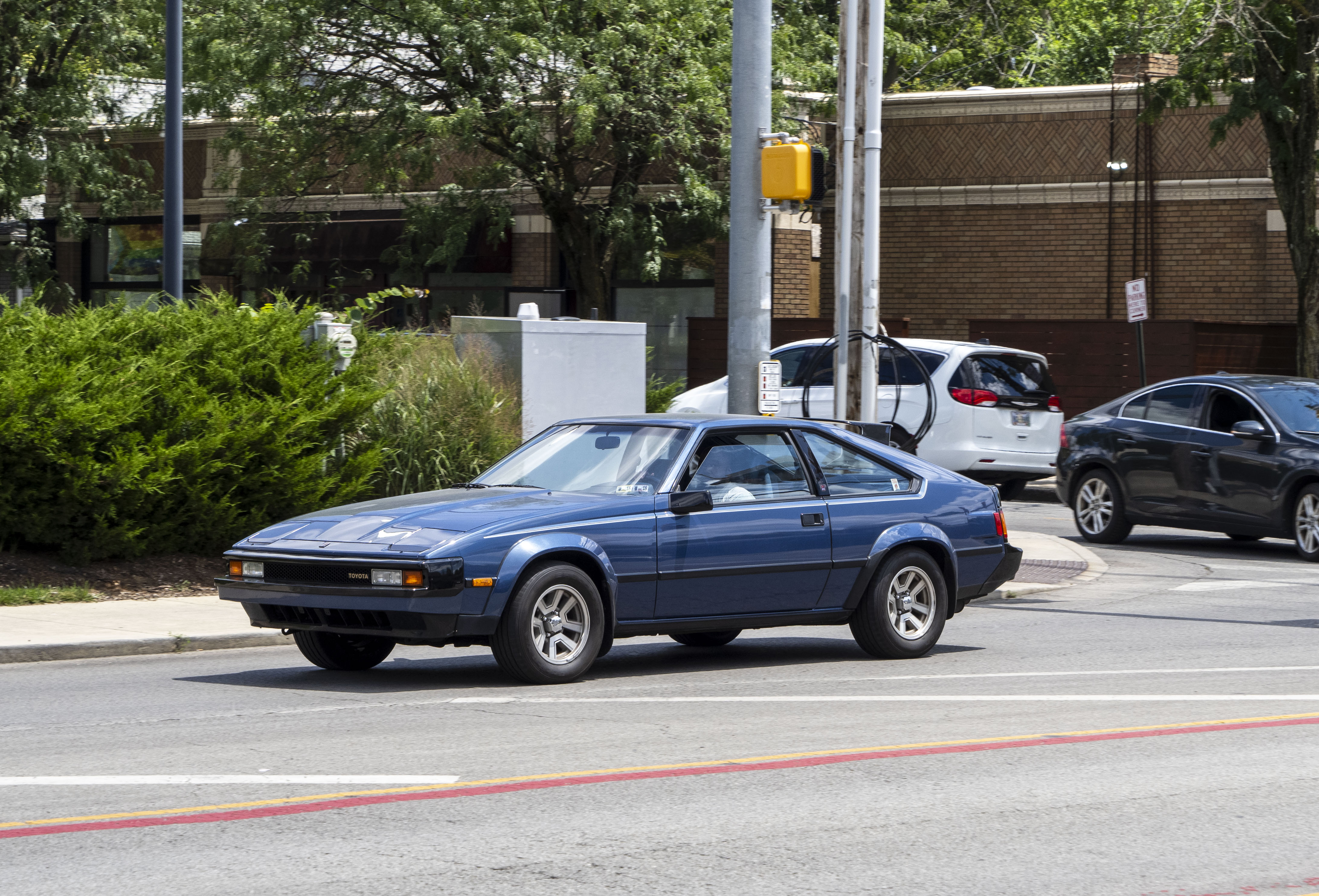
1983 Toyota Celica Supra


The car that eventually became known as just the Supra started out as a zhuzhed-up Celica with a snout stretched to accommodate an inline six. In Japan it was the Celica XX, but export models were sold as the Celica Supra.

For the 1982 model year a whole new generation of Celica Supra debuted, the A60. In the North American market these came in two flavors, the P-type and L-type, for Performance and Luxury. The fender flares, rear spoiler above the hatchback, and wide wheels indicate that this Dark Blue Metallic 1983 Celica Supra is a P-type.

For 1983, power would be provided by Toyota's 5M-GE 2.8 liter inline six. A DOHC motor with two valves per cylinder, for 1983 it was rated at 150 SAE net horsepower and 159 lb-ft of torque in U.S. trim.

While not threatening the Corvette on American streets, this generation of Supra was able to give the late Malaise Era Mustangs and Camaros a run for their money, at least in their lower-spec versions. Car and Driver got 0-60 times in the mid 8-second range and clocked a top speed of 115mph, which is pretty comparable to what my 1984 Pontiac Trans Am would do. Unsurprising since that Trans Am had the sluggish carbureted 150hp LG4 305 V-8 and weighed something like 300 pounds more than the Toyota.


The A60 was one of a number of Japanese performance cars in the early Eighties that announced that the era of cars from Japan being viewed as cut-rate econoboxes was well and truly over. Heck, my orthodontist at the time drove a black A60 Celica Supra.

These photos were taken in July of 2024 with an Olympus OM-D E-M1X and a Panasonic 12-60mm f/2.8-4 zoom lens.

1976 Chevrolet Caprice Classic

We've had a '76 Caprice Classic, the last of the big Chevy land yachts before downsizing, on these pages before. That one was on ch...