Showing posts with label 1987. Show all posts

Tuesday, November 25, 2025

1987 Porsche 911 Carrera Cabriolet


Introduced as an entirely new model for 1964, it didn't take long for the 911 to become the Porsche. The Carrera 3.2 version, introduced twenty years later, was a directly-evolved successor to that original car.

Displacement of the rear-mounted SOHC air-cooled flat six was bumped to... as one might surmise from the name ...3164cc. Fitted with Bosch LE-Jetronic injection, the output of the swole motor rose to 200 SAE net horsepower in North American trim.

This was enough to propel a 911 Cabrio to sixty in 5.7 seconds when Road & Track tested one in their January 1986 issue. It managed to zip through the quarter mile in 14.3 seconds at 97mph and circled a skidpad at 0.80g. Price as tested was $41,301, which comes to about $122,400 when adjusted for inflation.


The 1987 Cabriolet in the uncommon Summer Yellow color was photographed in September of 2025 using a Canon EOS R and an RF 24-105mm f/4-7.1 IS zoom lens.
 

Friday, November 21, 2025

1987 BMW M6


Introduced in '83 and known in its home market as the M635CSi, for 1987 BMW of North America imported the Motorsport-tuned performance version of the E24 6-series coupe as the M6, keeping the name in line with the M3 and M5 already being sold in US showrooms.

This Henna Red example in my neighborhood is just crazy hot. Quite the rara avis, too, as only about 1,677 were imported to the North American market out of a global production run of 5.855.


It used a DOHC version of BMW's 3.5L inline six that put out a claimed 256bhp in US trim at the time, which isn't a lot by modern standards but back then the tuned-port 350 in a 'Vette was only rated at something like 245. The 150+ mph M6 was legitimately big iron in its time, the second fastest production car from BMW up to that point, second only to the M1.

In Car and Driver's testing, it laid down a 14.7 second quarter at 94mph and sprinted to sixty in 6.1 seconds. Slower than the Euro version, due to fewer ponies and big, clunky bumpers, top speed was measured at 144mph. Price as tested was $58,720 in 1987 dollars, which comes to $168k in current money.


The lower two photos were taken with a Nikon D7100 and a 16-80mm f/2.8-4E VR zoom lens in June of 2022, while the upper was snapped in May of 2025 using the same camera and lens.

Saturday, March 8, 2025

1987 Mercedes-Benz 300SEL


The mid-cycle refresh of the W126 Mercedes-Benz S-class sedans saw the 280SE/SEL replaced with a new 300SE/SEL.

These featured the new M103 normally-aspirated fuel-injected SOHC 12V inline six, displacing 3.0L. The engine had debuted in the W124 300E midsize and was rated at 178 SAE net horsepower, which was reasonably potent for the era, although it had its work cut out for it hauling nearly two tons of Benz long wheelbase sedan.


The one in the pictures was photographed in July of 2021 using a Canon EOS Rebel T3 and an EF 28-80mm f/3.5-5.6 zoom lens.

Saturday, March 1, 2025

1987 Cadillac Brougham D'Elegance


When Cadillac moved the Fleetwood name to a front-wheel drive platform in 1985, they continued producing the old rear-wheel drive body-on-frame car as the Fleetwood Brougham. After a couple of confusing model years at Caddy dealerships where unrelated Fleetwoods and Fleetwood Broughams were sold side-by-side, they ended the confusion by dropping the Fleetwood part of the name from the older car.

The 1987 Brougham in the picture, finished in Chestnut with a Buckskin vinyl roof, has the ultra-luxe D'Elegance package, with such niceties as rear seat reading lamps.

Standard equipment under the hood would be a Oldsmobile-sourced 5.0L V-8 with a four-barrel Quadrajet carburetor. This 307 cubic inch engine sent 140 SAE net horsepower to the rear wheels via a 4-speed automatic transmission.

Like the other big RWD full-size cars from GM, these things soldiered in the catalog long after they were intended to be axed because sales stayed strong and the tooling was long amortized, so they were pure profit centers as long as they remained popular. A friend's mom in high school bought one after getting rear ended while riding with a friend. After that experience she no longer wanted to drive her Fiat Spider 2000 and went shopping for the biggest slab of sheet metal she could find.

This one was photographed with a Canon EOS 40D and an EF-S 18-135mm f/3.5-5.6 IS zoom lens in April of 2023.

Tuesday, December 3, 2024

1987 Ford Country Squire


The 1979-1991 Ford Country Squires were the end of the road for the full-size Ford station wagon with the classic woodgrain trim look.

By then, the "full size" Ford wagon had been moved to the new Panther platform, which meant it was on a wheelbase about the same size as that of a mid-Sixties Fairlane wagon and shorter than an early-Seventies Gran Torino's, both of which had been midsize cars for their eras.

The front end on this Midnight Canyon Red Metallic example marks it as a '79-'87 model, before the '88 styling refresh gave it a slightly more aero nose. Nosing around the internet and looking at year-to-year grille changes has me tentatively identifying it as a 1987 model, which would mean it has the 5.0L multi-port EFI V-8 rated at 150bhp (160 with the towing package).

This one was photographed with a Nikon D2X and 18-200mm f/3.5-5.6 VR II zoom lens in October of 2023.

Thursday, September 12, 2024

1987 Porsche 911 Carrera 3.2


If you're a GenX'er, like me, this is what a Porsche 911 looks like. Hell, this is what a Porsche looks like. The original gangsta 911's production ran continuously from its introduction in 1964 all the way through the 1988 model year. Cosmetically it remained virtually unchanged from 1974, when its bumpers were upgraded to conform to new U.S. standards, until it was replaced with the 964 series for the '89 model year.

That means that the 911 looked pretty much exactly like this from the time I was old enough to understand that car brands were a thing until I was almost old enough to drink.

The side view mirrors tell us that it's at least as recent as the late Seventies. The lack of a whale tail was making me think it's an SC. The 911SC was in production from the '78 through '83 model years and sold well enough that it may well have saved the 911, which Porsche had intended to phase out and replace with the 928. A reader pointed out that a couple of small details... the fog lights being integrated in the valance panel under the front bumper and the size of the semicircular torsion bar cover just in front of the rear wheel well ...mark it as an '87-'88 911 Carrera 3.2.

The Carrera 3.2 debuted in '84 as a replacement for the 911SC. For its time, the 3.2L air-cooled SOHC flat six made the 911 Carrera a beast. It was putting out 200 SAE net horsepower in a time when that was the same horsepower total as the Cross-Fire Injection 5.7L V-8 in a Corvette 

Car & Driver's testing of a 1984 911 Carrera returned a zero-to-sixty time of 5.3 seconds, with the quarter dispatched in 13.9 seconds at 100 mph on the way to a top speed of 149. This vintage of 911 had enough juice to really test a driver's skills. It was an easy to generate big speed with, but it was also an easy car to put into a ditch ass-end-first.

The sun was low in the sky on that November afternoon in 2021 and I had an original 2003-vintage Canon EOS Rebel with the 18-55mm kit lens and no lens hood, preparing to do a report on it for the other blog. On the same side of the street, the Cassis Red Metallic 911 Carrera was harshly backlit from any angle where it wasn't obscured by that tree or the trashcan, plus the sun was causing horrible veiling glare. Trotting across the street yielded the above photo, taken by waiting for a gap in traffic. Even then, the 18-55mm lens doesn't have a lot of reach and the 6MP sensor doesn't give you much room to crop.

Saturday, September 7, 2024

1987 Mercedes-Benz 420SEL


It feels like the largest Mercedes-Benz sedans have been known as the S-class for my entire life, but not exactly. It wasn't until the W116 full-size Benzes debuted in September of 1972 as a '73 model that the S-class moniker became official. The W116 line soldiered on through the entirety of the Seventies until their W126 replacement was launched for the 1980 model year.

When it was launched in the U.S. as a 1981 model, the W126 S-class sedans were only available with the 3.8L SOHC V-8, producing 215 SAE net horsepower or the 119 horsepower 3.0L inline-five diesel. Grey market imports pressured Benz into filling out the model lineup when the W126 got its mid-cycle refresh for the '87 model year.

The car in the photo is a 420SEL sedan... we'll call it an '87 ...and that means it's an S-class, fuel-injected ("Einspritzung", for "fuel injected"), long-wheelbase car.

The 4.2L SOHC V-8 with its Bosch EFI produced 201 SAE net horsepower in 1987, which was pretty sporty by the standards of the time. Road & Track put an '87 420SEL through its paces and the 4.2L V-8 managed to shove the 3900-pound sedan to sixty in 8.7 seconds and through the quarter in 16.7 at 86 mph.

This was a pretty deluxe ride for the day. The as-tested price of R&T's 1987 420SEL was $57,500, the equivalent of just short of $160,000 in 2024 monetary terms.

This one was photographed in August of 2024 with an Olympus OM-D E-M1X and Panasonic 12-60mm f/2.8-4 zoom lens.

Sunday, September 1, 2024

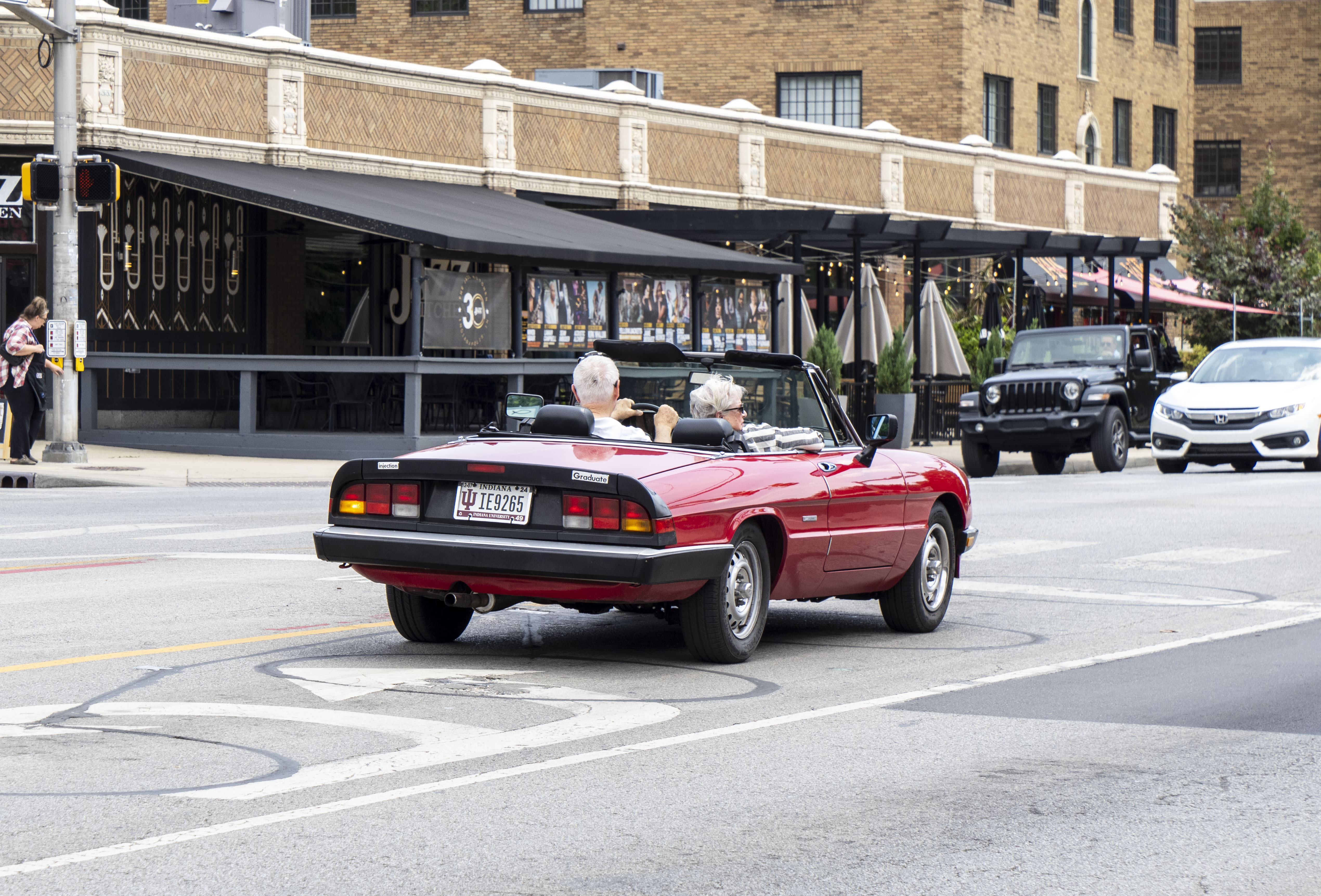
1987 Alfa Romeo Spider Graduate


The Alfa Romeo Spider, which had been in production since 1966, saw its third generation debut in the North American market for the '82 model year. New under the hood was electronic-controlled fuel injection by Bosch, which replaced the previous SPICA mechanical system.

Prices on the Spider had been creeping upward such that, by the mid-'80s a Veloce was over sixteen grand and the deluxe Quadrifoglio Verde model was nudging twenty long, which was getting close to Corvette territory.

To boost sales, Alfa introduced a stripped down model with a more spartan interior, vinyl top, steel wheels, and a limited option list... you could opt for air conditioning and a dealer-installed stereo ...and dubbed it the Graduate. With the Boomer generation hitting its peak earning years, this was to remind them of Dustin Hoffman's ride in the eponymous film.


With a base MSRP in 1986 of $13,995, now you were talking about Camaro money, not Corvette money, which was a much more enticing sticker for what would be a second or third car for most buyers. That's a hair over forty grand in today's money.

The powertrain was unchanged from the regular Spider's. It still had that spicy normally aspirated sixteen-valve twincam 2.0L fuelie four, rated at 115 SAE net horsepower in EPA-compliant trim, backed by a five-speed gearbox.


The one driving down College Avenue was photographed in August of 2024 using an Olympus OM-D E-M1X and a Panasonic 12-60mm f/2.8-4 zoom lens, while the one sitting in the parking lot at Half Liter BBQ was snapped using a Fujifilm X-T2 and XF 16-80mm f/4 R WR OIS zoom lens in August of 2023. Someone's added the alloy wheels from the more upmarket trim levels to it.


Tuesday, August 27, 2024

1987 Pontiac Firebird Formula


Here's a 1987-1990 Pontiac Firebird Formula. If that's the factory paint, I think that's an '87, because that's the only year that solid (non 2-tone) Bright Blue Metallic was available as an option on the Formulas.

The third generation of the F-body, before its mid-cycle refresh for the 1991 model year, is a sort of historical record of the American performance car renaissance.

When the third gen Firebirds debuted for the 1982 model year, the base Firebird came with a 151cid throttle-body injected 90bhp Iron Duke four cylinder and a 4-speed manual and the baddest Trans Am had an LU5 305 cubic inch V8 with "Crossfire fuel injection" rated at 165 SAE net horsepower.

For 1990, the last model year before they uglified the nose cone, the cheapest loss-leader Firebirds had a 140bhp 3.1L V6 with a 5-speed gearbox and the Trans Am could be had with a 245bhp L98 Tuned Port Injection 350 under the hood.

In 1987 the Formula package was freshly back after a six year hiatus, and the base motor in this car would have been the 170 horsepower LG4 305 V-8 with a Rochester 4-barrel carburetor, backed by either a 5-speed manual or 4-speed automatic transmission. Optionally, the buyer could opt for the LB9 Tuned Port Injection 305, which gave 190hp with the automatic or 205 bhp with the manual. Finally, the Formula could also be had with the L98 350 TPI V-8, which made 225 horsepower in the Firebird, down slightly from the Corvette due to different, iron cylinder heads and a more restrictive intake. 

The 5.7L 'Vette-derived motor could only be had with an automatic transmission because the Borg Warner T5 World Class five-speed used in the third-generation F-bodies (like their arch rival Fox Body Mustangs) wasn't rated to handle the torque from the bigger motor.

The giant screaming chicken hood decal was gone as a factory item for '87, so the one in the photo is likely a dealer-installed option. Normally it would have a plain hood save for either "5.0 Liter" or "5.0 Liter F.I." decals on either side of the power bulge. The 5.7L cars had big "FORMULA 350" decals along the lower door panels. WS6 performance suspension and 16" wheels came standard on the Formula, too.

Car and Driver tested the '87 Formula with the Tuned Port 305 and a 5-speed and turned in a 6.8 zero-to-sixty time and a 15.1 second quarter; respectable for the era and still plenty quick enough to keep up with traffic.

The one in the photos was snapped with a Canon EOS-1D Mark III and EF 24-105mm f/4L IS zoom lens in April of 2024.

Monday, August 26, 2024

1987 Ford Escort GL Wagon


The Escort was the budget front-wheel drive subcompact that Ford used to replace the aging rear-wheel drive Pinto in the 1981 model year, just in time for the second Fuel Crisis.

There was much hype about the new Escort being a "world car" designed jointly between Ford of North America and Ford of Europe. Indeed, the "Escort" nameplate had been in use on little European Fords since the Sixties. There were even little badges on the car with the Escort name on a stylized globe for a background.

In actuality, all they shared was the name, the little cam-in-head 8-valve four cylinder motor, and the same automatic transmission on cars so equipped. (The cam-in-head design is still, technically an OHV engine, but the cam is in the head, operating the rocker arms via hydraulic lash adjusters, sans pushrods.)

These were the cars that Ford sent out to do battle with the Civics, Corollas, and Sentras that were devouring the North American marketplace

The one in the pictures is an '87 model, after the first major upgrade. The hemi-head 1.6L engine had been bored and stroked to 1.9L, becoming notably undersquare in the process. With throttle body fuel injection it put out 90 SAE net horsepower. In coupe or hatchback form, and with a manual transmission, this was enough motor to nudge the Escort under the 10-second barrier in the 0-60 sprint. In a wagon with an automatic? LOL. LMAO, even.

This Oxford White 1987 Escort GL wagon has somehow managed to avoid oxidizing away to nothing over the last thirty-seven years, despite obviously not leading a pampered existence. However either they're smuggling a crate of lead bars or the rear suspension has packed it in.


It was photographed using a Nikon D3 and 24-120mm f/4 VR zoom lens in April of 2023.
 

Tuesday, August 13, 2024

1987 Chevrolet Monte Carlo SS Aerocoupe


Back in the Eighties, with the original midsize coupes that used to contest NASCAR long gone, the stock car racing chores fell to the "personal luxury coupes" from the Detroit manufacturers. When Ford released their new, very aerodynamic ninth generation Thunderbird for the '83 model year, that left its G-body competitors from General Motors...the Buick Regal, Olds Cutlass, Pontiac Grand Prix, and Chevy Monte Carlo...at a disadvantage on the high banked ovals.

Chevrolet was pretty quick in getting a more aerodynamic snout on the Monte Carlo SS that same year, but the formal roofline, with its nearly vertical rear window, was still something of a built-in drag chute for the Chevy.

As so often happens when a Detroit manufacturer encounters a NASCAR challenge, Chevrolet turned to a homologation special: The Monte Carlo SS Aerocoupe, with a compound rear window shape to reduce drag.


While the cars themselves were built by Chevrolet, they went to Cars & Concepts for the conversion work, which consisted of the compound curved rear window and a shorter decklid, which required the addition of gas struts to support it when open. The trunk opening on these things was like a mailbox slot.

All 200 built for the 1986 model year were in White, so that means the Silver one in the photos is one of 6,052 produced for 1987, the only other year for Aerocoupe production. (You could get them in Black or Maroon in '87, as well.)

Under the hood would be the L69 305 H.O. small block V-8, with a Rochester 4-barrel carb and a 9.5:1 compression ratio, rated at 180 horsepower. The only transmission was a 4-speed TH200-4R automatic, with a 3.73:1 rear end standard. The underpinnings were vintage Detroit midsize, with a live axle and drum brakes in the back; there not being much point in upgrading as by '87 the platform had less than a year to live.

The Aerocoupe option package, RPO Z16, added just less than fourteen hundred bucks to the base $13,463 MSRP for a Monte Carlo SS.

The one in the photos was snapped in a grocery store parking lot just before midnight back in December of 2015, using a Nikon Coolpix P7000.

1966 Chevrolet Impala Super Sport Convertible

This Madeira Maroon 1966 Chevrolet Impala Super Sport has the 325 horsepower Turbo-Jet 396 cubic inch big block V-8. The '66 models can ...