Sunday, October 27, 2024

1924 Ford Model T Doctor's Coupe


Some car body styles from the earlier days of American motoring have such interesting origin stories. One example is the "business coupe", a two-door coupe with very spartan features and an empty space where the back seat would normally be, which gave the traveling salesman an inexpensive auto with storage space for sample trunks and merchandise in the back, out of the weather, without the bulk or expense of a station wagon body.

Another example is this 1924 Model T doctor's coupe. The two-seat runabout was one of the cheapest Model T variants, but a little light on weather protection, even with the folding top erected. The doctor's coupe was an enclosed two seater with space for the driver and passenger. A doctor in the more sparsely populated America of the day could toss his bag in the his Model T and motor in enclosed-cabin comfort from the county seat to rural farms or smaller hamlets to make house calls. It was essentially an updated version of the horse drawn "doctor's buggy" or "physician's phaeton".

To really understand what was needed here requires going back to the early 20th Century, before the Depopulation of the Great Plains. If you’ve spent time in one of those county seat towns, you know that their old cores are nearly as dense and compact as any east coast city of the period. The courthouse square is surrounded by a block or two’s worth of two- and three-story buildings, generally commercial fronts with residences above them. The town physician may have had a walk up over his (and he was a “he”) downtown office, or he might have had a house not far off the courthouse square, at Second & Main or Third & Church, but for normal functions in town, no car was required. The Doctor and the Missus could walk wherever they needed to go socially, and the hired help could walk to market or the druggist’s. An automobile was only needed for the physician’s official work and it needed no more capacity than the doctor, his bag, and (maybe) a passenger.

This example was photographed with a Nikon D800 and 24-120mm f/4 VR zoom lens in May of 2024.

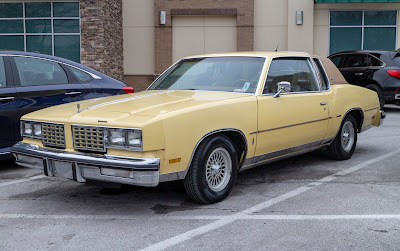
1980 Oldsmobile Cutlass Calais


For 1980, the "Calais" name badge signified the tip-top tier of the personal luxury coupe G-body Cutlasses, even higher up the luxo ladder than the Supreme and Supreme Brougham.

$7,199 was the base MSRP, about $27,500 in constant dollars, and it got you a two-door notchback coupe with a Buick-sourced 3.8L pushrod V-6 with a 2-barrel carburetor and 110 SAE net horsepower, backed by a three-speed automatic. Performance was typical Malaise-era, with zero-to-sixty times in the high thirteen second range.

Buyers could opt for a 105hp Olds 260 cubic inch V-8, or a 305 Chevy 4-barrel small-block putting out 155 ponies. (Or an Olds 350 diesel V-8, if they liked long chats with the mechanics at their dealership.)

This Yellow '80 Cutlass Calais with a Light Camel vinyl landau top was photographed in March of 2019 using a Canon EOS M mirrorless camera and an EF-M 18-55mm f/3.5-5.6 IS zoom lens.

Saturday, October 26, 2024

2020 Bentley Continental GTC V8


If you're a Boomer or a GenX'er, it's hard to believe that Bentleys have been running around on Volkswagen-designed chassis for two decades now, but here we are. The 2025 Continental marks the fourth generation of Bentley's racy coupe to ride on VW-group underpinnings.

The one in the picture (I believe that color is "Dragon Red") is a third generation Continental GTC V8, the generation that spanned the 2019-2024 model years.

The Continental GTC could be had with either the V-8 or W-12 motors, both of which packed a brace of intercooled turbos. The 4.0L DOHC 32V V-8, shared with numerous Audi, Porsche, and Lamborghini vehicles, was rated at 542 SAE net horsepower as installed in the Bentley coupes. Not bad for a motor whose roots date back to a normally-aspirated 247 bhp 3.6L V-8 used in late-'80s Audi luxury sedans.


The reinforcement required for the folding top adds considerably to the car's already-considerable heft, bringing the curb weight to an eye-watering 4,982 pounds. This being the entry-level droptop Bentley, it was priced at $222k, a nearly twenty thousand dollar savings over the W12.

It was photographed in June of 2022 using a Nikon D7100 and 18-200mm f/3.5-5.6 VR II zoom lens.

Friday, October 25, 2024

1965 Chevrolet Impala Convertible


While Super Sports, like the '65 Crocus Yellow L30 hardtop we saw back in August, get all the attention, a regular 1965 Impala is nothing to sneeze at, either.

'65 was the first model year of the Impala's fourth generation. It saw the car move from the old X-shaped frame to a new perimeter frame structure to aid in achieving those Sixties Detroit goals of Longer, Lower, and Wider.


The fender badges tell us that popping the hood would reveal a Turbo-Fire 283 cubic inch small-block V-8. Rated at 195 SAE gross horsepower, it featured a Rochester 2-barrel carb and a 9.25:1 compression ratio. It was no rocket, but it was definitely up to some chill top-down cruising in your 3,765 pound boulevardier.


This super clean Regal Red example was photographed with a Nikon D7100 and 16-80mm f/2.8-4E VR zoom lens in April of 2022.

2007 Saturn Sky Red Line


Of all the "Oh what could have been..." stories to ever come out of Detroit, the tale of the Sky and Solstice two-seater twins from Saturn and Pontiac is among the most poignant.

Saturn had been born in the Eighties as a response to complaints about the state of American, and especially GM, automotive manufacturing. General Motors started a whole new division and built it a whole new factory in Spring Hill, Tennessee. The cars and the manufacturing process were supposed to be a clean sheet of paper. The first cars, the SL sedans and SC coupe, were produced for the 1991 model year and shared nothing of their platforms or mechanicals with other GM products.

That dream faded over time and by the 2000s, Saturn was selling badge-engineered products like every other General Motors division, albeit the Saturns were generally badge-engineered with or from various European properties held by GM at the time.

Debuting for 2007, the Saturn Sky was on the new Kappa platform, a stubby RWD base intended from the ground up to be used for two-seat convertibles and badged variously as the Sky, Pontiac Solstice, Opel GT, and Daewoo G2X.


Base cars had the LE5 2.4L Ecotec DOHC four cylinder, with variable valve timing and a 10.4:1 compression ratio combining for a healthy 177 SAE net horsepower.

The Sky Red Line, like the Bluestone example in the photos, featured upgraded suspension components and functional cooling ducts in the front fascia leading to the forward brakes. The Red Line also had the LNF 2.0L Ecotec intercooled turbo, a direct-injection motor that made 260 horses and gave the Sky some serious performance.

Road & Track's '07 test car zipped to sixty in 5.6 seconds and through the quarter in fourteen seconds flat at 99 mph, topping out at 142.


Alas, the Sky only lasted a bare handful of model years before disappearing along with the rest of the Saturn division after the '09 model year.

The one in the photos was captured in October of 2024 using a Nikon D7100 and 16-80mm f/2.8-4E VR zoom lens.

Thursday, October 24, 2024

1989 Mercedes-Benz 560SL


The primary market for Benz's SL roadsters had long been the US, so it was something of an irony that the best versions of the third generation R107 were, for many years, only available here via gray market importers. All through the Malaise Era, we were officially saddled with low-compression smog motor 450SL and 380SL cars officially, and if you saw a 500SL swanning about at the local country club, it had entered the country via the back door.

That changed in the '86 model year when the 560SL hit showrooms. The top of the line Mercedes two-seater (technically a 2+2 but the rear "seats" were vestigial) now boasted a 338 cubic inch SOHC fuel injected V-8 with a 9.0:1 compression ratio rated at 227 SAE net horsepower at a zingy 5,200 rpm.


1989 was the final year for the R107, capping an eighteen year long run, and Car and Driver put one of those last 560SL Benzes through its paces, recording a 7.1 second zero to sixty time and a 15.6 second quarter at 90 mph. The big V-8 pulled all the way to 136 on the top end, too. The car circled the skidpad at 0.78 g's and stopped from seventy in 178 feet, which figures weren't too shabby considering it weighed in just shy of 3,700 pounds.

Even in 1986 terms they were big bucks, of course. Price as tested was $65,780, or more than $167,000 in current 2024 dollars.

The one in the photos was snapped using a Nikon D7100 and 16-80mm f/2.8-4E VR zoom lens in October of 2024.

Wednesday, October 23, 2024

1995 Chevrolet Monte Carlo LS


Despite the Monte Carlo nameplate being a consistently strong seller for Chevrolet from its introduction in 1970 all the way through its final, abbreviated 1988 model year, Chevy decided to put it out to pasture when the rear wheel drive G-body personal luxury coupes got the axe.

For 1989, the new Lumina on the front wheel drive W-platform came in both notchback coupe and sedan forms and replaced both the Monte Carlo and the midsize Chevrolet Celebrity.

However when the second generation of the W cars came around for the 1995 model year, the Lumina name was only used for the sedans, and the coupes revived the Monte Carlo name after its half-decade hiatus.

All the attention was on the sporty Monte Carlo Z34, which carried over the 210 horsepower DOHC LQ1 3.4L V-6 from the Lumina Z34. Although the motoring press paid all the attention to the performance version, as usual, the base Monte Carlo LS outsold it by nearly a two to one margin. (As it did most years, sometimes by as much as more than four to one.)

A base Monte Carlo LS, like the Torch Red example in the photo, would have started at $16,760 ($34,675 today) and come with the 160 horsepower 3.1L pushrod 3100 GM corporate V6. The LS Monte had an interior style that was rare in a coupe of the era, with a column shifter and split bench front seat with a folding armrest; the six-passenger coupe was practically a relic of a bygone time by then.

Notably, the one in the picture has the optional 15" five-spoke alloys shared with the performance model.

Tuesday, October 22, 2024

2015 Alfa Romeo 4C


The first batch of Alfa Romeo 4C mid-engine 2-seaters came ashore in the USA in the summer of 2014, ending what had been a twenty year absence from the American market for the marque.

A little bantamweight coupe with fiberglass bodywork enclosing a carbon fiber monocoque chassis, the hardtop 4C coupe rode on a 93.7-inch wheelbase and only weighed 2,471 pounds all gassed up and ready to rock. The roofline barely came up to a six-footer's belly button and it cast a shadow hardly more than 13-feet long.


Thanks to these diminutive measurements, the 4C didn't need a lot of motor to put up decent performance numbers. Powered by Alfa's turbocharged and intercooled DOHC 16V 1.7L inline four, rated at 237 SAE net horsepower, the 4C managed to crack off a 4.1 second zero-to-sixty time and a 12.8 second quarter at 107 through the traps when tested by Car and Driver.

It was a head to head test against a Porsche Cayman, which the Alfa handily out-accelerated despite a nearly forty horsepower deficit, thanks to a quarter ton weight advantage. Top speed was measured at 159mph and it stopped from seventy in only 144 feet.

Alas, the 4C coupe was discontinued in the US market after the 2018 model year, with less than 2,000 units having sold here. This means the Rosso Alfa Red and Basalt Gray Metallic coupes here are uncommon sights indeed. The red one was snapped with a Fuji X-T2 and XF 16-80mm f/4 R WR OIS zoom lens in July of 2021, while the gray one was photographed in April of 2021 using a Sony RX100. 

Monday, October 21, 2024

1980 Pontiac Catalina


The "Catalina" badge at Pontiac started life in the 1950s as the top trim package on their full-size Chieftains and Star Chiefs.

Beginning with the '59 model year it became its own line, the lowest level of the full-size Pontiac hierarchy, beneath the Star Chief and top-line Bonneville. There it remained for the next two decades, in various levels of sportiness. During the Bunkie Knudsen years, the Catalina 2+2 was the flag bearer for full-size Poncho performance, with wild triple carb "Tri-Power" Super Duty mills until GM forbade multiple carburetors in anything that wasn't a 'Vette or a Corvair.

Going into the Malaise Era of the Seventies, the enormous B-body Catalinas got more formal and sedate and finally got their turn in the downsizing barrel for the 1977 model year.

That final generation of the Catalina, available as a coupe, sedan, or wagon, rode on the same 116-inch wheelbase as the Bonneville, Impala, LeSabre, and Olds 88. 

By 1980, this Mariposa Yellow coupe would have come with the LS5 Pontiac 2-barrel 265 cubic inch V-8, rated at 120 SAE net horsepower, as the base motor, tasked to lug 3500 pounds of Pontiac down the boulevard. Optionally, a buyer could pay for the 301 cubic inch Pontiac V-8, which featured a Rochester QuadraJet and 150 ponies.

Neither of those Pontiac V-8s would meet California emissions standards, so buyers in the Golden State could get a 115hp 3.8L Buick V-6 or a 160hp Old Rocket 350.

After the 1981 model year, the Catalina nameplate was no more, and neither were Pontiac's in-house V-8 motors. Future performance Ponchos would have Chevy and Buick mills until the division's demise in thirty years.

Sunday, October 20, 2024

1932 Chevrolet Confederate Deluxe


For the 1932 model year, Chevrolet replaced the Series AE Independence model with the new Series BA Confederate. Under the skin they had a great deal in common but there were noticeable external changes.

While the older car had a vertical windshield and an external sun visor, the Confederate's windscreen lost the visor and gained a slight rearward rake. Also, the fine louvers on either side of the hood were replaced with four pivoting vent panels, which were chromed on the Deluxe model to add a bit of bling and distinguish it from the cheaper Standard trim level.


Under the hood, the '32 Confederate had Chevy's 194 cubic inch "Stovebolt" inline six. In an era when most cars still had flathead motors, the Chevy six was quite modern. The 1932 iteration saw the introduction of a balanced crankshaft, a new downdraft carburetor, and the compression ratio bumped from 5.0:1 to 5.2:1. These changes nudged the output from 50 to 60 SAE gross; a twenty percent boost in power on tap. The only transmission was a three-speed manual.


Sales were still in a slump from the Great Depression, with Chevy only moving 323,000 units for the year, barely more than half of 1931's total. Still, that was enough to leave Chevrolet as the highest-volume automaker in the USA.

The '32 Chevy in the photos it local to me. The top picture was snapped with a Pentax Q7 and 5-15mm f/2.8-4.5 02 Standard Zoom lens in June of 2018, while the lower two pics were taken with a Sony Cybershot W650 in May of 2014.

Saturday, October 19, 2024

1965 Ford Mustang 2+2 GT


The Falcon-based Mustang that inaugurated the sporty compact genre named after it, "pony cars", was initially offered as a notchback coupe and a convertible. Those two body styles were joined in its first full model year of production by a fastback coupe that Ford called the "2+2". 

That designation can be seen on the fender badges of the Raven Black 1965 2+2 GT parked on College Avenue in the SoBro neighborhood of Indianapolis back in early April of 2018.

The arrangement of bars surrounding the "corralled pony" on the grille mark it as a GT, and specifically a '65, as the 1966 grille lacked the vertical bars in the center. Amber fog lights were apparently less common than clear ones. This one lacks the rocker stripes usually found on GTs, but some came without them and some owners removed theirs. The rear valance with exhaust cutouts and the grille lead me to believe it's a real GT and not a base fastback LARPing as one.

The GT only came with a choice of 3- or 4-speed manual transmissions. Under the hood was either an "A-code" 225 horsepower 289 4-barrel Challenger V-8 or the "K-code" HiPo 289 Challenger rated at 271 SAE gross horsepower.

The K-code motor had numerous differences, from the special crankshaft and harmonic balancer all the way up to the un-silenced air cleaner. It had a bigger carb, hotter cam, solid lifters, and a 10.5:1 compression ratio and a host of little details garnered from Ford racing motors of the era.

Car and Driver tested a '65 fastback with the K-code motor and four-speed and reported a 0-60 time of 5.2 seconds and a blistering quarter mile run of 14.0 seconds at 100mph through the traps.

While this may sound sus, it was running on sticky (for the time) optional 15" semi-race rubber and, more importantly, swinging a set of 4.11:1 gears in the diff. While a 4.11 rear end would make for extremely unpleasant cruising at anything much over 50mph, it'd launch that thing like an F-18 Hornet off a steam catapult.

The photo above was taken with an Olympus OM-D E-M5 and an M. Zuiko Digital 12-40mm f/2.8 PRO zoom lens.

2017 Chevrolet Camaro ZL1

Dormant since the late Sixties, Chevrolet revived the "ZL1" moniker for the top performance spec of the Fifth Generation Camaro fr...