Saturday, November 23, 2024

1978 Pontiac Bonneville


Parked out in front of The Jazz Kitchen one summer Sunday afternoon a few years back was this super-straight '77-'81 Pontiac Bonneville coupe. It's a boat of a car by modern standards, but it's actually downsized from the Peak Boat era of GM B-bodies, 1971-'76, when the Bonneville would have stretched most of nineteen feet from stem to stern and sported a wheelbase long enough to park a pair of Smart ForTwos side-by-side between the axles with inches to spare.

I think this one's a '78 (in which case the two-tone colors are Desert Sand and Burnished Gold) or a '79 (which renames the colors Mission Beige and Sierra Copper), which would mean the base engine was Pontiac's 301 c.i.d. V-8 smog motor, putting out 135 net hp, with optional 350-, 400-, and 403-cubic inch motors. The latter was a 4-barrel Oldsmobile engine rated at 185 horsepower. Not a ton of grunt by the standards of the '60s-'70s muscle car years, to say nothing of the modern era, but it'd still get out of its own way.

In 1980, the increasingly strict CAFE regs caused GM to downgrade the base motor to Buick's 231 cubic inch V-6. The optional V-8s shrunk to 265- and 301-c.i.d. motors, plus the dire Olds 350 diesel V-8, which helped put an entire generation of Americans off the very idea of diesel power.

The late Seventies B-body coupes had really good lines, and made better looking by the fact that their 2-door full-size counterparts from FoMoCo got beaten badly with the ugly stick in their '79 downsizing.

This one was photographed in June of 2019 using a Nikon D700 and a 24-120mm f/3.5-5.6 VR lens.

1996 Jaguar XJS Convertible


A 1996 Jaguar XJS convertible in Signal Red.

The basic lines on this grand tourer were twenty years old by '96, with the car having been introduced as the XJ-S in 1975. The hyphen went away with the light styling refresh of 1991 that followed Jag's purchase by FoMoCo.

Like my '94 Mustang GT, this is a design that predates the Euro pedestrian-protection standards that went into effect around the turn of the millennium. As a result, the sixteen-inch wheels and tall sidewalls of the 55-series rubber look oddly quaint after a couple decades of grocery-getter sedans and secretarymobile sporty coupes flaunting 18+" rims and 45-series (or lower) rubber.

They sure make a lot more sense on the bomb-crater pavement of Indianapolis, though.

The owner flashing both the Leaper and Growler on the hood is a mite busy for my tastes, but it's his Barbie doll and he can dress it how he pleases.


This '96 is from the last model year for the XJS. I was personally a huge fan of them... it was my dream car as a young teen ...but the XK8 that replaced it was a lot closer in style to the revered E-Type.

It was photographed in September of 2023 using a Nikon 1 V1 and a 1 Nikkor 32mm f/1.2 lens.

Friday, November 22, 2024

2009 Bentley Brooklands Coupé


The Bentley Brooklands Coupé is certainly one of the most bougie production automobiles of the current century, although referring to this largely handbuilt 1-of-550 monster coupe as a "production" car is stretching the definition of the word until it makes appalling creaking and groaning noises of the sort you would likely never hear behind the wheel of this luxobullet.


Made by literally welding a fixed roof to a Bentley Azure convertible by hand, the Brooklands Coupé is propelled by the ultimate iteration of the old Rolls Royce pushrod V-8, transformed by a brace of intercooled turbos into a 6.75L beast pumping out 535 SAE net horsepower and a tyre-melting (if you defeat the traction control) 774 lb-ft of torque, which Bentley pointed out was the most ever from a gasoline-fueled V-8 auto engine.

Tested by Car and Driver as though it were just some plebeian car, rather than an automobile, the big Bentley launched itself to sixty in five seconds flat and torched the quarter in 13.3, acceleration numbers made all the more impressive by the fact that this thing weighs every bit of three tons once the driver's climbed aboard.

All this power and exclusivity came with a base price of $348, 085, but it didn't take much playing around with options...like the nearly $30k carbon-ceramic brakes...to shove the bill over $400 grand.

The upper photo was snapped in October of 2020 using a Canon EOS 5D Mark II and EF 24-105mm f/4L IS zoom lens, while the lower was taken in March of 2023 with an Olympus E-5 and Zuiko Digital 12-60mm f/2.8-4 zoom.  

Thursday, November 21, 2024

1970 Buick LeSabre Convertible


Bobbi and I were having a late lunch at Twenty Tap back in July of 2021 when this Fire Red '70 Buick LeSabre ragtop rolled past. Fortunately I was able to stand up and grab a shot before the light turned green. I had the EF-S 18-135mm IS travel zoom on the Canon EOS Rebel T1i, and that let me take a shot that didn't require trying to crop a bunch of diners out of the picture.

The LeSabre nameplate denoted the most basic of Buick's full-size cars, originally beneath the Invicta and Electra. The Invicta eventually got subsumed by the Wildcat (which was in turn replaced in '71 by the Centurion.) Now that I know to look for the "Sweepspear" on Buicks, I can't not see it.

Also note the three vestigial chrome "Ventiports" on the fender behind the front wheel well. If it were the more upmarket Electra, it would have had four.


The base engine would have been a 260bhp 350 with a 2bbl carburetor. There were two optional 4bbl 350s; a low-compression one that would run on regular gas that was rated at 280 SAE gross horsepower, and a premium-fuel-only 10.25:1 compression version rated at 315. Top of the line was the then-new 370bhp Buick 455cid V-8, which was also a high-compression engine that required premium gas. The dual exhausts on this car mean it's most likely either the 455 or the higher output 350.

Tuesday, November 19, 2024

2017 Fiat 500e


Here's an unusual sighting this far east. The original U.S. market Fiat 500e battery electric vehicles were solely imported to meet California mandates for zero-emissions vehicles and were only ever offered for sale in California and Oregon, the two states with the largest percentage of electric vehicle sales. They weren't even advertised outside of those two states, probably because Fiat supposedly lost more than ten grand on each sale.

The front wheels are turned by a 111 horsepower electric motor, powered by a 24-kWh lithium-ion battery pack. With an EPA claimed range of 84 miles, one can assume that the car wasn't driven here to Indianapolis from the west coast, or if it was, the driver had a lot of time on their hands and a heck of an extension cord.


Car and Driver tested a 2013 500e and noted an 8.4 second zero-to-sixty time and an elapsed time of 16.7 seconds in the quarter and an 80mph trap speed. Sticker price for 2017 was nudging $34,000 which is a lot for such a narrow focus car, if you ask me. It's sure adorable, though.

This one was photographed with a Canon EOS-1D Mark IV and an EF 24-105mm f/4L IS zoom lens in November of 2024. 

Monday, November 18, 2024

1977 Mercury Grand Marquis


Here's the less pretentious cousin of Lincoln's Continental, a Mercury Grand Marquis from 1977 in Dove Grey. It's hard to pick the year because they hardly changed between '75 and '77, but the Dove Grey color only showed up in '77, replacing Silver Metallic in the Marquis palette. Its current owner wants you to know it's packing the 460 V-8 with a bit of aftermarket badge work. 

You can tell it's a Grand Marquis from the wide bodyside rub strip that runs across the rear fender skirts. A Marquis Brougham would have had fender skirts but no rub strip, and a vanilla Marquis wouldn't have fender skirts at all, nor a vinyl roof. The Marquis and Marquis Brougham came with a 400 V-8 and the 460 as an option, but the big motor was standard in the Grand Marquis. Of course, by 1977 we were well into the Malaise Era and even the massive 460 (that's 7.5L if you prefer metric) only put out 197 SAE net horsepower.

This was the pinnacle of size for FoMoCo sedans, and among the very longest postwar autos. The mid-'70s Continental, Marquis, and LTD were enormous cars. The final year before the downsizing, a '78 Grand Marquis with the 460cid mill stretched 229 inches between the bumpers and tipped the scales at over 4600 pounds. That's nearly two feet longer than a current base F-150.

In the early '80s my mom's trusty Malibu wagon gasped its last and my folks bought the Mercury Colony Park station wagon the neighbors across the street were selling, basically a Grand Marquis that could transport a whole soccer team. Us kids thought it was cool because it had every plush-bottomed luxo feature in Ford's arsenal at the time. Alas, that experiment lasted only a week or so, if I recall correctly, before mom refused to continue trying to negotiate parking lots and narrow streets with that four-wheeled supertanker.

This one was photographed in August of 2023 using an iPhone 13 Pro Max.

Friday, November 15, 2024

1930 Chrysler Six Series CJ Royal Sedan


Chrysler's Six was thoroughly revamped for 1930 with the CJ series cars. Smaller than the full-size Chryslers and Imperials, the CJ sat lower to the ground and featured hydraulic brakes and suspension dampers.

Under the hood was the same trusty Chrysler flathead inline six, now displacing 196 cubic inches and rated at 62 SAE gross horsepower. Unlike the previous year's model, the new 1930 Series CJ sported a pressurized fuel system with a mechanically-driven fuel pump driven by the engine's camshaft, rather than relying on gravity feed from the tank to the carburetor float bowls.

With its combination of updated mechanical systems and wooden spoke wheels, the 1930 CJ was straddling the line between antique and more recognizably modern auto designs. In fact, Chrysler was a bare handful of years away from introducing the Airstream.

This example was spotted in Rochester, Indiana in September of 2013 and photographed with a Samsung Galaxy SII cell phone.

1979 GMC Caballero


While the Chevrolet El Camino dates all the way back to 1959, when they added an open bed to the 2-door full size Chevy Brookwood station wagon, it wasn't until the 1971 model year that GMC began offering their own version of it.

Christened the GMC Sprint, it shared the platform of the Chevelle sedan & wagon, just like its Chevy sibling.

For the 1978 model year, the Sprint name was changed to Caballero, Spanish for "gentleman" (literally "horseman") possibly to reflect the Spanish themed name of the Chevrolet original.

Riding on the Malibu chassis with the wheelbase stretched nine inches (to 117"), the Caballero had a bed that was a bit over six and a half feet long, capable of swallowing the standard 4'x8' sheet of plywood, if you didn't mind some of it sticking up over the tailgate.

The original '78 Caballero had an eggcrate type grille, while the horizontal bars and single headlamps on either side of the one in the photo identify this Beige-and-Camel Metallic two-tone example as a 1979 model. 

Standard under the hood would have been the L26 3.3L pushrod V-6 with a 2-barrel carb, rated at 95 SAE net horsepower. A buyer dismayed at the thought of trying to drive a pickup loaded with up to 1,250 pounds of cargo using such a dismal little motor could instead opt for either the 2-barrel 4.4L L39 V-8, which put out 120 horsepower, or the LG4 305 V-8, which made 160 horsepower with a Rochester Quadrajet carb.

This one was photographed using a Hasselblad Lunar and a Sony Zeiss T* 16-70mm f/4 OSS zoom lens in August of 2021.

Thursday, November 14, 2024

1966 Ford Mustang GT Convertible


The "corralled pony" in the middle of the grille with a horizontal crossbar but no corresponding vertical crossbar tells us this Mustang convertible is a 1966 GT model. Other GT tells are the fog lights, rocker panel stripes, and the (duh) GT fender badges.

The chrome accents make the styled steel wheels pop and the Nightmist Blue is such an attractive color on these clean-looking early First Generation 'Stangs.

The fender badges tell us there's a 289 Ford Small Block V-8 under the hood, and the fact that it's a GT means that it's either the 225 horsepower four-barrel motor or the gnarly K-code 289, rated at 271 SAE gross horsepower. Statistically speaking, it's almost certainly the 225-horse, or "A-code" motor. Of the slightly less than 5,500 K-code Mustangs sold in 1966, something like six percent went into convertibles. A GT convertible is something of a rarity in itself, representing only 12,520 of the over 607,000 Mustangs that sold that year.

This one was photographed in June of 2024 using an Olympus OM-D E-M1X and a Panasonic Leica 12-60mm f/2.8-4 zoom lens.

Tuesday, November 12, 2024

1955 Ford F-250


Ford's F-series of pickup trucks started with the 1948 model year. Called the "Bonus-Built" line, they were all-new designs, replacing the prewar carryovers that had resumed civilian sales after VJ day. They offered a stronger frame, V-8 engines were available at every level of the lineup, including the light-duty ½-ton F-1, and were the first domestic pickups to offer telescoping hydraulic shock absorbers, which were marketed as "Aircraft-Type" shocks.

The Bonus-Built trucks were replaced for '53 with the new "Triple Economy" series of trucks. This was when Ford went to the triple-digit nomenclature that has hung on to this day. The half-ton F-1 became the F-100, while the ¾-ton F-2 was transmogrified into the F-250.

The F-250 had a wheelbase eight inches longer than the F-100, at 118", and had a heavier duty suspension, rear axle, and 8-lug wheels. The wheels make it an unusual choice for hot-rodding, as disc brake conversions aren't really available, so the driver of the '55 F-250 in the picture is something of an iconoclast.

Engine choices for 1955 were either Ford's 223 cubic inch Mileage Maker  OHV inline six, rated at 115 SAE gross horsepower, or the Y-Block 239cid OHV V-8, which put out 130 horses.

This one was photographed in October of 2024 using an Olympus OM-D E-M1X and M. Zuiko Digital 12-200mm f/3.5-6.3 zoom lens.

Monday, November 11, 2024

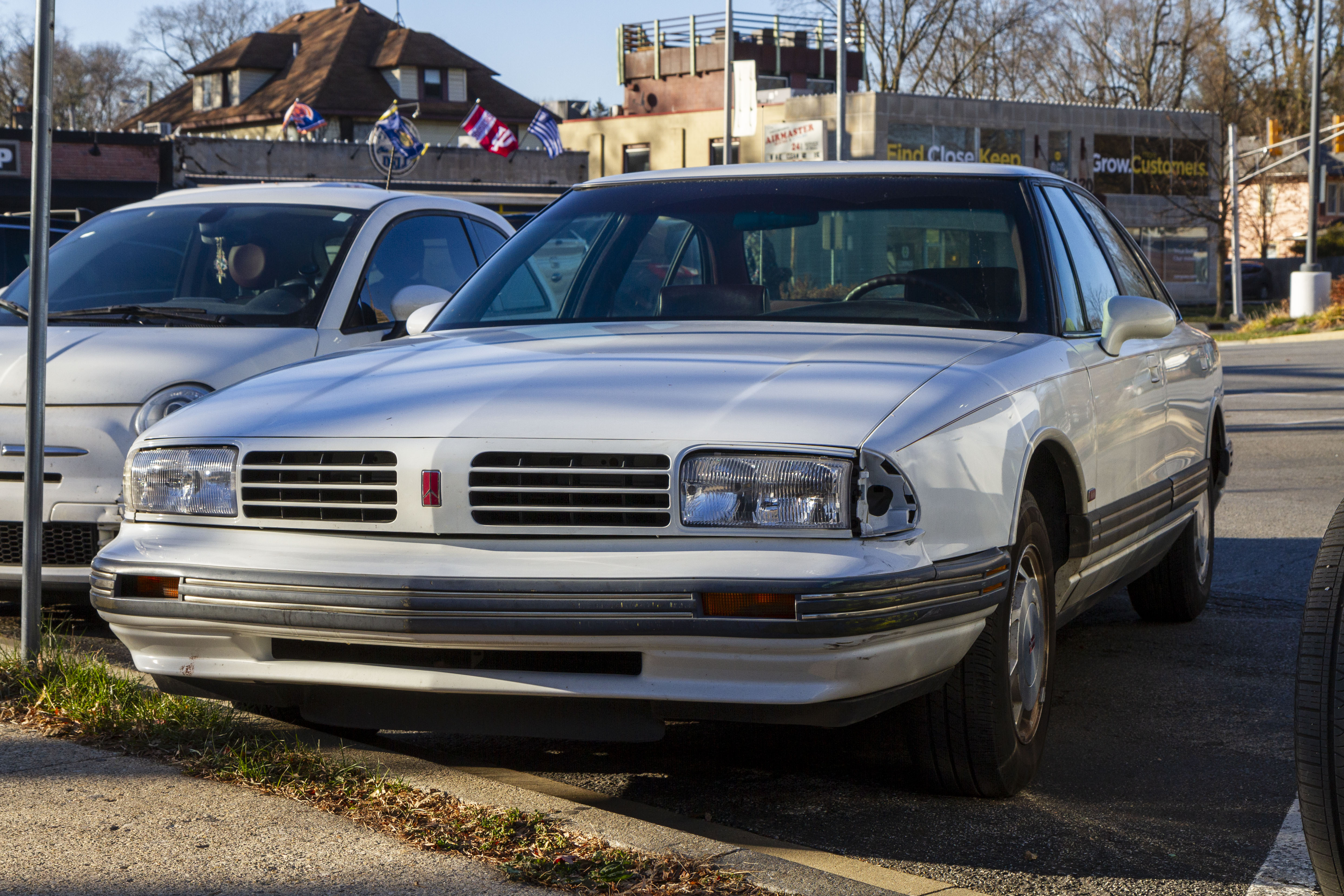
1994 Oldsmobile Eighty Eight Royale


A few models in Detroit have enjoyed unusual longevity. The Chevrolet Corvette and Ford Mustang, for example, celebrated their 71st and 60th birthdays, respectively, in 2024. Almost no other model name has had such an enduring run.

In the photo above is one of the closest: Oldsmobile introduced the 88 in 1949. Its predecessor, the 1948 Olds 78, was powered by a 257cid straight eight rated at 112 horsepower, but while it carried over the Futuramic postwar Olds styling of its predecessor, the 88 featured Oldsmobile's brand new Rocket V8. The 303 cubic inch Rocket had overhead valves, a 7.5:1 compression ratio, and put out 135 SAE gross horsepower.

The 88 nameplate remained in production through ten whole generations, and the Bright White 1994-'95 Oldsmobile Eighty Eight Royale is an example of that final generation. (Its grille was slightly different to the '92-'93 models, and the car received a mid-cycle refresh that gave it a more rakish snout for '96, which is how we can pin down the model year.)

The tenth generation of the 88 was the second one after the car had gone to a front wheel drive platform in 1986, and this '94 Royale would be powered by the GM corporate 3800 V6. This was a Buick-derived port fuel injected pushrod 3.8L motor rated at 170bhp SAE net. When Car and Driver tested a '92 Eighty Eight Royale LS, they recorded an 8.8 second zero-to-sixty and a 107mph top speed.

Oldsmobile axed the 88 name after the 1999 model, finishing a fifty year run, among Detroit's longest.

This one was photographed in November of 2023 using a Canon EOS 7D and the excellent EF-S 17-55mm f/2.8 IS zoom lens. 

2017 Chevrolet Camaro ZL1

Dormant since the late Sixties, Chevrolet revived the "ZL1" moniker for the top performance spec of the Fifth Generation Camaro fr...