Sunday, December 1, 2024

1972 Cadillac Eldorado Convertible


Through the Fifties the Eldorado nameplate at Cadillac signified advanced design, sportier features, and could be found applied to coupes, convertibles, and even a couple sedans. For the '61 model year the Eldorado became a convertible coupe based on the DeVille series but with a more sporty mien.

In 1967, the convertible went away but, leaving just a hardtop coupe Eldorado, but even more significantly, the driven wheels moved to the front of the car, drawing on tech developed at sibling GM division Oldsmobile for the Toronado. The engine was still a big longitudinally-oriented V-8, but at the rear of the bellhousing was a massive roller chain shunting power to the Turbo-Hydramatic 425 3-speed automatic lying beside and below the engine block on the driver's side.

The Eldorado was completely restyled for the 1971 model year. The car's wheelbase had been stretched to a whopping 126.3" and the car itself was over eighteen and a half feet long. The sole powerplant was the 500 cubic inch version of Cadillac's V-8. An Eldorado exclusive at the time, the 500 was created by taking the 472 Caddy motor, which had been introduced for '68, and lengthening the stroke about a quarter inch. The enormous motor was proudly proclaimed by the "8.2 LITRE" badging on the Eldo's front fenders.


External changes for '72 were minimal. The "Eldorado" badging on the fenders and decklid was now in script rather than block lettering. Advertised horsepower was now given in SAE net rather than gross numbers, so while the engine itself remained unchanged (4-barrel carb, dual exhausts, 8.5:1 compression ratio) the output was adjusted from 365hp to 235hp.

This Palomino Firemist 1972 Eldorado convertible was snapped with a Canon EOS 7D and EF-S 17-85mm f/4-5.6 IS zoom lens in August of 2022.

Saturday, November 30, 2024

1977 Cadillac Seville


Here's an interesting find: A first generation Cadillac Seville, perhaps a 1977.

This was the very first downsized Caddy, a response to the first fuel crisis and the Silent Generation hitting their peak earning years and leading edge of the Baby Boomers fixing to get into their thirties and start making real money. Its base DNA was derived from the Nova, and the final result was a Cadillac that was half a ton lighter & more than two feet shorter than the deVille and much nimbler and easier to navigate in tight quarters.

It featured the rear suspension from the previous generation ('68-'74') Nova and 11-in rear drums from the Nova police package, a 350 Olds Rocket V8 with Bosch/Bendix fuel injection (still a rarity back then) rated at 180 SAE net horsepower, and the first optional digital dash & trip computer in a Detroit car.

Road & Track managed a 13.3 second zero-to-sixty run and a 19.0 second quarter at 73 mph with a top speed of 105mph, which was pretty typical Malaise Era sedan performance in the days of the 55 mile per hour national maximum speed limit. It did circle a skidpad at 0.66g, which was downright racecar-like compared to the other supertankers in the Cadillac catalog.

With a base price of $12,479 (about $69,229 in current dollars), they actually stickered for more than any of the bigger Caddies on the lot at the time, except the limos. Cadillac marketed the Seville as "International Size Luxury", and they were intended to bring younger buyers back from Benz and BMW (a recurring theme with Caddy, seen again later in the Catera and CTS).

This Sable Black one was photographed in December of 2019 using a Nikon D700 and a 24-120mm f/3.5-5.6 VR zoom lens.

Friday, November 29, 2024

1974 BMW 2002tii


The final iteration of the compact BMW 02 Series was the sportiest, and its timing couldn't have been better.

Preceded in the US market by the 1602, the 2002 was at least partly in response to importer Max Hoffman's pleas for a bigger-engined version of the 02 series that would sell well in America. In the late Sixties and early Seventies it was mostly the province of the sort of motoring nerds who also fancied British roadsters and had read the earnest paeans to the 2002 written by Car and Driver editor David E. Davis:
Down at the club, Piggy Tremalion and Bucko Penoyer and all their twit friends buy shrieking little 2-seaters with rag tops and skinny wire wheels, unaware that somewhere, someday, some guy in a BMW 2002 is going to blow them off so bad that they'll henceforth leave every stoplight in second gear and never drive on a winding road again as long as they live.

In the suburbs, Biff Everykid and Kevin Acne and Marvin Sweatsock will press their fathers to buy HO Firebirds with tachometers mounted out near the horizon somewhere and enough power to light the city of Seattle, totally indifferent to the fact that they could fit more friends into a BMW in greater comfort and stop better and go around corners better and get about 29 times better gas mileage.

Mr. and Mrs. America will paste a "Support Your Local Police" sticker on the back bumper of their new T-Bird and run Old Glory up the radio antenna and never know that for about 2500 bucks less they could have gotten a car with more leg room, more head room, more luggage space, good brakes, decent tires, independent rear suspension, a glove box finished like the inside of an expensive overcoat and an ashtray that slides out like it was on the end of a butler's arm—not to mention a lot of other good stuff they didn't even know they could get on an automobile, like doors that fit and seats that don't make you tired when you sit in them.
But the 2002 really came into its own when the dual-carb ti was replaced with the fuel injected tii. This bumped output from 118 to 128 SAE net horsepower. This might not sound like a lot, but consider a few things related to the car in the picture above: The bumpers indicate that it's a 1974 model. That means it was in the country just in time for the Oil Embargo of 1973. Meanwhile, domestic cars were having compression ratios lowered, emissions controls added, and advertising was changing from SAE gross to SAE net numbers.

All that means that for the '74 model year the base 302 2-barrel V-8 in a Mercury Montego MX was rated at 140 horsepower, and the Chevelle Laguna S-3 came with a 145hp 2-barrel 350 small block. Suddenly 128 horsies in a gnarly little sports coupe doesn't sound too shabby.

The '72 2002tii tested by Car and Driver managed a 9.0 second zero-to-sixty performance and put the quarter away in 16.8 seconds at 81 mph with a top speed of 115mph. Not only would it outhandle most anything from Detroit, but it would keep up with the more vanilla variants of even the sportiest cars. Remember that for every Super Duty 455 Trans Am and 460-4V Gran Torino, there were a bunch of lesser 350-engined Firebirds and 302-motored Torinos, all set to be surprised by this zingy little Bavarian.

This one was photographed in April of 2022 using a Fujifilm X-E1 and XF 23mm f/2 R WR lens.

Thursday, November 28, 2024

1964 Chevrolet Chevelle Malibu SS Convertible


All new for '64 was the midsize Chevelle model from Chevrolet. Riding on a 115" wheelbase that split the difference between the compact Chevy II and the full-size Chevys, it was mostly aimed at younger buyers who didn't want the stigma of a "penalty box" frugal compact but wanted fresh styling and better handling than the big cars.

Just like the full-size Chevrolets, they came in three basic tiers: The stripped-down Chevelle 300, the better-optioned Chevelle Malibu, and for the super sporty buyer, the Chevelle Malibu Super Sport.

With distinctive "Malibu SS" badging on the rear fenders, the SS was only available as a hardtop coupe or convertible. The base engine was the 283 Turbo-Fire small block V-8 with a 2-barrel carb, rated at 195 SAE gross horsepower. A buyer could upgrade to the 4-barrel 283 with dual exhausts and get 220 horses. The Hi-Thrift 194cid and Turbo-Thrift 230cid inline sixes were also available as credit delete options for buyers who wanted to look baller on a budget.

All Super Sport Malibus had a floor shifter for the the 2-speed PowerGlide, or buyers of V-8 cars could opt for an all-synchromesh four-on-the-floor.

Motor Trend tested a Malibu SS hardtop with the 220-horse 283 and 4-speed combo and managed a 9.7 zero-to-sixty time and a 17.4 quarter at 80mph through the traps. Base price on the Tuxedo Black convertible in the photo would have been $2,857.

It was photographed in May of 2022 using a Canon EOS 7D and EF-S 17-85mm f/4-5.6 IS zoom lens.

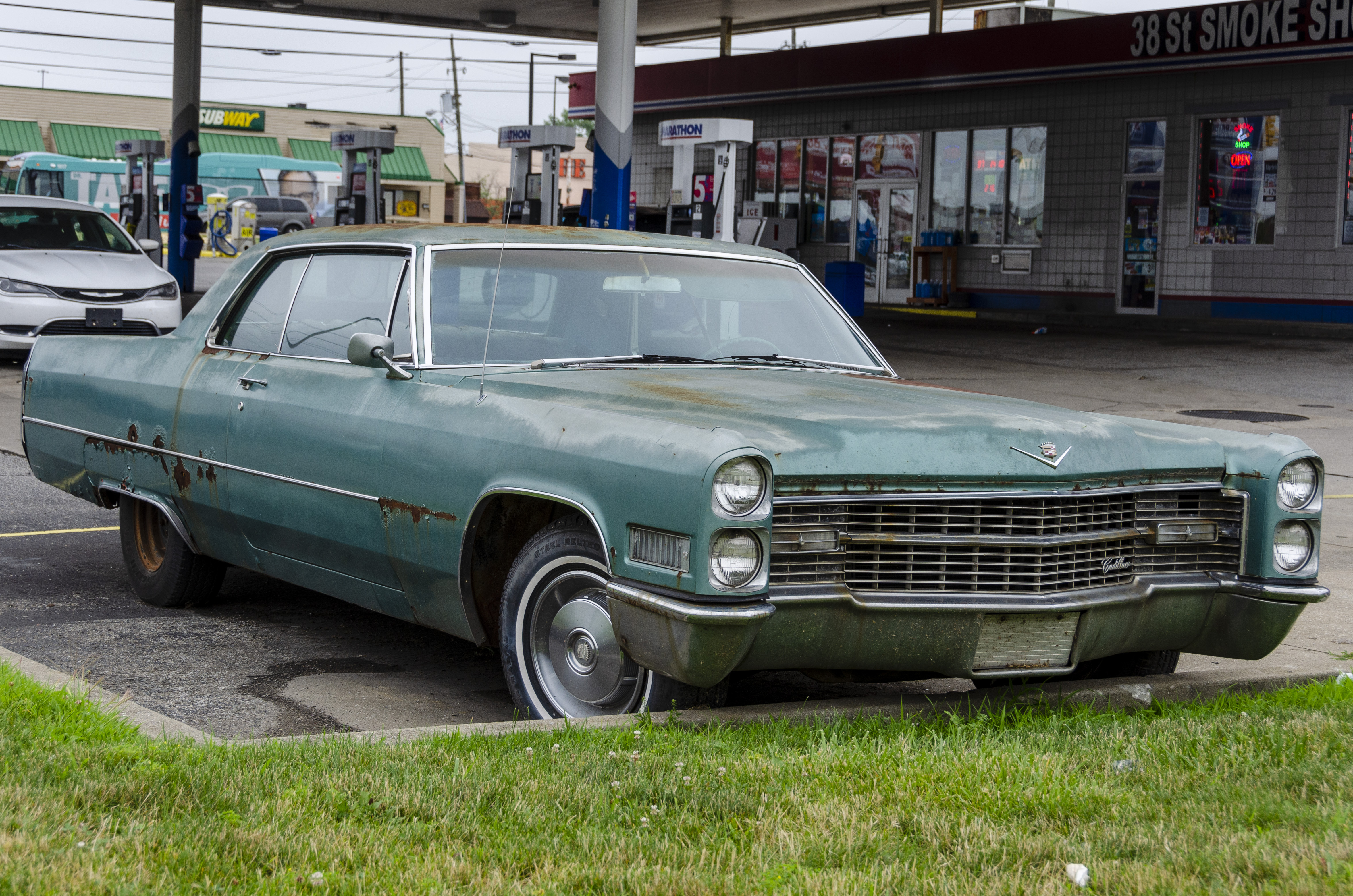
1966 Cadillac Calais


For the 1965 model year, someone at Cadillac decided that referring to cars by numbered series names might be a little too fuddy-duddy and old-fashioned for the Space Age, at least on the cars in the lower end of the lineup. So the Series Sixty-Two, the closest thing there was to an "entry level" Caddy, got re-dubbed as the Calais.

Essentially a de-contended DeVille with less chromed bling on the outside, you could still option a Calais up to be every bit as plush as its more expensive sibling. (Power windows, power seats, AM/FM radio, et cetera were all standard on the DeVille but had to be purchased separately on the Calais.)

It could be had as a pillared sedan, a hardtop sedan, or a hardtop coupe. Unlike the DeVille, there was no convertible offering

The horizontal bar in the grille marks this Cascade Green Calais Coupe as a 1966 model. Under the hood was the Cadillac V-8, which in 1966 displaced 429 cubic inches, sported a four-barrel carb, and was rated at 340 SAE gross horsepower. The 10.5:1 compression ratio would have demanded premium fuel, but presumably that didn't matter to the Cadillac Man, who wouldn't balk at needing to spend as much as nine whole bucks to fill the 26-gallon tank on his Calais.

According to Car Life at the time, the motor was healthy enough to shove the 4760-lb coupe to sixty in 9.4 seconds and through the quarter in seventeen flat at 83mph. The car would float down the interstate at up to 115 with the optional 3.21:1 performance rear axle ratio, maybe a little faster with the standard 2.94:1, although acceleration would suffer a bit.


Base price was $4,955 (or $48,275 in current dollars) but by the time you added air conditioning, power seats & windows, tilt/telescoping steering wheel, and an AM radio, as well as a few other bits and bobs, you were looking at six grand. But hey, it was still the most reasonable entree to driving the Standard of the World.

This one was photographed using a Nikon D7000 and 18-200mm f/3.5-5.6 VR zoom lens in July of 2020 in Speedway, Indiana.

Wednesday, November 27, 2024

1988 BMW 325i Touring


Take the most acclaimed sports sedan of its day, with a zingy-yet-bulletproof inline six and a slick 5-speed manual gearbox, and then make a wagon version... but never officially import it to the USA.

This gray market E30 wagon makes me go weak in the knees every time I see it.

Apparently the origins of the 3 Series Touring came from a BMW engineer making a home-brewed conversion on an existing sedan.


Incidentally, this was the first wagon BMW ever offered for sale. The Black (or Schwarz if you want to sound like a fanboi) one was snapped in the top photo with a Canon EOS 7D and EF-S 17-55mm f/2.8 IS zoom lens in November of 2022, and the bottom photo was also taken in that month, but with an Olympus E-5 wearing a Zuiko Digital 12-60mm f/2.8-4 ED SWD. 

1958 Chevrolet Impala Convertible


William Durant, a wagon maker who had just acquired Buick, founded General Motors in 1908 as a holding company with the intent to purchase more automobile manufacturers (he got the idea for the name from General Electric). To celebrate its fiftieth anniversary, all the divisions got to build a new, special, extra-deluxe version of their top of the line car.

Chevrolet's anniversary car was an even higher-zoot version of their Bel Air that they dubbed the Impala.


Available as either a Sport Coupe or a convertible, the Impala was available with a variety of powerplants. The most vanilla was the 235 cubic inch Blue Flame six, the latest iteration of the by-then long in the tooth Chevy Stovebolt, rated at 145 SAE gross horsepower.

But why would you get a swoopy Impala with such a dull grocery-getter of a motor? Moving up the option list came three variations of the 283 Turbo Fire small block V-8: a single two-barrel carb version with 185 horsepower, a 230-horse 4-barrel, and the Ramjet fuel-injected 250 horsepower version. (The latter two were down a few ponies from the previous year because they now had 9.5:1 compression and hydraulic lifters to civilize them a bit.)

The real news, though, was the debut of the new Turbo Thrust 348 cubic inch big block V-8. In single four-barrel trim the 348 was rated at 250 horsepower, while the triple-two-barrel Super Turbo Thrust put out 280.

The Honey Beige ragtop in the photos was snapped in July of 2023 using a Canon EOS-1D Mark IV and an EF 24-105mm f/4L IS zoom lens.

Tuesday, November 26, 2024

2017 Mercedes-Benz S550 Cabrio


There have been coupe versions of the big Mercedes-Benz S-class sedans since the C126 380SEC debuted back in the late 1981. They didn't hit US shores officially, though, until the 1984 model year, when the 500SEC went on sale here.

However, apparently leery of poaching sales away from the halo SL-class, there was never a convertible S-class coupe until the C217 cabrio made its appearance for the 2015 Benz lineup.

The S550 coupe and cabriolet replaced the luxo C216 CL coupes. Priced at a bougie $132 grand even before you get jiggy wit' the option sheet, the two-and-a-third ton ragtop was powered by a twin-turbo intercooled 32V DOHC direct-injection 5.5L V-8 putting out 449 SAE net horsepower through a 9-speed auto.

The example tested by Car and Driver (with the optional $5900 Sport Package) launched to sixty in 4.4 seconds and dispatched the quarter in thirteen seconds flat at 110mph. The engine's governor ensures you won't get a ticket for more than 132 in a 55. Impressively, all that heft went 'round a skidpad at 0.88g and stopped from seventy in 164 feet.

The example in the photo was snapped with a Fujifilm X-T2 and XF 16-80mm f/4 R WR OIS zoom lens in October of 2024.

Monday, November 25, 2024

1991 Honda Accord


By its fourth generation, the Honda Accord was all grown up, in more ways than one.

Road & Track had already done a comparison test of the third generation Accord sedan with the Mercedes-Benz 190E and the Honda more than held its own, such that the photo spread to open the article was a closeup of the car's snouts with their hood emblems switched.


The 1990-1993 fourth generation sedan, like this Frost White example, was ten inches longer and seven hundred pounds heavier than the first Accord sedans to hit these shores in our bicentennial year as 1977 models. Back in the mid-Seventies "made in Japan" was still synonymous with cheap and shoddy, and the Accord did as much as anything to turn that rep on its head.

Those first Accords had 72 horsepower 1.8L CVCC carbureted four cylinders, while the 1990 Accord EX sedan Car & Driver tested had a 2.2L SOHC 8V motor with port fuel injection and 130 horsies. Backed with a 5-speed manual, this was enough to get the car to sixty in 9.7 seconds and through the quarter in 17.1 at 80mph. Sprightly performance for a 4-cylinder midsize sedan of the era. It'd run all the way up to 119mph and circle a skidpad at 0.79g, too.

While rumpled around the edges and showing some hints of rust, this thirty-year-old Honda is still plugging along.

It was photographed with a Canon EOS 7D and 17-55mm f/2.8 IS zoom lens in December of 2023.

1985 Toyota Celica GT-S Convertible


Debuting for the 1982 model year, the third generation of the Celica, the A60, was the last to sport the traditional front-engine, rear-wheel-drive chassis layout.

All convertible Third Generation Celicas were done here in the U.S. by ASC of California; 200 in the '84 model year and a few thousand for the '85 model year, which was the end of the line for the angular A60 3rd Gen body style. They were imported from Japan as notchback coupes and handed over to ASC for the roof-ectomy.

The coupe bodies had been specially reinforced on the production line in Japan, and the conversion work wasn't cheap. Base MSRP was a $6500 price bump over the $11k sticker on the hardtop GT-S.

This was a bunch of dough for the time; you could check every option box you wanted on a Mustang GT or Camaro IROC-Z and have a hard time hitting the $17k mark, and you'd get V8 power to boot, rather than the Celica GT-S's 2.4L 22R-E EFI SOHC four cylinder.

The U.S. market was hungry for convertibles in the mid-'80s, having gone through a serious convertible drought for the last decade or so, largely due to stringent rollover standards. The American Sunroof Corporation handled factory convertible conversions on everything from Pontiacs to Porsches. They didn't have any problem selling them


That angular look is so very mid-80s Japanese sports coupe. Celica/Supra, Subaru XT, Mitsubishi Starion, Honda Prelude...they all had that crisply edged style about them. It's also notable that back then you could still market a car as having sporting pretensions with a 116bhp 2.4L four-banger under the hood and a zero-to-sixty time north of ten seconds.


With only 4500 ever built, it's kinda cool that I've spotted three in the neighborhood (these two, plus another red one.)

The Super Red car was photographed in July of 2022 using a Canon EOS-1D Mark III and EF 28-70mm f/2.8L zoom lens, while the Gloss Black one was snapped with a Nikon D7000 and 16-80mm f/2.8-4E VR lens in August of 2020.

Sunday, November 24, 2024

1961 Ford Thunderbird


The 1961 model year saw the debut of the third generation of Ford's Thunderbird coupe. The baroque rolling Wurlitzer look of the second generation cars was replaced with a sleek new shape styled by original Thunderbird design honcho, Bill Boyer.

With the second generation T-Birds having abandoned any tenuous sports car pretensions held by the original 2-seater cars by adding rear seats and a hardtop model, the third generation cars continued to carve out the "personal luxury coupe" niche that the Thunderbird had basically invented.

Just about the ritziest offering you could find in a Ford showroom and boasting a price tag in the neighborhood of four grand (over $40k in today's coin) before any options, the T-Bird came with standard features that were pricey extras on lesser models. All Thunderbirds had power steering, power brakes, automatic transmissions, and a neat new steering wheel that could be slid out of the way when the column-mounted shifter was in "Park" allowing the driver to enter and exit with grace and ease.


The only motor was available for '61, a four-barrel version of Ford's 390 cubic inch FE big block V-8, rated at 300 SAE gross horsepower. Car Life tested a ragtop and recorded a zero-to-sixty time of 9.7 seconds and a 17.6 second quarter mile at 78mph. The Honey Beige hardtop in the photos would likely have been somewhat quicker.


This one was photographed in March of 2021 using a Fujifilm X-T2 and an XF 18-55mm f/2.8-4 R OIS zoom lens.

2017 Chevrolet Camaro ZL1

Dormant since the late Sixties, Chevrolet revived the "ZL1" moniker for the top performance spec of the Fifth Generation Camaro fr...