Monday, December 9, 2024

1984 Dodge 600


Here's an unusually rust-free '83-'84 Dodge 600 sedan.

The 600 was the next step up in the '80s Dodge sedan hierarchy from the Dodge Aries. It rode on what Mopar called the "E-platform", which was the K-car platform with the wheelbase stretched three inches. This longer platform was not only used for the 600, but also the higher-zoot Chrysler New Yorker.

The numerical model name and angular styling was meant to give the car a vibe as being "Euro" and "Sporty" but there was only so much you could do to disguise the pedestrian underpinnings. The marketing materials introduced the new-for-'83 Dodge 600 as "America's Midsize Driving Machine", although the experience of driving one was definitely more Buick than BMW.

Looking at the sample here, the bright chrome moldings everywhere tell us it's not the sportier ES (which stood for "Euro/Sport") version, which would have all the brightwork blacked out, and the lack of vents in the hood tell us it's not a turbo car. The Garnet Red paint tells us it's an '84 model as the only red available in the launch year was the much darker Crimson Red.

Since it's not a turbo, power... such as it is ...comes from either the standard 2.2L Mopar SOHC EFI four cylinder, rated at 99bhp, or the optional Mitsubishi G54B "Silent Shaft" 2.6L four cylinder, which put out 101bhp. While the Mitsu unit was rated at almost the same power, it put out 140 ft-lb of torque at 2800 RPM, versus the 2.2's 121 ft-lb at 3200. Available transmissions were either an utterly banal 3-speed automatic, or a five-speed with a vague and rubbery cable-operated shift linkage. Torque steer was included at no charge, but fortunately the general lack of torque held it down to a dull roar in the normally aspirated cars. Early 2.2L Turbo Mopars would lunge enthusiastically for the nearest ditch if you got on the boost hard at launch.


Car & Driver tested a 1983 Dodge 600ES with the 5-speed and carbureted 2.2L and it wheezed its way to sixty in 11.4 seconds and through the quarter in 18.1 at 73mph. Their testers summed up the Dodge experience thusly:
Not liked for its driving environment, despite excellent seats, control relationships, and visibility. Very poor shifting, universally disliked instrument panel and interior decor, buzzing vibrations prejudiced all drivers against this otherwise promising upgrade of the K-car. Comfortable back seat, commodious trunk, but seems to lack tight fit and finish essential for quality "feel."
The one in the photo was snapped in February of 2017 using a Leica D-LUX 3.

Sunday, December 8, 2024

1968 Volkswagen Karmann Ghia Convertible


A collaboration between Turin-based styling house Ghia, coachbuilder Karmann of Osnabrück, and Volkswagen in Stuttgart, the Karman Ghia gave VW a stylish 2+2 coupe to slot in above its sturdy little Beetle as postwar Germany became more prosperous in the mid-1950s.

While the underpinnings were pure Beetle, the voluptuous bodywork was old-fashioned coachbuilding. Rather than being bolted on, the fenders were hand shaped and manually butt-welded to the main shell. A convertible model was added to the lineup in the 1958 model year.

The round rear side marker lights, added for FMVSS compliance on US models, mark this Velour Red convertible as either a 1968 or 1969 model. The headrests, all in a unit with the seatbacks, say it's a '68, because the '69 and later models had theirs on struts.


The one in the photos is local and gets spotted fairly frequently. The upper photo, from August of 2021, was taken with a Nikon D3 and 24-120mm f/4 VR zoom lens, while the lower shot was with a Canon EOS-1D Mark IV and EF 24-105mm f/4L IS zoom lens in October of 2023.


Saturday, December 7, 2024

1967 Plymouth Barracuda Convertible


Ford's Mustang was one of the worst-kept secrets in Detroit as its April of 1964 launch date neared. The Falcon-based sporty coupe available in a wide range of performance and price levels threatened to upend the equilibrium of a car market where most Detroit companies only made two sizes of car.

In a crash program, Plymouth fitted a wraparound glass fastback and a 2+2 seating arrangement to their Valiant compact coupe and got the new Plymouth Barracuda into showrooms two weeks before the original pony car.

Both in terms of sales and performance, though, the Mustang trounced the original Barracuda, which had somewhat awkward styling and mechanically literally was a Valiant fastback coupe.

For 1967, a second generation Barracuda debuted, and while it still shared some mechanicals with the Dart/Valiant compacts, the sheet metal was all new and it was gorgeous. The coke bottle flanks and bobbed Kamm-esque tail were a one thousand percent improvement over the boxy, tail-heavy looks of the first ones.

The lack of side marker lights on the Bright Red ragtop in the photo mark it as a '67 model.


The base motor was that Mopar stalwart, the 225 cubic inch Slant Six. Optionally, buyers could spring for 2- or 4-barrel versions of Chrysler's 273 cid LA small block V-8, making either 180 or 235 SAE gross horsepower. Finally, if the shopper sprang for the Formula S package, they'd get cool badges, a suite of performance parts, and unlocked availability of the 383 cubic inch B-series Commando V-8. The engine bay had been widened enough to accommodate the big block, but there wasn't any room for a power steering pump, so not only did you get the quickest Barracuda, but also a tremendous upper body workout machine. The exhaust was more restrictive in the small car, too, so the 4-barrel Commando only made 280 horses, instead of the 325 it did in a Sport Fury.

When Car Life put a '67 hardtop coupe with the 145 horsepower Slant Six and three-speed TorqueFlite through its paces, they recorded a zero to sixty time of 13.6 seconds and a 19.4 second quarter mile at 70 miles per hour, and a 97mph top speed.

This one was photographed with a Nikon Coolpix S6500 in August of 2014.

1974 Lincoln Continental


The year was 1974, the dawn of the Malaise Era. The Hemi was gone, the Mustang was a Pinto, and all cars got a clunky 5-mph mandatory bumper hung off their ass end to match the one that had been disfiguring their proboscii since the previous model year. Next year would come catalytic converters and unleaded gas. Fuel injection was still uncommon and computers were things that took up whole rooms in college basements, so compliance with emissions and mileage rules was done via methods that look crude today and mostly involved miles of vacuum lines under the hood.

Into this world was born the '74 Continental above, appropriately painted a color called "Medium Beige", a soulless color for a soulless time. (Although when slathered over that much sheet metal it should be "Venti Beige".)

This was the fourth model year of the fifth generation of Lincoln's Continental, and it was enormous: 80" wide, roughly nineteen and a half feet long, riding on a 127.7" wheelbase, and weighing every bit of 5,362 pounds. Under the hood was exactly one powertrain configuration, Ford's 460 cubic inch big block V-8 with a four-barrel Motorcraft carb and rated at 215 SAE net horsepower, backed by a Ford C6 3-speed automatic.

This one was photographed in August of 2023 using an iPhone 13 Pro Max.

1970 Oldsmobile Cutlass Supreme Holiday Coupe


By 1970 the performance wars of the Muscle Car Era had reached a crescendo and Detroit was starting to feel some pushback in the press as well as soaring insurance rates on higher horsepower vehicles. Pollution controls were already a thing and looked to only get tighter in the future. The leading edge of the Baby Boom generation was graduating college and entering the workforce & starting families.

The hot new vehicle was the "personal luxury coupe", which had been around in cars like the Thunderbird and Eldorado for a while, but was starting to spread downmarket. Mercury had a plusher Mustang in the shape of the Cougar. Olds and Buick had the Toronado and Riviera. Then came the workingman's personal luxury coupes: In 1969 Pontiac launched the Grand Prix based on the midsized GM A-body, but with a stretched snoot to give it those classic long-hood, short-deck proportions. For '70 it was joined by a Chevy platform sibling, the Monte Carlo, which had a successful first year, moving almost 160,000 cars despite a two-month labor strike at the Flint, Michigan plant where they were built.

Oldsmobile wanted some of that market share, but while Monte Carlos started at $3,100 and MSRP for a base Grand Prix squeaked a few bucks under four grand, the Olds Toronado was a plush, high-tech car with a Corvette-like over-$5,000 sticker.

The solution for 1970 was to take the A-body Cutlass Supreme and take a chunk out of its fastback profile, giving it a more formal roofline and the name "Cutlass Supreme Holiday Coupe". With a $3,100 base MSRP it could go right at the Monte Carlo and Cougar on price.


This Rally Red 1970 Oldsmobile Cutlass Supreme Holiday Coupe has, at some point over the last half-century wound up with a Cutlass S badge on the nose, but the notchback roofline says it's a Supreme. All Cutlass S coupes had the fastback roofline.

The standard motor for the Cutlass Supreme was the 4-barrel 350 cube Oldsmobile Rocket V-8 with a single exhaust pipe, requiring premium fuel for its 10.25:1 compression ratio and rated at 310 SAE gross horsepower. Optionally, the buyer could get the SX performance package with either the L33 320 horsepower 2-barrel 455 or the 365 horsepower W32 four-barrel 455 Rocket V-8.

This one was photographed with a Canon EOS 7D and EF-S 17-85mm f/4-5.6 IS zoom lens in April of 2023.

Friday, December 6, 2024

1963 Pontiac LeMans


The first attempt at compact cars by General Motors devolved into something of a goat rope. Initially, everyone was going to share the unibody shell of Chevrolet's Corvair, but none of the other divisions were keen on the idea of an air-cooled rear engine car. Buick and Olds, further, were skeptical of trying to offer a vehicle on the short 108" Corvair wheelbase, which would make it cramped and out of step with their plusher catalogs, to say nothing of how much harder NVH (noise, vibration, and harshness) would be to curb in a unit body car relative to a body-on-frame one.

So GM came up with a stretched 115"-wheelbase version for Buick & Oldsmobile, dubbed the Y-body, while Pontiac would try and shoehorn a front engine driveline into the Corvair envelope.

They did this by slicing the 389 cube V-8 in half to create a honking big 195cid slant four, mounting it in front, and then putting a transaxle derived from the Corvair's in the rear, with independent rear suspension, also cribbed from the rear-engine Chevy. The engine and transaxle were connected by a curved driveshaft only two thirds or three quarters of an inch in diameter, immediately dubbed the "rope drive" by the motoring press. Marisa Tomei's character explains all this to you in My Cousin Vinnie.

Most of that work, incidentally, was for nothing because at the eleventh hour GM headquarters relented and green-lighted Pontiac to use the longer Y-body platform.

The big four cylinder was the base motor, and optional was the Buick-designed alloy 215 V-8.


Initially there were no coupes when the Buick, Olds, and Pontiac compacts were launched for the '61 model year, only sedans and wagons, but, surprising everybody, the plusher, more powerful "Monza" model was the best-selling version of the Corvair, causing the other divisions to pile in with their own sporty two-doors. Pontiac's was called the LeMans. The coupe did have clean lines for the era.

1963 was the last year for the compact Y-bodies, as it was decided that for 1964 the Buick/Olds/Pontiac cars would move up to the midsize A-body used by the new Chevelle to fight against the midsize Ford Fairlane.


This LeMans (its own model for that year) had a new option for '63: The 326 V-8. It was essentially a de-bored 389 and weighed like a boat anchor, and it actually displaced 337 cubes but supposedly GM mandated that no compact car could boast a bigger motor than the Corvette's 327.

It was available in standard 2-barrel form, rated at 260 SAE gross horsepower, or a higher compression 4-barrel 326 H.O. variant with dual exhausts that made 280.  When Car Life tested a car with the 2-speed TempesTorque slushbox and the 2-barrel 326, they got a zero-to-sixty time of 9.5 seconds and a 17.0 second quarter at 81 mph, with a top speed of a buck fifteen. Price as tested was $2,953, or about $30,500 in 2024 currency.

There's an excellent, turbo-nerdy deep dive into the tale of the 1st Generation Tempest at Ate Up With Motor, by the way.

The car in the photos was snapped in September of 2021 using a Nikon 1 V2 and a 1 Nikkor 17.5mm f/1.8 lens.

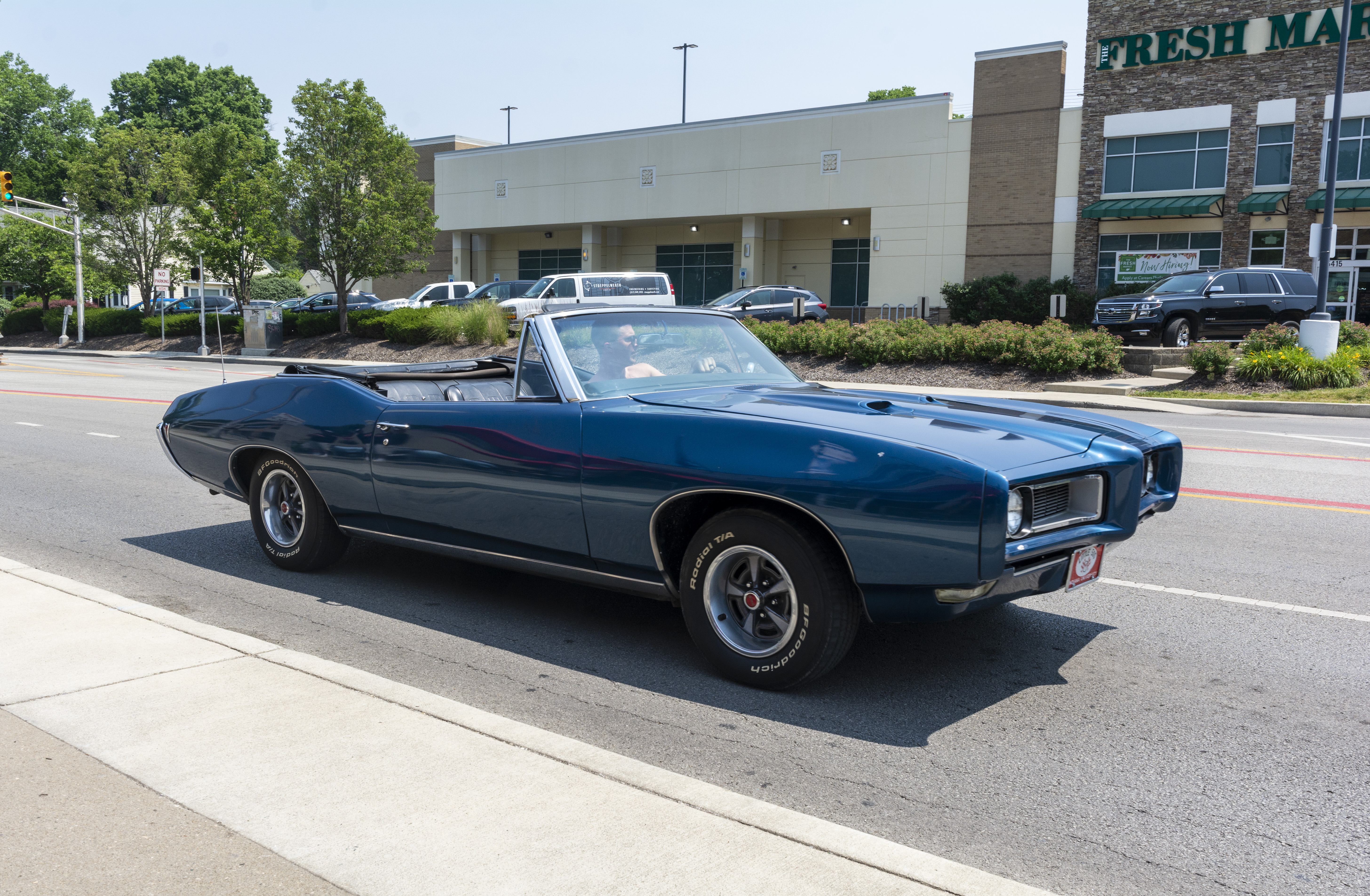
1968 Pontiac LeMans Convertible "GTO Tribute"


Without a look at the VIN plate, this one is tough to call for certain at just a glance.

It certainly could be a de-badged 1968 Pontiac GTO ragtop.

Far more likely, though, someone has added an Endura nose, scooped hood, and GTO taillights to a 1968 Pontiac LeMans or Tempest. Ethical people who do this (especially if they go whole hog and add GTO badging) will call the resulting rides "GTO Tributes". Unethical people will try and pawn them off on unsuspecting buyers as real Goats.


I think the side marker lights in the rear fenders on this Aleutian Blue example are the giveaway. The Tempest & LeMans had the red side marker light lenses that were shaped like the Pontiac logo, while those on the GTO were shaped like a GTO badge. [EDIT: My bad. The GTO emblem shaped rear side marker lights were on the '69s.]


This one was photographed in June of 2023 with a Nikon D7100 and 16-80mm f/2.8-4E VR zoom lens, which is probably the best F-mount crop sensor zoom that Nikon's yet made.

Tuesday, December 3, 2024

1987 Ford Country Squire


The 1979-1991 Ford Country Squires were the end of the road for the full-size Ford station wagon with the classic woodgrain trim look.

By then, the "full size" Ford wagon had been moved to the new Panther platform, which meant it was on a wheelbase about the same size as that of a mid-Sixties Fairlane wagon and shorter than an early-Seventies Gran Torino's, both of which had been midsize cars for their eras.

The front end on this Midnight Canyon Red Metallic example marks it as a '79-'87 model, before the '88 styling refresh gave it a slightly more aero nose. Nosing around the internet and looking at year-to-year grille changes has me tentatively identifying it as a 1987 model, which would mean it has the 5.0L multi-port EFI V-8 rated at 150bhp (160 with the towing package).

This one was photographed with a Nikon D2X and 18-200mm f/3.5-5.6 VR II zoom lens in October of 2023.

1980 Mercedes-Benz 300D


The W123 midsize sedans from Mercedes-Benz were the immediate forebears for what's now known as the "E-class" Benz. They were sober-sided, solid cars that broke sales records for the brand.

Launched in 1976, they were sold as coupes, sedans, and wagons, and came with an array of gas and diesel powerplants and both manual and automatic transmissions. These were found in roles as everything from taxicabs to junior executive cars all around the globe, but M-B North America only brought the higher-trim varieties into the U.S. market.

Stateside we could get either the 2.8L fuel-injected DOHC 12V inline-six rated at 142bhp or one of two diesels: the 62hp 2.4L four banger or the 77bhp 3.0L inline five-cylinder. After 1980, only the diesels remained, with the gasoline M110 I6 dropped to keep CAFE (Corporate Average Fuel Economy) numbers up.


The early-'80s (you can tell by the yellow lenses on the fog lamps; '76-'79 cars had clear ones) Mercedes-Benz 300D in English Red in these photos would be bog-slow, with a zero-to-sixty time that struggled to crack the twenty second barrier and a top speed of something like 90mph, but they got good mileage for their time and a well-maintained diesel Benz from this era is harder to kill than a cockroach. If you couldn't get 300k miles out of one, you weren't trying, and in an era when a car was considered completely knackered when its five-digit odometer rolled over, that was nothing short of miraculous.

This one was photographed with a Nikon D800 and 24-120mm f/4 VR zoom lens in May of 2024.

Monday, December 2, 2024

1967 Chevrolet Corvette Sting Ray Convertible


Intended to have been replaced by the 3rd Generation Corvette, the Sting Ray stuck around for one last model year to allow the C3 to get debugged.

The lack of a hood bulge on this Sunfire Yellow ragtop indicates a small block V-8 lives under there, which in 1967 would be one of two flavors of 327. The base four-barrel motor had a 10.25:1 compression ratio and was rated at 300 SAE gross horsepower, while the L79 bumped the compression up to 11.0:1 and made 350 horses. Either one could be mated to a 3-speed automatic or 4-speed manual transmission.


You can tell it's a '67 by the four gills on the fender vents.

Road & Track tested a four-speed convertible Sting Ray with the base 300hp 327 and recorded a zero-to-sixty time of 7.6 seconds and a quarter mile run of 16.0 flat at 86mph. Base price was $4,228, which is as close to forty grand in current money as makes no nevermind.

This example was photographed in August of 2021 using a Nikon D2X and 24-120mm f/3.5-5.6 VR zoom lens.

Sunday, December 1, 2024

1972 Cadillac Eldorado Convertible


Through the Fifties the Eldorado nameplate at Cadillac signified advanced design, sportier features, and could be found applied to coupes, convertibles, and even a couple sedans. For the '61 model year the Eldorado became a convertible coupe based on the DeVille series but with a more sporty mien.

In 1967, the convertible went away but, leaving just a hardtop coupe Eldorado, but even more significantly, the driven wheels moved to the front of the car, drawing on tech developed at sibling GM division Oldsmobile for the Toronado. The engine was still a big longitudinally-oriented V-8, but at the rear of the bellhousing was a massive roller chain shunting power to the Turbo-Hydramatic 425 3-speed automatic lying beside and below the engine block on the driver's side.

The Eldorado was completely restyled for the 1971 model year. The car's wheelbase had been stretched to a whopping 126.3" and the car itself was over eighteen and a half feet long. The sole powerplant was the 500 cubic inch version of Cadillac's V-8. An Eldorado exclusive at the time, the 500 was created by taking the 472 Caddy motor, which had been introduced for '68, and lengthening the stroke about a quarter inch. The enormous motor was proudly proclaimed by the "8.2 LITRE" badging on the Eldo's front fenders.


External changes for '72 were minimal. The "Eldorado" badging on the fenders and decklid was now in script rather than block lettering. Advertised horsepower was now given in SAE net rather than gross numbers, so while the engine itself remained unchanged (4-barrel carb, dual exhausts, 8.5:1 compression ratio) the output was adjusted from 365hp to 235hp.

This Palomino Firemist 1972 Eldorado convertible was snapped with a Canon EOS 7D and EF-S 17-85mm f/4-5.6 IS zoom lens in August of 2022.

2017 Chevrolet Camaro ZL1

Dormant since the late Sixties, Chevrolet revived the "ZL1" moniker for the top performance spec of the Fifth Generation Camaro fr...